


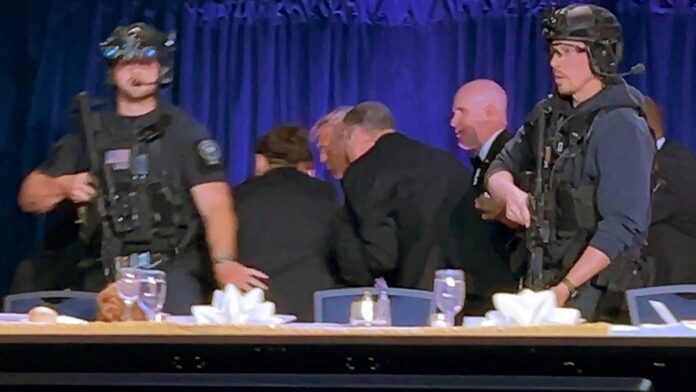

In a moment that instantly reshaped the national conversation and sent shockwaves far beyond Washington, a night traditionally reserved for political satire, media access, and symbolic unity between government and press abruptly descended into confusion and fear. The annual White House Correspondents’ Association Dinner—long regarded as one of the most visible intersections of political power and journalistic scrutiny—was interrupted by what multiple eyewitnesses described as gunfire, forcing the rapid evacuation of high-ranking officials, members of the press, and invited guests from inside the Washington Hilton ballroom.
The evening, held on Saturday, April 25, had already carried heightened attention due to the attendance of Donald Trump, marking his first appearance at the event in over a decade and notably his first as a sitting president. Historically, Trump had avoided the dinner throughout much of his political tenure, making this return a moment of political theater in its own right. That significance, however, was quickly overshadowed by the unfolding emergency.
According to reporters positioned inside the ballroom, the initial disruption came in the form of loud, sharp bursts—described by multiple attendees as sounding consistent with gunshots—followed immediately by confusion and audible chants of “USA” echoing through the room. Within seconds, members of the press corps, political staff, and guests dropped to the floor, instinctively seeking cover as security personnel began issuing urgent commands.
The response from the United States Secret Service was immediate and highly coordinated. Agents moved decisively toward the stage, where Trump had been present, and executed a rapid extraction. Witness accounts confirm that agents were heard shouting “shots fired” as they secured the president and initiated evacuation protocols. JD Vance, along with multiple Cabinet officials, was also swiftly escorted from the venue under tight security.
Within minutes, the ballroom—once filled with the energy of Washington’s most prominent political and media figures—was transformed into a controlled emergency scene. Law enforcement officers secured the perimeter, while federal and local authorities began sweeping the premises to assess the situation and neutralize any potential threat.
Early reports indicated that a suspect had been apprehended, a claim later reinforced by statements from the president himself. In a message released shortly after the incident, Trump confirmed that the shooter was in custody and praised law enforcement for acting “quickly and bravely” in containing what could have escalated into a far more catastrophic event. He further indicated that, at the request of authorities, he would return to the White House and address the nation in a forthcoming press conference.
The proximity of the incident to key media figures added another layer of urgency to the unfolding situation. Wolf Blitzer, who was positioned just outside the main ballroom, reportedly witnessed the suspect discharging a weapon only feet away. According to accounts, law enforcement officers immediately intervened, directing Blitzer and others to safety while securing the area.
For New Jersey audiences and readers of Sunset Daily News, the implications of such an incident extend beyond Washington’s political ecosystem. The event underscores the evolving security landscape surrounding high-profile gatherings, particularly those that bring together federal leadership, national media, and influential stakeholders. Venues across the country—including major event spaces throughout New Jersey—continue to adapt their protocols in response to the growing complexity of security threats in public and semi-public settings.
This incident also places renewed scrutiny on the symbolic role of the White House Correspondents’ Association Dinner itself. Traditionally framed as a rare moment of levity and mutual acknowledgment between politicians and the press, the dinner has increasingly reflected broader tensions within the national discourse. Trump’s presence alone signaled a shift in tone for this year’s event—one that was abruptly overtaken by a far more serious and immediate reality.
In the aftermath, federal investigators are expected to conduct a comprehensive review of the security breach, examining how the suspect gained proximity to the venue and what measures can be implemented to prevent similar incidents in the future. The coordination between the Secret Service, local law enforcement, and federal agencies will likely become a focal point of both internal review and public discussion.
The administration has confirmed that the dinner will be rescheduled within the next 30 days, an effort to restore a sense of continuity to an event that has long served as a cornerstone of Washington’s annual calendar. Whether the rescheduled gathering will carry the same tone—or whether it will be fundamentally reshaped by the events of April 25—remains to be seen.
What is clear is that the night will be remembered not for speeches or satire, but for the moment when one of the nation’s most closely watched events became the center of a real-time security crisis. In a matter of seconds, ceremony gave way to survival, and a tradition rooted in dialogue was overtaken by the urgent realities of protection and response.
Defiant and Unshaken: Donald Trump Addresses Nation After Assassination Attempt Disrupts White House Correspondents’ Association Dinner, Raising Urgent Questions on Security, Stability, and the State of American Political Life
In a moment that will be studied, analyzed, and debated across every level of American political and media institutions, President Donald Trump delivered a forceful and composed response late Saturday night after surviving what authorities have described as another targeted attempt on his life—this time unfolding in real time at one of the most visible and symbolically significant events in Washington: the White House Correspondents’ Association Dinner.
What began as a high-profile convergence of political leadership, national media, and institutional tradition rapidly escalated into a national security crisis when the sound of gunfire sent shockwaves through the Washington Hilton ballroom. Within seconds, the controlled pageantry of the evening gave way to a coordinated emergency response, as members of the press, administration officials, and invited guests were instructed to take cover while federal agents moved to secure the president and neutralize the threat.
The speed and precision of the response from the United States Secret Service underscored both the severity of the moment and the preparedness embedded within modern presidential security operations. Agents quickly extracted Trump from the stage, while JD Vance and members of the Cabinet were simultaneously evacuated under layered protective protocols designed to eliminate exposure and restore control over a rapidly evolving situation.
In the hours that followed, confirmation emerged that the suspect had been apprehended, with law enforcement agencies moving swiftly to secure the perimeter and begin a full-scale investigation. Yet it was the president’s response—delivered with characteristic directness and a tone of unmistakable defiance—that immediately reframed the narrative.
Standing before reporters after returning to the White House under advisement from federal authorities, Trump addressed the incident not as an isolated act of violence, but as part of a broader and increasingly volatile environment surrounding American political leadership. He commended law enforcement for their rapid intervention, emphasizing that their actions prevented what could have escalated into a far more devastating outcome. At the same time, he made clear that the attempt would not alter his posture, his schedule, or his approach to governance.
The symbolism of that message cannot be overstated. In choosing to address the press directly—particularly following an attack that unfolded within a media-centric event—Trump reinforced a posture of continuity and control at a moment designed to create disruption and fear. For a presidency that has often existed in tension with the national press corps, the setting itself added a layer of complexity to both the incident and its aftermath.
Eyewitness accounts from inside and around the ballroom further illustrate the intensity of the situation. Wolf Blitzer, positioned just outside the main event space, reportedly observed the suspect discharging a weapon at close range before being quickly ushered to safety by law enforcement officers. Inside the ballroom, journalists and attendees described a scene of immediate confusion followed by disciplined compliance as security personnel took control.
For readers and stakeholders across New Jersey, the implications extend well beyond the boundaries of Washington, D.C. The incident represents a stark reminder of the evolving risk environment surrounding public events, particularly those that combine political leadership, media visibility, and symbolic national significance. From major venues in Newark and Atlantic City to high-profile gatherings across the region, event security protocols continue to adapt in response to increasingly complex threat scenarios.
Within the broader political framework, the attempted attack raises immediate questions about the sustainability of public-facing political events in their current form. The White House Correspondents’ Association Dinner has historically served as a moment of recalibration—a rare convergence of adversarial institutions in a setting designed to humanize both sides. That equilibrium was decisively disrupted, and its restoration will require not only logistical adjustments but a reassessment of how such events are structured and secured moving forward.
The administration has already indicated that the dinner will be rescheduled within a 30-day window, signaling an intent to preserve institutional continuity despite the disruption. Whether that rescheduled event can recapture its traditional tone—or whether it will carry the weight of heightened security and altered expectations—remains an open question.
From an operational standpoint, federal investigators are now tasked with reconstructing the sequence of events that allowed the suspect to reach proximity to such a high-security environment. This includes evaluating perimeter controls, access screening, coordination between federal and local agencies, and real-time response mechanisms. The findings of that review are expected to influence not only future White House–adjacent events but also national standards for large-scale political gatherings.
At a strategic level, Trump’s response positions the incident within a narrative of resilience and continuity—an approach designed to project stability in the face of targeted disruption. For supporters, it reinforces an image of strength under pressure; for critics, it invites further scrutiny of the broader conditions that contribute to such incidents. In either case, the political and cultural reverberations are likely to extend well beyond the immediate news cycle.
As this story continues to develop, Sunset Daily News New Jersey will maintain comprehensive coverage, examining not only the facts of the incident but the wider implications for governance, public safety, and the evolving intersection of politics and media in the United States. What unfolded on April 25 was not merely a disruption of a single event—it was a moment that crystallized the fragility and intensity of the current national climate, and one that will shape conversations across every level of public life in the weeks and months ahead. Sunset Daily News New Jersey will continue to provide in-depth coverage and analysis, ensuring that readers remain informed on both the immediate developments and the broader implications of this unprecedented disruption at one of the country’s most high-profile political gatherings.



