


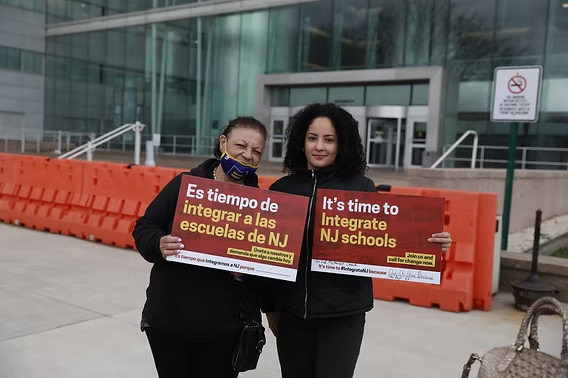

A closely watched education and civil rights dispute now heading before the Supreme Court of New Jersey could carry sweeping implications for school district autonomy, racial balance policies, public education funding, and the future of long-standing send-receive relationships throughout New Jersey as the state’s highest court prepares to examine whether a local school district can legally sever ties with another district when demographic impacts become central to the decision-making process.
The case, formally titled Board of Education of the City of Absecon v. Board of Education of the City of Pleasantville, centers on an effort by the Board of Education of the City of Absecon to terminate its long-standing sending-receiving relationship with the Board of Education of the City of Pleasantville and instead redirect its high school students to the Greater Egg Harbor Regional School District.
At first glance, the dispute may appear to involve a relatively localized administrative disagreement between South Jersey school systems.
In reality, however, the case touches some of the most politically and legally sensitive issues embedded within New Jersey’s education structure: racial equity, school segregation, demographic balance, district independence, state oversight authority, educational opportunity, municipal identity, and the enduring legacy of socioeconomic division within public education.
The legal questions now before the New Jersey Supreme Court could ultimately influence how future send-receive severance petitions are evaluated statewide and may help define the extent of authority the Commissioner of Education possesses when balancing local district preferences against broader demographic and public policy concerns.
The dispute dates back to August 30, 2019, when Absecon formally petitioned the state Commissioner of Education seeking permission to terminate its existing send-receive relationship with Pleasantville for high school students.
Under New Jersey’s send-receive system, smaller municipalities lacking their own secondary schools frequently send students to neighboring districts through long-established educational agreements. These arrangements have historically served as important structural mechanisms within New Jersey’s fragmented municipal education system, where many communities operate independent K-8 districts but rely on regional or neighboring high schools for secondary education.
Absecon sought to redirect its students instead toward Greater Egg Harbor Regional School District, arguing that the transition would not create substantial negative educational, financial, or racial impacts.
The district submitted feasibility studies supporting its application, asserting that severing the relationship would not significantly harm Pleasantville’s operational stability or student outcomes.
Importantly, Pleasantville itself initially opposed the severance request but later withdrew its objection, allowing the matter to proceed before the Commissioner as an uncontested case under New Jersey administrative regulations.
That procedural shift made the Commissioner’s eventual rejection of the severance request especially significant.
In May 2022, the Commissioner of Education issued a final decision denying Absecon’s petition despite acknowledging that the proposed separation would not create substantial negative educational or financial consequences for Pleasantville.
Instead, the denial centered overwhelmingly on racial composition concerns.
The Commissioner concluded that removing Absecon students from Pleasantville High School would substantially alter the racial makeup of the student body because Absecon’s students represented a significant portion of the school’s white student population.
Although the total number of white students at Pleasantville High School was relatively small overall, the Commissioner determined that the loss of Absecon students would effectively eliminate as much as 80% of the school’s gross white student population, creating what the state considered a substantial negative racial impact under the governing statute.
That finding immediately transformed the case into a much broader legal and philosophical debate surrounding race, integration, and educational policy in modern New Jersey.
At the heart of the dispute lies interpretation of N.J.S.A. 18A:38-13, the state law governing severance applications involving send-receive relationships.
The statute, as amended in 1986, states that the Commissioner “shall grant” a severance petition if no substantial negative impact would result concerning educational prospects, financial stability, or racial composition among affected districts.
The legal conflict now before the Supreme Court centers largely on how that language should be interpreted and applied.
Absecon has argued that the Commissioner exceeded statutory authority by applying what the district characterizes as an effectively impossible racial standard — one that would prevent predominantly white sending districts from ever severing relationships with predominantly minority receiving districts whenever demographic reductions occur.
The district contends that the Commissioner’s decision created an arbitrary and unreasonable precedent not clearly supported by the underlying statute itself.
According to Absecon, the state improperly expanded its own role beyond what lawmakers intended when crafting the severance law.
The district also argued that its phased withdrawal approach and supporting studies demonstrated that no substantial harmful impact would occur sufficient to justify blocking the severance request.
The Appellate Division, however, rejected those arguments and upheld the Commissioner’s ruling.
The appeals court concluded that substantial credible evidence supported the state’s finding that removing Absecon students would negatively impact racial balance at Pleasantville High School. The court further ruled that the Commissioner acted within the scope of her authority and that the decision was neither arbitrary nor unreasonable under existing legal standards.
The Appellate Division’s affirmation effectively reinforced the state’s broad discretion when evaluating racial impact within school district restructuring decisions.
Now, with the New Jersey Supreme Court granting certification, the case enters a far more consequential stage.
The justices have agreed to examine whether the Commissioner exceeded statutory authority under N.J.S.A. 18A:38-13, whether the decision aligned properly with existing case law, and whether the denial of severance was arbitrary, capricious, or unreasonable.
The implications extend well beyond Absecon and Pleasantville themselves.
New Jersey operates one of the most fragmented educational systems in the United States, with hundreds of highly localized school districts often divided along municipal, socioeconomic, and demographic lines. Questions surrounding racial segregation, district boundary structure, school funding inequities, and regionalization have shaped education policy debates in the state for decades.
Many of New Jersey’s send-receive relationships exist within precisely those demographic realities.
Some smaller suburban or majority-white communities send students into larger urban or majority-minority districts under arrangements originally created decades ago. Efforts to sever those relationships can therefore trigger highly sensitive racial balance concerns, particularly when departing student populations materially affect demographic composition within receiving schools.
The Supreme Court’s eventual ruling could significantly influence how difficult it becomes for districts to exit those arrangements moving forward.
A ruling strengthening the Commissioner’s authority may reinforce the state’s ability to preserve demographic diversity and limit district fragmentation based on racial impact concerns. Conversely, a ruling favoring Absecon could expand local district autonomy and make future severance petitions easier to obtain even when racial composition changes substantially.
The broader political and educational context surrounding the case is equally important.
New Jersey continues confronting longstanding debates over school segregation and educational equity despite often ranking among the nation’s top-performing public education systems overall. Civil rights advocates, education reform groups, suburban districts, urban school systems, and state policymakers have repeatedly clashed over how aggressively the state should intervene to address racial and socioeconomic separation across district lines.
The state’s school segregation issues gained renewed national attention following major lawsuits and advocacy efforts arguing that New Jersey operates among the most segregated public education systems in America despite lacking formal segregation policies.
Against that backdrop, the Absecon-Pleasantville case becomes more than an administrative severance dispute.
It represents another chapter in New Jersey’s ongoing struggle to balance local control with statewide equity goals inside an educational system deeply shaped by municipal fragmentation and demographic inequality.
The case also raises difficult philosophical questions without easy answers.
Should local communities retain broad authority to determine where students attend school if operational and financial concerns favor separation? Or does the state possess a broader obligation to preserve racial diversity and prevent demographic fragmentation even when districts themselves support restructuring?
Can demographic shifts alone justify blocking district autonomy requests?
And how should courts define “substantial negative impact” in modern educational contexts where race, funding, municipal identity, and school quality remain deeply interconnected?
The Supreme Court’s eventual answers may establish important precedent not only for future send-receive relationships but also for broader state authority over educational integration policy itself.
For now, oral arguments have not yet been scheduled.
But as New Jersey’s highest court prepares to hear the case, education leaders, municipal officials, civil rights advocates, attorneys, and school districts statewide will be watching closely.
Because whatever the Court ultimately decides could reshape the legal boundaries governing school district relationships across New Jersey for years — and potentially decades — to come.