



New Jersey’s public education system is approaching one of the most consequential financial and structural turning points in modern state history as widening disparities in school funding, declining enrollment trends, rising operational costs, and mounting political tension force communities across the Garden State to confront increasingly painful questions about fairness, sustainability, and the future of public education itself.
At the center of the growing debate is a startling financial reality: more than 7 percent of New Jersey’s entire state budget now flows into just 10 school districts, even as smaller districts throughout the state brace for staffing reductions, program cuts, consolidation pressures, and the possibility of permanent school closures ahead of the 2026-2027 academic year.
The imbalance is reigniting fierce statewide arguments over educational equity, taxpayer burden, demographic shifts, urban funding formulas, suburban instability, and whether New Jersey’s education finance system — long regarded as one of the nation’s most complex — is beginning to fracture under the weight of modern economic and political pressures.
The issue is no longer abstract.
In communities across New Jersey, school boards are already preparing contingency plans tied to declining enrollment, shrinking state aid adjustments, rising transportation expenses, pension obligations, healthcare costs, infrastructure maintenance, and escalating operational overhead. Some districts are discussing grade reconfiguration. Others are considering building closures entirely. Still others are evaluating staff reductions, extracurricular program cuts, or long-term consolidation scenarios that would have been politically unthinkable only a decade ago.
Meanwhile, the state’s largest districts continue absorbing enormous portions of state education spending as policymakers attempt to balance constitutional obligations surrounding educational equity with growing fiscal strain affecting taxpayers statewide.
The result is a deeply polarized education environment where nearly every community feels financially squeezed regardless of how much aid they receive.
For decades, New Jersey’s education funding model has been shaped heavily by court rulings, equity mandates, and constitutional requirements designed to ensure students in historically underfunded districts receive adequate educational opportunities regardless of local property wealth. Those principles fundamentally reshaped how state aid flows across New Jersey, especially benefiting large urban districts with substantial concentrations of economically disadvantaged students.
But the modern financial landscape is becoming dramatically more complicated.
Enrollment patterns are changing rapidly. Birth rates are declining. Housing affordability pressures are reshaping where families live. Pandemic-era learning disruptions continue impacting educational systems operationally and financially. Teacher shortages persist across multiple disciplines. Special education costs continue rising. Infrastructure modernization demands are accelerating. And taxpayers across suburban and working-class communities alike are increasingly demanding greater transparency regarding where education dollars actually go.
This combination of pressures is now exposing deep fault lines inside the state’s educational funding framework.
The concentration of massive state spending within a relatively small number of districts has become one of the most politically explosive aspects of the debate. Supporters of the current funding model argue that high-need districts require substantial investment because students facing poverty, housing instability, language barriers, food insecurity, healthcare inequities, and community violence often need significantly more educational support infrastructure to achieve equitable outcomes.
Critics, however, increasingly argue that the funding system has become structurally imbalanced and financially unsustainable, especially for suburban and smaller districts now confronting operational crises despite taxpayers already carrying some of the highest property tax burdens in the nation.
This tension is becoming especially visible in communities facing potential closures.
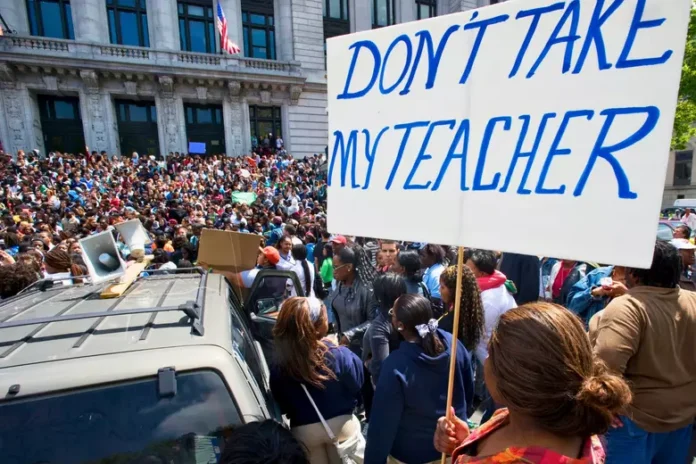
For many New Jersey towns, public schools function as far more than educational institutions alone. They are civic anchors, neighborhood stabilizers, property value drivers, local identity centers, athletic hubs, and multigenerational community institutions deeply woven into municipal life itself. The possibility of permanent closures therefore carries enormous emotional and political weight.
Parents fear overcrowding, longer transportation routes, diminished educational quality, and reduced extracurricular opportunities. Local officials worry about declining property values and weakened municipal identity. Educators fear staffing instability and resource depletion. Students face uncertainty surrounding community continuity and academic support systems.
The crisis also reflects broader demographic transformations unfolding throughout New Jersey.
Some regions are experiencing population decline or aging demographics that reduce student enrollment naturally over time. Others continue absorbing population growth, immigration expansion, or housing density increases that place enormous strain on already stretched educational infrastructure. These uneven population shifts are making statewide funding formulas increasingly difficult to balance politically.
At the same time, operational costs continue climbing across nearly every category of school administration.
Transportation expenses have surged due to fuel prices and driver shortages. School construction and maintenance costs remain extraordinarily high. Technology integration requirements continue expanding. Mental health support demands have increased substantially following years of social disruption and student stress. Security infrastructure spending continues rising. Healthcare and pension obligations remain major long-term budget pressures.
Districts throughout the state increasingly report that even relatively stable aid levels no longer stretch nearly as far as they once did.
This is particularly devastating for smaller districts with limited economies of scale.
Large districts often possess broader administrative infrastructure and greater capacity to absorb operational fluctuations. Smaller districts, by contrast, frequently operate with tighter margins and less flexibility. A single budget reduction or enrollment decline can dramatically destabilize staffing structures, course offerings, transportation systems, and building operations.
The phrase “fairness” now dominates much of the public conversation surrounding New Jersey education funding.
But fairness itself has become politically contested.
For some advocates, fairness means ensuring high-need districts continue receiving robust state investment regardless of political backlash. For others, fairness means reducing the disproportionate financial burden placed on suburban taxpayers whose districts are simultaneously losing state aid while still maintaining high educational expectations.
There are also growing questions surrounding whether existing funding formulas adequately account for modern educational realities.
The structure of public education itself has changed dramatically over the last twenty years. Schools are increasingly expected to function not only as academic institutions, but as providers of mental health services, meal programs, counseling infrastructure, technology access, social stabilization, career readiness, healthcare coordination, and crisis intervention. These expanding responsibilities place extraordinary pressure on district budgets regardless of geographic location.
Political leaders in Trenton now face an increasingly difficult balancing act.
Any major shift in state education funding risks immediate backlash from communities fearing financial loss or educational destabilization. Urban advocates warn against retreating from decades of equity progress. Suburban officials argue that middle-class taxpayers are approaching financial exhaustion. Rural districts continue confronting geographic and transportation challenges unique to their regions.
There is no politically painless solution.
Meanwhile, the broader economic climate continues intensifying pressure on families statewide.
New Jersey residents already face some of the highest property taxes in the country, combined with elevated housing costs, transportation expenses, healthcare inflation, and general affordability concerns. School funding debates therefore increasingly intersect with wider anxieties surrounding economic sustainability and quality of life throughout the state.
The political implications are enormous.
Education has always occupied a uniquely emotional position within New Jersey politics because schools remain deeply tied to property values, municipal identity, and family decision-making. Voters who may disagree on national ideological issues often become intensely engaged when local school funding, staffing, or closures enter public discussion.
As a result, education finance may become one of the defining political battlegrounds shaping New Jersey’s next decade.
The conversation is already evolving beyond simple funding numbers into larger questions involving governance structure, regionalization, consolidation, educational efficiency, accountability, and whether the state’s current school district map itself remains financially sustainable in the modern era.
Some policy experts argue New Jersey maintains too many fragmented districts relative to its geographic size, creating administrative duplication and inefficiency. Others warn that forced consolidation risks eroding local control and weakening community engagement in public education.
Both arguments carry significant political risk.
What makes the current moment especially volatile is that nearly every stakeholder feels simultaneously vulnerable.
Urban districts fear losing critical support systems. Suburban communities fear escalating tax pressure. Smaller districts fear extinction. Parents fear instability. Teachers fear burnout and uncertainty. Students fear disruption. Taxpayers fear permanent financial escalation without corresponding improvement in outcomes.
And underlying all of it is a growing recognition that New Jersey’s educational future may be entering a period of structural transformation far more dramatic than many residents previously imagined.
Because the debate unfolding now is not merely about budgets or line items.
It is about what kind of public education system New Jersey wants to preserve — and whether the state can still afford to sustain the model it built over the last generation without fundamentally reshaping how educational opportunity, taxpayer responsibility, and community survival are balanced moving forward.
As districts continue preparing for the 2026-2027 academic year, one reality is becoming impossible to ignore: the financial and political pressures now converging across New Jersey schools are no longer temporary.
They are becoming the defining educational challenge of the state’s next era.



