



Higher education across New Jersey continues evolving far beyond the traditional classroom model, and Rowan University is once again positioning itself at the center of that transformation through a pair of major partnerships designed to reshape both campus retail and academic access for students across South Jersey and beyond. The university’s announcement that it will partner with Rally House and eCampus.com beginning this summer signals far more than a routine vendor transition. It represents a broader strategic shift toward modernizing the student experience while strengthening Rowan’s growing regional identity as one of the fastest-expanding public research universities in the Northeast.
As universities nationwide compete not only for enrollment but for long-term student retention, alumni engagement, campus culture, and affordability initiatives, Rowan’s decision to overhaul both its merchandise and course materials operations arrives at a critical moment in higher education. The move reflects changing expectations among students who increasingly demand seamless digital access, lower textbook costs, stronger school branding, faster fulfillment systems, and campus environments that feel more connected to both student life and regional culture.
Beginning in July, Rally House will officially assume operation of the two-story Rowan Boulevard retail facility currently managed by Barnes & Noble Collegiate. At the same time, eCampus.com will take over management of textbook and course material distribution systems, introducing a more technology-driven and affordability-focused platform intended to streamline academic purchasing for Rowan students.
The dual announcement immediately positions Rowan University among a growing class of institutions aggressively modernizing campus infrastructure while simultaneously investing in school identity, retail culture, and student accessibility.
The partnership with Rally House may ultimately become one of the most visible transformations for students, alumni, and visitors arriving on campus. Known nationally for its extensive collection of licensed collegiate and professional sports apparel, Rally House has rapidly expanded its footprint throughout sports-centric communities where school pride and regional identity intersect heavily with retail demand. The company’s arrival on Rowan Boulevard introduces a more contemporary and community-oriented retail model that extends beyond traditional campus bookstore operations.
Under Rally House management, students can expect a significantly expanded selection of Rowan University apparel, spirit wear, gifts, collectibles, and branded merchandise designed to appeal not only to undergraduates but also to alumni, families, faculty, local residents, and regional sports fans. The retailer has built its reputation on blending collegiate identity with localized sports culture, and that approach appears central to Rowan’s long-term vision for the corridor surrounding the university.
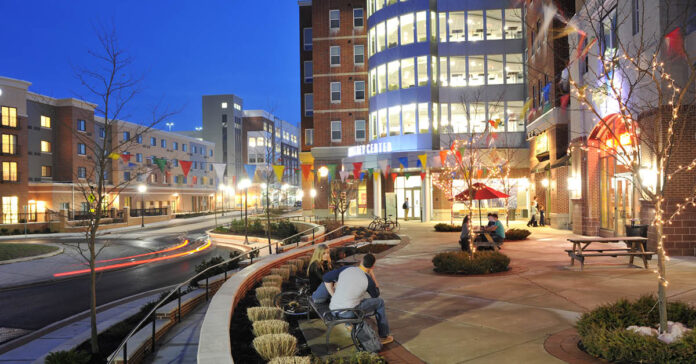
The Glassboro campus itself has transformed dramatically over the past decade. Rowan Boulevard has emerged as one of the most ambitious university redevelopment projects in New Jersey, serving as both an academic anchor and a mixed-use destination integrating student housing, restaurants, retail operations, entertainment venues, and university expansion projects. The arrival of Rally House adds another commercial and cultural layer to that ecosystem while reinforcing Rowan’s increasing visibility throughout the region.
University President Ali A. Houshmand framed the partnerships as part of Rowan’s broader commitment to innovation and student-centered development, emphasizing the importance of delivering modernized services that align with how today’s students learn, shop, and engage with campus life. The university has increasingly focused on operational modernization in recent years as enrollment growth, athletic expansion, research investment, and campus development continue accelerating simultaneously.
That growth has fundamentally altered Rowan’s identity within New Jersey higher education. Once viewed primarily as a regional institution, Rowan has expanded aggressively through research initiatives, medical education partnerships, engineering programs, business development, and large-scale infrastructure investment. As the university’s profile rises nationally, institutional branding and student experience have become increasingly important components of its long-term strategy.
Rally House appears positioned to capitalize directly on that momentum.
Company CEO Aaron Liebert pointed directly to Rowan’s decade-long growth trajectory as a major factor behind the partnership, highlighting the university’s expanding alumni base and increasingly visible regional influence. The retailer’s strategy focuses heavily on schools with rapidly growing fan engagement and community integration, making Rowan a natural fit for expansion into campus retail operations.
The inclusion of professional Philadelphia sports merchandise inside the Rowan Boulevard location also reflects the university’s unique geographic and cultural positioning within the South Jersey and Greater Philadelphia sports market. Eagles, Phillies, Flyers, and Sixers merchandise is expected to become part of the in-store experience, helping create a hybrid retail model that merges collegiate branding with regional sports culture in a way that aligns closely with local consumer behavior.
That decision may prove especially important for alumni engagement and year-round retail traffic. Traditional campus bookstores often rely heavily on seasonal purchasing cycles tied to move-in periods, graduation, and athletic events. Rally House’s broader sports-focused inventory model creates opportunities for more consistent consumer engagement throughout the calendar year while strengthening Rowan Boulevard’s role as a destination beyond strictly academic activity.
The redesign and refreshed retail environment expected under Rally House management also arrives during a broader national shift in how universities approach physical campus retail. Across the country, institutions are increasingly abandoning outdated bookstore models in favor of more experiential retail environments emphasizing lifestyle branding, apparel culture, technology integration, and community engagement. Rowan’s move aligns directly with that industry-wide evolution.
At the same time, the university’s partnership with eCampus.com may carry even greater long-term significance for students navigating rising education costs and increasingly complicated course material systems.
Textbook affordability has become one of the most pressing operational and political issues in higher education over the past decade. Students nationwide continue facing rising costs not only for tuition and housing but also for required academic materials, many of which have transitioned into expensive digital licensing ecosystems with limited resale value. Universities have come under growing pressure to provide more affordable alternatives, greater format flexibility, and improved purchasing transparency.
eCampus.com’s operational model appears specifically designed to address those concerns.
Under the new system, Rowan students will gain access to print textbooks, digital materials, used inventory, rental programs, and marketplace purchasing options through a customized online storefront integrated directly with course schedules. The platform automatically populates required course materials based on student enrollment, simplifying what has traditionally been one of the more frustrating administrative processes at the beginning of each semester.
The technology-driven integration may significantly reduce ordering confusion while helping students compare purchasing formats and pricing more efficiently.
Affordability initiatives remain central to the eCampus approach. Used books, rental options, and marketplace listings from third-party sellers are expected to create broader pricing competition, potentially lowering overall student spending on academic materials. Free shipping options further strengthen the accessibility component, particularly for commuter students and those balancing financial pressures alongside academic responsibilities.
The proprietary Marketplace system could become especially important in helping students locate discounted materials that might otherwise remain financially out of reach through traditional campus bookstore channels. As digital education models continue evolving, flexibility in purchasing formats has become increasingly essential for modern student populations.
The transition also reflects the growing digitalization of higher education logistics overall. Universities are now expected to operate with consumer-grade convenience standards that mirror broader e-commerce trends shaping nearly every industry. Students increasingly expect personalized interfaces, automated recommendations, mobile accessibility, rapid fulfillment, and transparent pricing systems. Rowan’s partnership with eCampus.com directly aligns with those expectations.
Taken together, the Rally House and eCampus.com partnerships represent more than operational outsourcing agreements. They are part of a broader institutional repositioning effort that reflects how rapidly higher education continues changing across New Jersey and nationally.
For Rowan University, the timing is particularly significant.
The institution has spent years aggressively expanding academic programs, physical infrastructure, research partnerships, medical education initiatives, and regional influence. The modernization of student retail and course material systems now becomes another visible extension of that growth trajectory. These changes are designed not only to improve operational efficiency but to strengthen the university’s overall brand identity at a moment when competition among institutions continues intensifying across nearly every category.
The evolution of Rowan Boulevard itself reinforces that narrative. What was once a traditional college-adjacent corridor has increasingly transformed into a fully integrated university district combining commerce, entertainment, housing, athletics, academics, and community development. The arrival of Rally House injects another layer of energy into that ecosystem while helping create a more modern retail environment reflective of Rowan’s broader ambitions.
Meanwhile, eCampus.com’s digital-first course material strategy reflects the increasingly technology-centered nature of modern education administration, where convenience, personalization, affordability, and integration are becoming baseline expectations rather than premium services.
For students arriving in Glassboro this fall, the changes will likely feel immediate. The bookstore experience will look different. Merchandise selection will expand dramatically. School spirit branding will become more visible. Academic purchasing systems will become more automated and digitally integrated. The campus retail environment itself will feel more aligned with modern consumer expectations.
But institutionally, the implications run much deeper.
Rowan University is continuing to position itself not simply as a traditional public university, but as a rapidly evolving regional powerhouse investing heavily in infrastructure, identity, accessibility, technology integration, and student engagement. These partnerships reinforce the idea that modern higher education success increasingly depends on building an entire ecosystem around the student experience — one that extends from academics and athletics to retail culture, affordability, branding, and community presence.
As universities throughout New Jersey continue adapting to demographic shifts, financial pressures, and evolving student expectations, Rowan’s latest moves may ultimately serve as another example of how institutions are rethinking every aspect of campus operations in order to remain competitive in a rapidly changing educational landscape.
With Rally House bringing a new retail identity to Rowan Boulevard and eCampus.com modernizing academic access systems, Rowan University is signaling that its next phase of growth is not slowing down. Instead, the institution appears determined to continue expanding its footprint, strengthening its brand, and redefining what a modern New Jersey university experience can look like for the next generation of students.



