



A heartbreaking discovery along the Delaware River has brought a devastating end to a two-month search for a missing South Jersey farmworker, while simultaneously exposing deeper concerns surrounding migrant labor vulnerability, worker isolation, healthcare access, mental health support, and the often invisible realities facing many of the agricultural laborers who help sustain New Jersey’s farming economy.
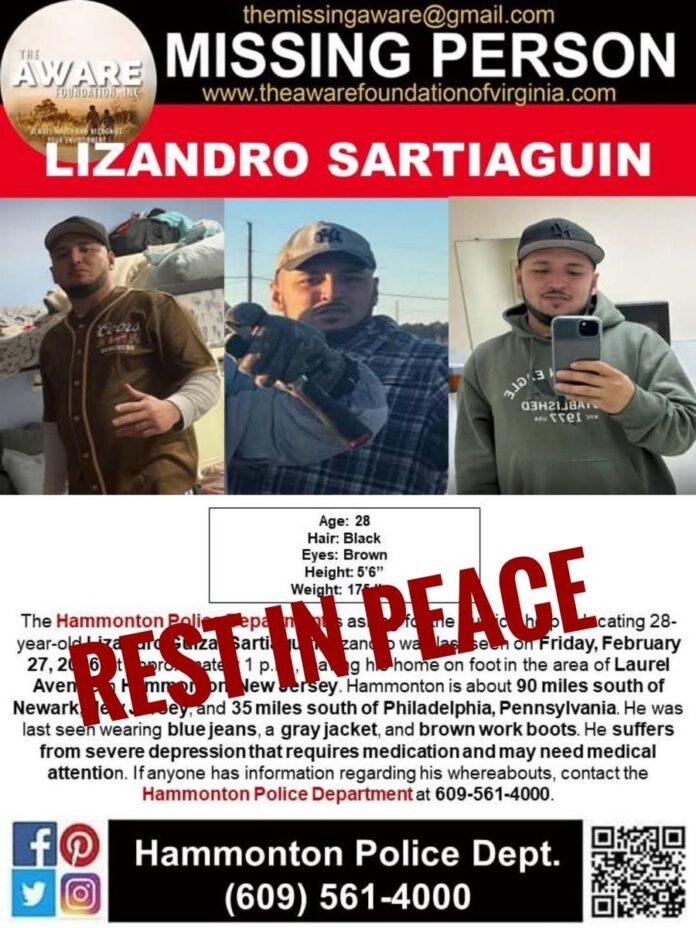
Authorities have confirmed that the remains recovered near the shoreline at Fox Point State Park in Wilmington, Delaware belong to Lizandro Guizar Sartiaguin, a 27-year-old migrant blueberry field worker from Hammonton, New Jersey who disappeared in late February after leaving his residence and never returning.
The tragic discovery has sent waves of grief through South Jersey’s agricultural communities, particularly throughout Hammonton, where migrant labor remains deeply interwoven into the region’s blueberry industry and broader farming infrastructure. The case is now drawing growing attention not only because of the mystery surrounding Sartiaguin’s disappearance and death, but because it reflects larger humanitarian and social issues affecting vulnerable workers throughout New Jersey’s agricultural economy.
According to investigators, Sartiaguin was last seen alive on February 27, 2026, leaving his residence on Laurel Avenue in Hammonton around 1:00 in the afternoon. Family members and advocates say he left behind his personal belongings and abruptly lost all communication with relatives afterward, triggering mounting concern among those who knew him.
What began initially as a missing person case slowly evolved into a prolonged search effort marked by uncertainty, emotional exhaustion, and increasing fear among both family members and members of the local migrant worker community.
For weeks, loved ones reportedly struggled to understand what could have happened.
Sartiaguin had been working in South Jersey’s blueberry fields, part of the agricultural labor force that remains essential to one of New Jersey’s most iconic farming sectors. Known nationally for its blueberry production, Hammonton and surrounding Atlantic County agricultural regions rely heavily on seasonal and migrant labor to sustain harvesting operations and maintain productivity during critical growing periods.
These workers often live largely outside public visibility despite their central role in the state’s agricultural economy.
Many laborers travel significant distances from family members, work physically demanding schedules, navigate language barriers, and operate within economically precarious conditions while supporting relatives both domestically and abroad. Advocates say Sartiaguin regularly sent earnings back to support his wife and daughter in Mexico, reflecting a common reality for many migrant workers whose labor sustains families across international borders.
Family representatives and community advocates also revealed an additional layer of vulnerability tied to Sartiaguin’s medical history.
According to those close to him, he had previously suffered a severe head injury several years earlier that reportedly left him dealing with ongoing cognitive and memory-related difficulties. Despite these lingering challenges, he continued working steadily in agricultural labor, attempting to maintain financial support for his family while navigating long-term health consequences that may have complicated daily life.
That detail has added even greater emotional weight to the case.
Advocates working with migrant labor populations frequently warn that workers experiencing cognitive difficulties, untreated trauma, mental health struggles, or medical limitations often face heightened vulnerability due to isolation, limited healthcare access, unstable transportation, language barriers, and fear surrounding employment security or immigration scrutiny — even among individuals holding legal residency status.
Sartiaguin reportedly possessed legal permanent resident status, commonly known as a green card, underscoring another important reality often lost within broader immigration narratives: many migrant laborers contributing to the regional agricultural economy are legally authorized workers deeply embedded into the fabric of local communities and industries.
The discovery itself unfolded under grim circumstances.
On the evening of April 24, a visitor walking through Fox Point State Park reportedly encountered a heavily decomposed body near the shoreline along the Delaware River. The park sits directly across the river corridor from portions of Salem County, New Jersey, an area deeply connected through transportation, industrial, and environmental networks spanning the Delaware Valley region.
The condition of the remains complicated identification efforts initially.
The Delaware Division of Forensic Science eventually used forensic testing procedures to formally confirm the identity as Sartiaguin, bringing painful closure to months of uncertainty while simultaneously opening a new phase of investigation into how he died and how his body ultimately ended up along the Delaware shoreline.
At this stage, authorities say the precise cause and manner of death remain undetermined pending the completion of autopsy and toxicology analysis.
That uncertainty continues fueling questions surrounding the timeline of Sartiaguin’s disappearance and whether any external circumstances may have contributed to his death. Investigators with the Delaware State Police criminal investigations unit are continuing to examine the case while urging anyone with information connected to his movements or timeline to contact Detective Joseph Lucyk.
The fact that the case remains open-ended has intensified concern throughout both migrant advocacy circles and local South Jersey communities.
Cases involving missing migrant workers often become especially difficult to investigate due to fragmented social networks, limited digital records, unstable transportation patterns, fear of law enforcement among some labor populations, and the geographic mobility associated with seasonal agricultural employment. Workers may move between housing sites, farms, transportation corridors, or temporary labor arrangements without extensive public visibility.
This invisibility can complicate both searches and broader public awareness.
Advocates say many agricultural laborers operate within conditions where disappearance, injury, exploitation, or medical crises can remain unnoticed longer than they would for individuals embedded within more stable social or institutional systems. Migrant workers frequently lack consistent healthcare access, transportation independence, or support infrastructure capable of responding rapidly during emergencies.
The tragedy is also drawing renewed attention to the physical and emotional demands placed on agricultural workers throughout New Jersey.
The state’s farming economy depends heavily on labor-intensive harvesting systems requiring long hours in difficult weather conditions during peak seasons. Workers often endure intense heat, physical strain, unstable income patterns, and housing insecurity while remaining largely invisible to the consumers benefiting from the agricultural products they help produce.
Blueberry farming in particular represents one of South Jersey’s defining agricultural industries.
Hammonton has long carried the identity of the “Blueberry Capital of the World,” with generations of farm operations helping shape the region’s economy and cultural character. But beneath the industry’s economic success lies a labor system heavily dependent on migrant workers whose lives often remain disconnected from broader public visibility.
Sartiaguin’s death now forces uncomfortable reflection on that reality.
The case also arrives during a period when broader conversations surrounding labor protections, healthcare access, mental health support, and migrant worker rights are intensifying nationally. Advocates increasingly argue that agricultural workers remain among the most economically vulnerable labor populations in the country despite performing work critical to food production systems and regional economies.
Mental health and cognitive health support represent particularly overlooked dimensions of this issue.
Workers coping with prior injuries, trauma, isolation, or untreated medical conditions frequently face enormous difficulty accessing consistent care, especially in rural or seasonal labor environments where healthcare infrastructure may already be limited. Family advocates’ comments regarding Sartiaguin’s past head injury have therefore resonated deeply with organizations focused on worker protection and migrant wellbeing.
The Delaware River itself adds another haunting layer to the case.
Stretching through some of the Northeast’s most industrialized and interconnected corridors, the river functions simultaneously as transportation artery, environmental boundary, commercial route, and geographic connector between New Jersey, Delaware, and Pennsylvania. Cases involving unidentified remains discovered along its shoreline often become extraordinarily complex because of the region’s overlapping jurisdictions and heavily traveled waterways.
For Sartiaguin’s family, however, the broader political and structural conversations surrounding the case remain secondary to the devastating human loss itself.
A husband and father who traveled far from home to support loved ones through physically demanding agricultural labor disappeared for months before being discovered far from the fields where he worked and the community where he lived.
And now, even after the recovery of his remains, many of the most important questions surrounding his final days remain unanswered.
As investigators continue piecing together the circumstances surrounding his disappearance and death, the tragedy is becoming a painful reminder of how easily vulnerable workers can disappear into the margins of systems that depend upon their labor but often fail to fully see them.
Because behind New Jersey’s farms, harvest seasons, and agricultural success stories are thousands of workers whose lives remain fragile, isolated, and deeply exposed to hardship in ways most residents rarely witness directly.
And in the case of Lizandro Guizar Sartiaguin, that hidden vulnerability has now become impossible to ignore.



