


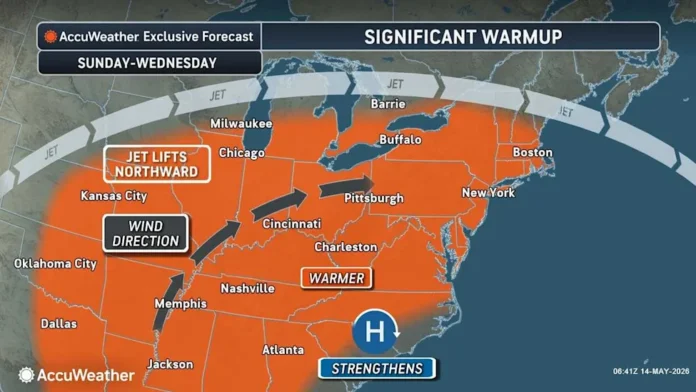

New Jersey is stepping into one of the most dramatic weather transitions of the spring season as a powerful warm-up surges across the Garden State, sending temperatures soaring into full summer territory before an aggressive midweek cold front abruptly flips conditions back toward cool, cloudy, and unsettled weather just days later. What began as a refreshing stretch of mild May air is rapidly evolving into a full-scale preview of summer, complete with building humidity, widespread inland heat, thunderstorm potential, sharp coastal contrasts, and a temperature rollercoaster that perfectly captures the volatility of late-spring weather patterns across the Northeast.
Saturday marks the beginning of the transition, and the difference is already impossible to ignore.
The Week Ahead: A Taste of Summer
| Day | Sky Condition | Temperature | Chance of Rain |
|---|---|---|---|
| Sat, May 16 | 80°F / 54°F | 0% (Day) / 30% (Night) | |
| Sun, May 17 | 88°F / 64°F | 0% | |
| Mon, May 18 | 93°F / 67°F | 5% | |
| Tue, May 19 | 94°F / 71°F | 35% | |
| Wed, May 20 | 93°F / 64°F | 35% | |
| Thu, May 21 | 64°F / 57°F | 25% | |
| Fri, May 22 | 57°F / 51°F | 20% |
After several cooler days dominated by comfortable air masses and lower humidity, New Jersey is now warming rapidly under bright sunshine, strengthening southwest flow, and expanding upper-level ridge development stretching across much of the eastern United States. Temperatures today are climbing toward 80 degrees statewide, with some inland locations already beginning to push beyond seasonal averages. Humidity remains manageable for now, hovering comfortably near 35 percent, allowing the warmth to feel pleasant rather than oppressive despite the strengthening sun angle and increasingly summer-like atmosphere.
The combination of blue skies, abundant sunshine, and moderate southwest winds around 12 miles per hour is creating one of the most inviting weather setups New Jersey has experienced so far this year. Parks, boardwalks, waterfront districts, outdoor dining areas, hiking trails, downtown shopping corridors, and recreational spaces throughout the state are expected to see substantial activity as residents take advantage of the warm and dry conditions.
Still, meteorologists are warning that the strengthening May sun should not be underestimated.
The UV Index is elevated, reflecting the increasingly intense solar radiation typical of late spring as the Northeast moves closer toward peak summer sun angles. Anyone spending prolonged time outdoors this weekend is being urged to use sunscreen, remain hydrated, and prepare for rapidly increasing exposure conditions even though humidity levels remain relatively comfortable for the moment.
Tonight remains largely quiet across the region, though a few isolated showers or brief sprinkles could drift through portions of the state after midnight as slightly more humid air begins advancing northward. Most communities will remain dry, however, with overnight lows settling into the mid-50s across much of New Jersey under a mix of clouds and lingering mild air.
What happens after that is where the real atmospheric transformation begins.
By Sunday and especially Monday, New Jersey will move directly into one of its first true heat surges of the season as expanding upper-level ridging and strengthening southwesterly flow transport significantly warmer air into the region. Forecasters expect temperatures to climb aggressively throughout inland portions of the state, with many communities reaching well into the upper 80s and low 90s by early next week.
For many residents, it will feel less like May and far more like mid-July.
Monday in particular is shaping up to be the peak of the heat event, with widespread inland temperatures expected near 93 degrees under partly sunny skies and rising humidity. Heat indices could push even higher in urban and densely developed areas where concrete, asphalt, and infrastructure retain warmth more efficiently. Cities throughout North Jersey, Central Jersey, and portions of the Delaware Valley corridor may experience notably warmer overnight lows as well, reducing nighttime cooling and adding to the summer-like feel.
Yet despite the statewide warmth, New Jersey’s coastline once again demonstrates why the state possesses one of the most fascinating weather contrasts in the country.
While inland communities roast under developing heat, coastal sections near the Atlantic Ocean will remain significantly cooler because of persistent ocean temperatures still trapped in the 50s. Sea breezes developing during the afternoon hours are expected to keep shore communities substantially more comfortable, with some beaches potentially remaining in the 70s while inland areas surge toward 90 degrees only a short drive away.
This dramatic coastal contrast is one of the defining characteristics of late-spring weather in New Jersey.
The Atlantic Ocean acts as a natural temperature regulator, delaying the onset of sustained summer heat near the shoreline even as inland regions rapidly warm under strengthening sun angles and continental air masses. As a result, shore communities often experience entirely different weather realities compared to interior counties during transitional months like May and early June.
That contrast will become increasingly visible throughout the upcoming week.
Sunday’s forecast already reflects the beginning of that divergence. Inland temperatures are expected to climb solidly into the 80s while coastal communities fluctuate more heavily depending on localized sea breeze development. Humidity levels will begin increasing noticeably statewide, though forecasters emphasize conditions should remain tolerable through the first half of the week before instability begins intensifying ahead of an approaching cold front.
The atmospheric setup driving this warm spell is tied to broader upper-air dynamics unfolding across much of the continental United States.
Meteorologists analyzing 250mb and 500mb atmospheric patterns note a predominantly zonal flow structure across the country, punctuated by periodic ridge peaks that are allowing warmer air masses to build northward into the eastern United States. These elevated ridge structures are effectively pumping heat into the Mid-Atlantic and Northeast while suppressing widespread storm development temporarily.
As heights continue building aloft, New Jersey enters a prolonged warm sector that remains locked in place through at least Wednesday.
But the atmosphere rarely remains stable for long during transitional seasons.
As heat and humidity increase, instability will also begin building rapidly by Tuesday afternoon. Scattered thunderstorms are expected to develop as the atmosphere becomes increasingly energized ahead of an advancing frontal system. Some storms could produce locally heavy downpours, gusty winds, and dangerous lightning, particularly during the late afternoon and evening hours when daytime heating peaks.
Wednesday appears similarly active, with another round of scattered thunderstorms possible ahead of the approaching cold front itself.
The combination of elevated temperatures, moisture-rich air, and frontal forcing creates an environment favorable for rapidly developing convective activity. While widespread severe weather is not currently guaranteed, forecasters are closely monitoring the evolving setup because late-spring heat surges often produce volatile storm environments across the Northeast.
The true shock to the system, however, arrives after the front moves through.
By Thursday, New Jersey’s brief taste of summer abruptly collapses.
Temperatures are expected to plunge nearly 30 degrees in some areas as cooler Canadian air floods back into the region behind the departing front. Thursday highs may struggle to escape the low-to-mid 60s across much of the state, while Friday could remain trapped in the upper 50s under heavily clouded skies and lingering damp conditions.
The shift will feel jarring after multiple days of widespread 80s and 90s.
Cloud cover, occasional showers, and sharply lower humidity will replace the tropical feel almost overnight, reminding residents just how unstable spring weather patterns can become in the Mid-Atlantic region. Yet meteorologists stress that this cooldown is not necessarily bad news, especially with Memorial Day Weekend now beginning to emerge on the extended forecast horizon.
Current projections suggest the cooler air mass stabilizes into a much more seasonable and comfortable pattern heading toward the holiday weekend.
Rather than oppressive heat or widespread washout conditions, Memorial Day Weekend currently appears likely to feature temperatures generally ranging from the low-to-mid 70s across much of the state — conditions many residents would consider nearly ideal for outdoor activities, travel, shore tourism, backyard gatherings, and early-season summer recreation.
While isolated spring showers can never be ruled out entirely during late May, forecasters currently see no major synoptic storm systems threatening the holiday period. Instead, the atmosphere may settle into a more balanced regime featuring mixed sun and clouds, moderate humidity, and temperatures closely aligned with long-term seasonal averages.
That outlook would represent a significant improvement after the rollercoaster conditions dominating the upcoming week.
The broader pattern unfolding across New Jersey also reflects increasingly noticeable seasonal volatility that many meteorologists say has become more common in recent years. Large temperature swings, rapid transitions between heat and cool air masses, stronger spring instability, extended pollen seasons, and increasingly erratic weather patterns are all becoming defining characteristics of Northeast climate behavior during transitional months.
Residents are already experiencing some of those effects directly.
The same warm surge now bringing near-90-degree temperatures is also helping fuel elevated pollen levels across much of the region. Allergy sufferers throughout New Jersey continue dealing with aggressive seasonal conditions tied to prolonged growing seasons, fluctuating temperatures, and repeated shifts between dry warmth and moisture-rich air masses.
At the same time, farmers and agricultural operators remain highly sensitive to the evolving weather pattern after portions of the state recently endured damaging freeze conditions that threatened crops and disrupted early-season agricultural activity. The coming heat may accelerate growth cycles rapidly, but additional weather instability later in the month remains a concern for producers monitoring vulnerable planting conditions.
For now, however, New Jersey is entering one of the most energetic and dynamic stretches of weather seen so far this spring.
From bright sunshine and dry warmth this weekend to full summer heat early next week, followed by thunderstorms and an abrupt return to cool air before Memorial Day, the atmosphere is preparing to deliver nearly every type of late-spring weather pattern imaginable within a matter of days.
And for residents across the Garden State, it serves as another reminder that in New Jersey, weather rarely stays predictable for long.