


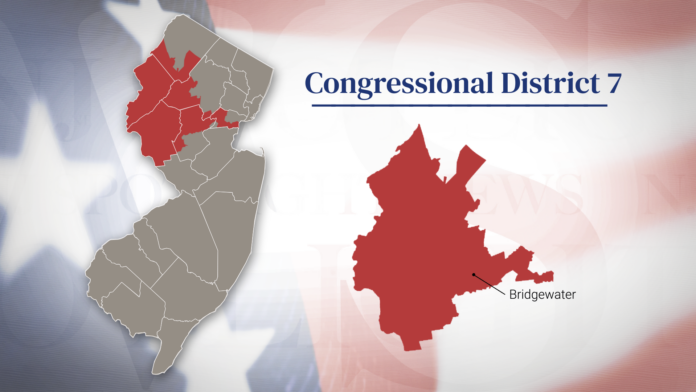

The race for New Jersey’s 7th Congressional District has entered a volatile and defining phase, one shaped as much by who is not present as by those actively campaigning. As Democratic candidates sharpen their arguments and mobilize voters ahead of the June primary, the prolonged absence of incumbent Congressman Tom Kean Jr. has transformed what was already the state’s most closely watched congressional battleground into a story with national implications.
At the center of the moment is a fundamental political reality: representation is being debated not only through policy positions and campaign messaging, but through visibility itself. During a recent candidate forum, Tina Shah delivered a pointed critique that has since echoed far beyond the room, stating bluntly that Kean “is saying nothing” and “nowhere to be found.” That line, once a campaign jab, has taken on a sharper edge in recent weeks as Kean’s absence from congressional voting activity stretches back to early March.
The explanation offered publicly points to a personal health matter, with assurances from his office that he is expected to make a full recovery and return to duty. Yet the extended silence has created a vacuum—one that has not been filled with clarity. Even within Republican circles familiar with the Kean family legacy in New Jersey politics, there is a noticeable lack of concrete information. That uncertainty has fueled both concern and speculation, raising broader questions about transparency and accountability for elected officials entrusted with federal legislative responsibilities.
In most contexts, personal health remains a private matter. In Congress, however, prolonged absence carries structural implications. Constituents in CD-7—spanning parts of Hunterdon, Morris, Somerset, Sussex, Union, and Warren counties—are effectively without an active voting representative during a critical stretch of legislative activity. For a district already defined by its razor-thin partisan margins, the timing is politically consequential.
This backdrop has created a strategic opening for Democrats, who are actively competing for the opportunity to flip the seat in November. At the recent forum hosted by the Jewish caucus of the Morris County Democratic Committee, four candidates—Tina Shah, Rebecca Bennett, Michael Roth, and Brian Varela—presented their visions on a range of issues, with particular focus on foreign policy, antisemitism, and campaign finance.
Across the board, there was alignment in condemning the rise of antisemitism, with candidates emphasizing that the issue transcends ideological boundaries. Yet within that consensus, distinctions emerged. Shah stood apart in expressing unequivocal support for continued U.S. military aid to Israel without conditions, positioning herself firmly within a traditional pro-Israel framework at a time when that stance is being actively debated within Democratic circles nationwide.
A related question centered on the adoption of the International Holocaust Remembrance Alliance’s definition of antisemitism—a framework that has gained traction globally but has yet to be formally embraced in New Jersey. Shah again distinguished herself as the only candidate to offer clear support for adoption, while the others took a more measured approach. Roth emphasized the need for continued dialogue, suggesting that formal definitions, while important, do not alone resolve deeper societal tensions.
The conversation also extended into the influence of political action committees, particularly in light of recent activity in neighboring districts. The role of the American Israel Public Affairs Committee (AIPAC) in shaping electoral outcomes has become an increasingly visible factor, especially following its involvement in nearby contests. All four candidates expressed opposition to the broader concept of “dark money” in politics and voiced support for overturning the Supreme Court’s Citizens United decision, which opened the door to unlimited outside spending.
Bennett added a nuanced perspective, cautioning that criticism of AIPAC must be carefully framed to avoid crossing into rhetoric that could be perceived as antisemitic. Her approach reflects a broader balancing act within the party—addressing concerns about campaign financing while maintaining sensitivity to the historical and cultural context surrounding pro-Israel advocacy groups.
As the primary approaches, the strategic pathways for each candidate are becoming more defined. Roth has secured endorsements from multiple progressive organizations, signaling an effort to consolidate support from the party’s left flank. Varela is pursuing a similar trajectory, aiming to replicate the kind of grassroots momentum that has fueled unexpected victories in recent elections.
Shah, meanwhile, is leveraging a significant fundraising advantage, reportedly backed by a multi-million-dollar campaign war chest that is already being deployed through direct voter outreach. Her strategy reflects a belief that early and sustained visibility can translate into durable support across the district.
Bennett’s campaign has taken a different approach, emphasizing broad coalition-building. With endorsements from Democratic organizations across multiple counties within the district, she has positioned herself as a candidate focused not only on primary success but on general election viability. Speaking at a recent event in Watchung, she underscored a message that appears to resonate with voters across ideological lines: the overriding priority is winning the seat in November.
Her background—combining military service with experience in the healthcare sector—forms a central pillar of that argument. It is a profile designed to appeal beyond the Democratic base, particularly in a district where Republicans maintain a registration advantage estimated at approximately 20,000 voters. Bennett’s outreach strategy explicitly targets independents and moderate Republicans, reflecting the electoral math required to flip CD-7.
What is unfolding in this race is more than a typical primary contest. It is a convergence of local dynamics and national narratives: questions about congressional accountability, debates over foreign policy within the Democratic Party, and the enduring influence of campaign finance structures. Overlaying all of it is the absence of the incumbent—a factor that continues to reshape the contours of the campaign with each passing week.
For voters across New Jersey’s 7th District, the stakes are increasingly clear. Representation is no longer an abstract concept but a present-tense issue, tied directly to visibility, engagement, and responsiveness. As candidates make their case and the electorate prepares to make its decision, the district stands as a microcosm of broader political currents—where silence, strategy, and scrutiny intersect in real time.



