


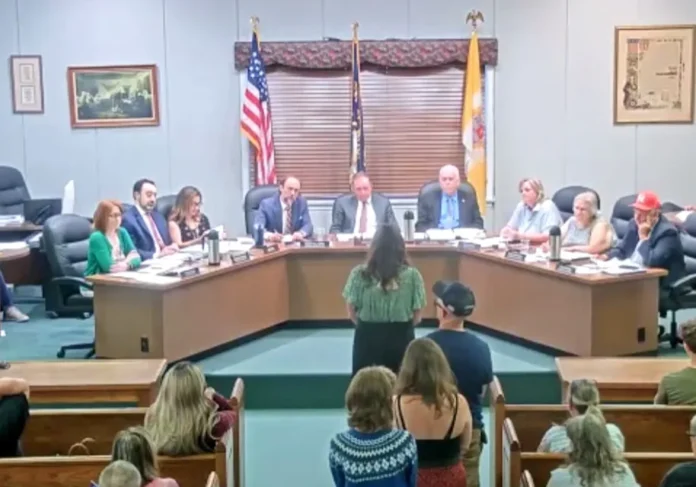

What unfolded recently inside the council chambers of Boonton, New Jersey was about far more than a municipal flag ordinance.
On the surface, the issue appeared procedural and relatively straightforward: whether the Morris County town should amend its municipal policy to allow the Pride Flag to be flown during Pride Month at Grace Lord Park alongside approved government-related flags already permitted on public property.
But as public meetings intensified, emotions escalated, and a swastika was repeatedly displayed during debate, the controversy transformed into something far larger — a deeply revealing snapshot of how symbolic politics, LGBTQ visibility, public identity, free speech concerns, local government power, and modern culture wars are colliding in communities across the United States.
At Sustainable Action Now, conversations surrounding law, public policy, civic discourse, and social conflict increasingly involve examining how local governance battles often become proxies for national ideological tensions. What happened in Boonton reflects a growing reality across America: debates once considered largely symbolic are now emotionally charged flashpoints capable of dividing communities, reshaping local elections, and exposing broader anxieties surrounding identity, inclusion, governance, and public representation.
The controversy centered around an effort to revise a municipal ordinance governing which flags may be displayed on town property.
Previously, the ordinance reportedly limited municipal flag displays primarily to the American flag and certain government-associated banners, including military branch flags as well as state and county flags. In order for Boonton to officially fly the rainbow Pride Flag during June’s Pride Month observances, the ordinance itself needed to be amended.
The proposed revision passed the town council in narrow 5-4 votes during both introduction and final approval stages, reflecting the recently shifted political makeup of the governing body after Democrats secured majority control.
Yet despite passage by the council, the ordinance was subsequently vetoed by Republican Mayor James Lynch, effectively halting implementation because supporters lacked the supermajority necessary to override the veto.
The result left the existing restrictions intact.
But the procedural outcome became overshadowed almost entirely by the emotionally explosive imagery introduced during public debate.
Former councilman Michael Eoga, a Republican who served on the governing body for more than two decades, reportedly displayed a swastika at both public meetings while arguing against the ordinance changes. During the later meeting, he attempted to distribute copies to council members as part of what he described as a “slippery slope” argument regarding future flag display requests on public property.
According to the discussion presented publicly, Eoga argued that once municipalities begin permitting non-governmental symbolic flags, local governments may expose themselves to legal disputes or pressure involving other controversial or extremist groups seeking equal treatment under public accommodation or free expression principles.
The swastika, he suggested, was intended not as endorsement, but as a provocative illustration of where such policy decisions could theoretically lead.
Yet the symbolism itself immediately became the dominant issue.
At Sustainable Action Now, one of the most important realities surrounding this controversy is understanding that symbols operate emotionally as much as intellectually in public discourse. Regardless of stated intent, the swastika carries extraordinary historical weight because it remains globally associated with genocide, fascism, antisemitism, white supremacy, state violence, and one of the darkest chapters in modern human history.
Introducing such imagery into a local debate surrounding Pride flags guaranteed emotional escalation instantly.
For many residents and observers, the symbolism itself overwhelmed any procedural or legal argument being attempted. Public reactions reflected not merely disagreement about flag policy, but deep discomfort surrounding the normalization of inflammatory imagery inside civic debate spaces.
This dynamic highlights one of the defining characteristics of modern political discourse nationally: symbolic escalation increasingly replaces nuanced policy discussion.
Local meetings that once focused narrowly on zoning, ordinances, budgeting, or municipal administration now frequently become emotionally charged battlegrounds tied directly to national identity politics and broader cultural anxieties amplified through social media, partisan media ecosystems, and ideological polarization.
The Boonton meetings appear to fit squarely within that evolving landscape.
Supporters of flying the Pride Flag argued that public recognition during Pride Month represented a meaningful acknowledgment of LGBTQ residents and communities historically marginalized, discriminated against, or excluded from public visibility and civic affirmation.
Statements emphasizing inclusion and equal recognition framed the Pride Flag not merely as political symbolism, but as representation for people seeking acknowledgment and acceptance within the broader community.
One speaker reportedly summarized that perspective succinctly by stating, “Inclusion is not un-American.”
That phrase captures a broader cultural argument increasingly central to municipal debates involving Pride displays nationwide. Supporters often view Pride symbolism as civic recognition similar to heritage celebrations, awareness months, or public acknowledgment extended toward other historically marginalized communities.
Opponents, however, frequently frame such displays differently.
Critics of changing the ordinance reportedly argued that government property should remain limited to officially governmental symbols only, contending that the American flag alone already represents all citizens regardless of identity categories. Others expressed concern about municipalities selectively elevating particular causes, groups, or movements through official endorsement-like symbolism on public property.
This debate mirrors legal and political battles unfolding nationally surrounding government speech, symbolic expression, and public forum doctrine.
Courts across the country have increasingly wrestled with complicated constitutional questions regarding whether public flag displays constitute government speech — allowing municipalities broad discretion over which symbols they endorse — or whether opening public spaces to certain expressions creates obligations toward viewpoint neutrality under First Amendment principles.
The “slippery slope” argument referenced during the Boonton meetings reflects those broader constitutional tensions, though critics argue such comparisons often become inflammatory when tied to extremist symbolism.
At Sustainable Action Now, another major aspect of this controversy involves how rapidly local governance disputes now become public cultural flashpoints amplified far beyond town borders.
Boonton is not a massive city. Yet the combination of Pride symbolism, partisan division, swastika imagery, mayoral veto power, and public emotional confrontation transformed a local ordinance debate into a broader cultural conversation reflecting national polarization dynamics.
Social media intensifies this dramatically.
Moments once confined largely to town halls now circulate regionally and nationally within hours, often stripped of procedural nuance and condensed into emotionally charged narratives. This creates pressure on local officials operating inside environments where every symbolic action may instantly become part of larger ideological conflicts extending far beyond municipal boundaries.
Mayor Lynch’s veto further intensified those dynamics because it shifted the conflict from procedural ordinance discussion into a direct confrontation over political authority itself.
His reported statement emphasizing the American flag as sufficient representation for all residents reflects a philosophy increasingly common among officials opposing expanded symbolic displays on government property. At the same time, critics interpreted the veto as suppressing LGBTQ visibility and recognition despite council majority support.
The response from Boonton Rainbow Pride illustrates how emotionally significant the issue became for local advocates. Their statement accusing the mayor of imposing “his own personal agenda” reflects broader frustrations many activists feel when symbolic inclusion measures face governmental resistance despite evolving public attitudes surrounding LGBTQ rights nationally.
At Sustainable Action Now, one of the most revealing aspects of this entire controversy is how clearly it demonstrates the growing fragmentation of civic consensus in modern America.
Not long ago, municipal governance often functioned largely through pragmatic compromise focused on infrastructure, services, and administration. Today, local politics increasingly operate as extensions of broader national ideological conflict. Questions involving flags, curriculum, library materials, public monuments, holidays, identity representation, and symbolic recognition now carry extraordinary emotional and political intensity.
These conflicts persist partly because symbols themselves have become proxies for deeper fears and aspirations surrounding social change.
For some residents, Pride flags symbolize visibility, inclusion, evolving civil rights recognition, and community affirmation. For others, they represent government overreach into identity politics or selective endorsement of social movements. Similarly, concerns surrounding unrestricted symbolic access to public spaces reflect anxieties about institutional neutrality and legal consistency, even when critics strongly reject inflammatory comparisons used rhetorically.
The difficulty is that emotionally charged symbols rarely produce calm procedural debate.
Instead, they activate historical trauma, political identity, personal values, cultural fears, and competing visions of public space simultaneously.
The Boonton meetings therefore became more than discussions about flags themselves. They became public confrontations over who feels represented, how government spaces should function symbolically, what civic inclusion means, and how communities navigate ideological division without collapsing into hostility.
At Sustainable Action Now, the broader lesson emerging from Boonton may be that local governments increasingly find themselves navigating national culture wars whether they seek to or not. Even seemingly narrow municipal policy revisions can rapidly evolve into emotionally explosive debates reflecting much larger societal tensions surrounding identity, representation, constitutional interpretation, and political power.
And perhaps most importantly, the controversy reveals how fragile civic discourse can become once symbolic escalation overtakes substantive dialogue.
Because regardless of political perspective, once swastikas enter a public meeting — even rhetorically — the debate itself changes fundamentally. The emotional center shifts. Trust erodes. The possibility of measured disagreement narrows dramatically.
What remains afterward is often not resolution, but a community left grappling with what its public spaces, symbols, and governing institutions are supposed to represent moving forward.