

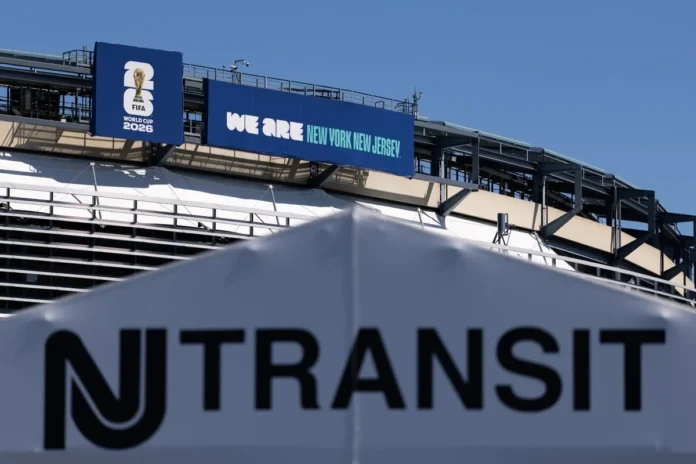

The countdown to the FIFA World Cup is no longer an abstract global sports conversation happening somewhere else. For New Jersey, the reality is becoming immediate, logistical, and deeply personal for hundreds of thousands of commuters who rely on NJ Transit every single day. While the world prepares for sold-out stadiums, international tourism surges, and historic soccer moments unfolding at MetLife Stadium, transportation officials are confronting a very different challenge entirely: how to keep everyday life functioning while simultaneously moving massive event crowds through one of the busiest transit corridors in the United States.
According to NJ Transit leadership, “life will go on” during the World Cup. But beneath that reassurance lies an enormous operational balancing act that may become one of the most consequential transportation stress tests in modern New Jersey history.
NJ Transit President and CEO Kris Kolluri recently began outlining what residents and commuters can realistically expect once World Cup traffic arrives in full force, including pricing discussions, operational planning, crowd management expectations, and warnings that rail systems surrounding game days could experience at least seven straight hours of intense congestion and crowding.
At Sustainable Action Now, transportation stories increasingly intersect with broader conversations surrounding sustainability, infrastructure resilience, urban planning, regional mobility, climate-conscious travel, and the growing pressure major global events place on already strained public transit systems. The upcoming World Cup does not simply represent a sports event for New Jersey. It represents a full-scale examination of whether one of the nation’s most critical regional transit systems can absorb extraordinary international demand while continuing to serve millions of ordinary riders whose daily routines cannot simply pause for a month-long global spectacle.
That tension is at the center of the entire conversation.
For everyday commuters, the World Cup introduces an unusual emotional contradiction. On one hand, there is enormous excitement surrounding the arrival of one of the largest sporting events on Earth directly into the New York-New Jersey region. The global visibility, tourism revenue, hospitality surge, economic stimulation, and international attention surrounding the tournament are historic opportunities. MetLife Stadium becoming part of the World Cup landscape instantly places New Jersey at the center of an unprecedented cultural moment.
On the other hand, commuters are asking a much simpler and more immediate question:
How exactly are people supposed to get to work?
That practical concern is entirely legitimate because the scale of transportation demand surrounding World Cup matches will likely dwarf most routine event operations the region typically handles. NFL games, concerts, and large-scale stadium events already create substantial pressure on NJ Transit lines serving the Meadowlands area. The World Cup introduces a dramatically larger international audience arriving with heightened security demands, compressed travel windows, unfamiliarity with local transit systems, and event attendance numbers capable of overwhelming infrastructure rapidly if coordination fails.
The acknowledgment that rail systems could remain heavily crowded for seven-hour stretches on game days reveals just how seriously officials are treating the operational challenge ahead.
At Sustainable Action Now, one of the most important aspects of this developing story is what it reveals about the growing importance of public transportation within large-scale global event planning itself. Modern mega-events increasingly succeed or fail not merely based on stadium quality, but on mobility systems surrounding them. Transportation becomes part of the event experience.
If public transit collapses operationally, everything else deteriorates with it.
Crowd safety, regional traffic flow, emergency response capacity, environmental sustainability goals, commuter confidence, tourism impressions, and economic activity all depend heavily on transportation systems functioning efficiently under extraordinary pressure.
This reality places NJ Transit under intense scrutiny.
The agency already faces familiar challenges known to New Jersey commuters for years: aging infrastructure, funding pressures, reliability concerns, staffing issues, delayed capital upgrades, and the sheer complexity of operating within one of the most densely populated transportation corridors in the country. The World Cup now adds a layer of global visibility onto those existing operational realities.
Kolluri’s public messaging therefore appears designed to walk a difficult line between reassurance and realism.
Saying “life will go on” acknowledges that commuters cannot simply stop traveling because international soccer arrives in town. Businesses will still operate. Offices will remain open. Residents will still need trains, buses, and daily transit access regardless of tournament scheduling.
At the same time, officials are clearly preparing the public for unavoidable disruptions and crowd intensity levels far beyond normal commuting patterns.
This balancing act becomes even more complicated once pricing discussions enter the equation.
Transportation costs surrounding mega-events frequently become politically sensitive because public transit systems must simultaneously manage operational expenses, demand surges, staffing requirements, overtime costs, security coordination, and infrastructure strain without alienating regular riders already frustrated by affordability pressures.
The possibility of event-related fare structures or crowd-management pricing inevitably raises concerns regarding fairness and accessibility. Commuters often worry they will effectively subsidize large-scale entertainment operations through increased inconvenience or pricing adjustments. Event attendees meanwhile expect transportation systems capable of handling extraordinary demand smoothly.
Managing those competing expectations will require extremely careful operational planning.
At Sustainable Action Now, another major dimension of this story involves sustainability itself.
Large international sporting events increasingly market themselves through environmental language emphasizing reduced emissions, public transit usage, walkability, and climate-conscious operations. The World Cup presents an enormous opportunity for New Jersey and the broader region to demonstrate how mass transportation can reduce traffic congestion and lower the environmental footprint associated with massive gatherings.
But that sustainability vision depends entirely on system reliability.
If attendees lose confidence in transit access, private vehicle usage surges rapidly. That creates additional traffic congestion, parking pressure, emissions increases, roadway strain, and logistical complications around stadium access.
In this sense, NJ Transit is not merely supporting the World Cup. It is central to whether the event can realistically function sustainably at all.
The seven-hour crowding estimate also reveals something broader about modern transportation systems in major metropolitan regions: infrastructure built for routine demand increasingly struggles during extraordinary surges. Large events expose every weakness already present inside systems people rely on daily.
This dynamic is becoming increasingly common globally.
Cities hosting major sporting events, conventions, concerts, festivals, and tourism surges are confronting mounting pressure surrounding infrastructure resilience. Climate events, population growth, hybrid commuting patterns, urban density, and global tourism expansion all intensify these operational challenges further.
The World Cup therefore becomes more than a transportation story. It becomes an infrastructure stress simulation unfolding publicly on an international stage.
For New Jersey specifically, the stakes are unusually high because transportation perception has long shaped the state’s broader regional identity. NJ Transit functions not merely as commuter infrastructure, but as one of the most visible daily experiences connecting New Jersey residents to New York City, regional employment centers, airports, entertainment venues, and economic activity throughout the Northeast Corridor.
The World Cup now places that system under a global microscope.
Millions of international visitors unfamiliar with regional transit systems will form impressions about mobility, organization, accessibility, and regional efficiency based largely on transportation experiences surrounding tournament operations.
That visibility creates both opportunity and risk simultaneously.
Successful operations could reinforce New Jersey’s role as a critical transportation hub capable of supporting world-class events efficiently. Significant breakdowns, overcrowding failures, delays, or confusion could quickly dominate international coverage and public discourse surrounding the tournament experience.
At Sustainable Action Now, one of the most interesting aspects of this entire situation is how clearly it exposes the invisible complexity of mass transportation systems people often take for granted daily.
Running additional trains sounds simple conceptually until the realities emerge: staffing coordination, scheduling windows, equipment availability, maintenance demands, crowd control logistics, security requirements, signal systems, station capacity, emergency contingencies, communication planning, and interagency coordination all become enormously complicated during large-scale operations.
World Cup transportation planning therefore resembles emergency management almost as much as routine transit scheduling.
The commuter perspective remains especially important because ordinary riders are being asked implicitly to coexist with an international mega-event unfolding directly inside their daily infrastructure ecosystem. This creates understandable anxiety regarding reliability, overcrowding, delays, and commute predictability.
Yet there is also something uniquely exciting about the moment.
Very few regions ever host events operating at the scale of the FIFA World Cup. For New Jersey, the tournament represents a rare convergence of global culture, sports, infrastructure, tourism, transportation, and international attention concentrated directly around the Meadowlands and broader transit network.
The challenge now is whether transportation systems can rise to meet that moment effectively.
At Sustainable Action Now, the larger lesson emerging already is that transportation infrastructure can no longer be viewed merely as background utility. It is central to economic resilience, climate strategy, tourism capacity, urban sustainability, and regional identity simultaneously.
The World Cup will simply make that reality impossible to ignore.
Because when millions of people converge on New Jersey expecting movement, access, reliability, and coordination, the true strength of a region’s infrastructure is revealed not in press releases or planning documents — but in whether people can actually get where they need to go when the pressure arrives.