


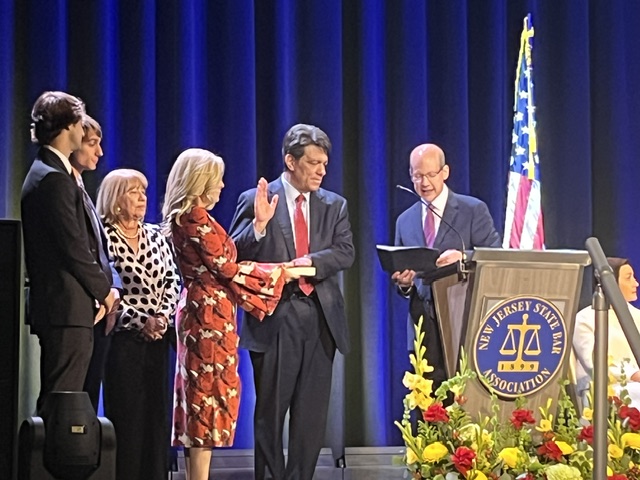

A major leadership transition inside New Jersey’s legal community is drawing statewide attention after veteran trial attorney Norberto A. Garcia was officially sworn in as president of the New Jersey State Bar Association for the 2026–2027 term, marking a historic milestone for one of the state’s most influential professional institutions.
Garcia’s installation by Stuart Rabner represents more than a ceremonial change in leadership. It signals a defining moment for the evolving identity of New Jersey’s legal profession, a profession increasingly shaped by diversity, changing demographics, expanded access to leadership opportunities, and growing conversations surrounding representation inside institutions that historically reflected narrower pathways to influence and power.
In becoming the first foreign-born president in the 126-year history of the state bar association, Garcia now occupies a position that sits at the center of New Jersey’s legal, political, and judicial ecosystem.
The moment carries symbolic significance well beyond the legal community itself.
For decades, the New Jersey State Bar Association has functioned as one of the state’s most powerful professional organizations, influencing discussions surrounding judicial appointments, legal ethics, courtroom procedure, attorney advocacy, access to justice initiatives, civil litigation reform, public policy, legal education, and the broader direction of the state’s judicial system.
Leadership within the organization often reflects larger institutional shifts occurring across New Jersey law and government.
Garcia’s rise to the presidency therefore arrives during a period of major transformation throughout both the legal profession and New Jersey itself.
The state’s attorney population has become increasingly diverse over the past generation, particularly within urban legal markets like Newark, Jersey City, Paterson, Elizabeth, and Camden. At the same time, longstanding conversations surrounding equity, professional access, mentorship, leadership representation, and institutional inclusion continue reshaping how legal organizations define both excellence and leadership.
Garcia’s career embodies many of those evolving dynamics.
A partner at the Newark-based law firm Blume Forte Fried Zerres & Molinari, Garcia built his reputation as a highly respected civil trial attorney specializing in personal injury litigation, medical malpractice matters, product liability disputes, and catastrophic accident cases. Over years of litigation practice, he became known inside New Jersey legal circles as a meticulous courtroom advocate with deep trial experience and strong institutional credibility.
His elevation to bar association president reflects not only his legal accomplishments, but also his longstanding involvement in professional leadership and legal community development throughout the state.
Before assuming the NJSBA presidency, Garcia already broke barriers by becoming the first Latino president of the New Jersey State Bar Foundation, serving from 2019 through 2021. That role positioned him at the forefront of statewide efforts surrounding legal education, public engagement, civic literacy, and professional outreach.
Now, his ascension to the state bar association presidency places him inside one of the most visible legal leadership roles in New Jersey.
The timing is especially significant given the pressures currently facing the legal profession nationwide.
Lawyers throughout New Jersey are navigating profound institutional changes involving technology disruption, artificial intelligence integration, judicial staffing shortages, rising litigation complexity, mental health concerns within the profession, escalating operational costs, shifting client expectations, and growing public skepticism toward major institutions overall.
The legal profession itself is under pressure to modernize while preserving core principles surrounding ethics, due process, fairness, and constitutional integrity.
Against that backdrop, Garcia assumes leadership at a moment when many attorneys believe the profession is entering one of its most consequential transition periods in decades.
The rise of AI-driven legal research, automation tools, digital evidence systems, virtual proceedings, cybersecurity risks, and evolving courtroom technologies are fundamentally altering legal practice itself. Younger attorneys increasingly approach the profession differently from previous generations, emphasizing work-life balance, mental health awareness, technological fluency, and broader social accountability within legal institutions.
At the same time, the legal system faces mounting public scrutiny.
Debates surrounding criminal justice reform, judicial independence, civil rights litigation, immigration policy, consumer protection, police accountability, corporate regulation, and access to affordable legal representation continue intensifying nationwide. State bar associations increasingly operate not simply as professional groups, but as influential civic institutions positioned inside larger societal debates over fairness, democracy, and institutional legitimacy.
New Jersey sits directly inside those national conversations.
The state’s legal system frequently serves as a battleground for major constitutional questions involving public policy, executive authority, environmental regulation, healthcare rights, housing disputes, labor protections, education law, and civil liberties. Attorneys practicing in New Jersey therefore operate inside one of the country’s most legally and politically dynamic environments.
Garcia’s background as a trial lawyer may prove particularly important during this moment.
Trial attorneys often occupy a unique position within the legal profession because their work centers directly on advocacy, evidence presentation, jury persuasion, accountability systems, and public-facing courtroom conflict. Personal injury and medical malpractice litigation especially involve high-stakes disputes where law, medicine, economics, institutional responsibility, and human trauma intersect intensely.
Those experiences often shape broader perspectives regarding access to justice and institutional power.
Board certification as a civil trial attorney — a distinction Garcia holds — also reflects a high level of professional recognition within New Jersey’s legal community. Certification standards are rigorous and signify advanced expertise, courtroom experience, peer recognition, and demonstrated litigation competence.
His educational background similarly reflects deep roots within both New Jersey and elite legal academia.
Garcia graduated from Seton Hall University before earning his law degree from University of Pennsylvania Carey Law School, combining regional institutional familiarity with nationally respected legal training.
That combination mirrors the trajectory of many influential New Jersey attorneys whose careers bridge local community engagement with broader national legal influence.
But the historic nature of Garcia’s presidency remains central to why his appointment is resonating so strongly this week.
New Jersey’s demographic evolution has dramatically reshaped the state over recent decades. Latino communities now represent a major and rapidly growing portion of the state’s population, workforce, educational system, business sector, and political structure. Yet leadership representation inside major institutions has often lagged behind those demographic realities.
Garcia’s installation therefore carries symbolic meaning for many attorneys and law students who see his presidency as evidence that traditional institutional barriers within elite professional spaces continue slowly changing.
Representation inside the legal profession matters because legal institutions themselves shape access to opportunity, protection, and power.
Who leads bar associations influences mentorship pathways, committee appointments, judicial recommendations, public advocacy priorities, and professional culture itself. Leadership visibility also affects how younger lawyers imagine their own professional futures inside institutions that historically may not have reflected their backgrounds or experiences.
This dynamic is especially important in New Jersey, one of the most diverse states in America.
The legal profession increasingly recognizes that maintaining public trust requires institutions capable of reflecting the communities they serve. Courts, law firms, bar associations, prosecutors’ offices, public defender systems, and legal nonprofits all face ongoing pressure to broaden leadership access and strengthen representation across the profession.
Garcia’s presidency arrives amid those larger institutional shifts.
At the same time, the legal profession remains deeply tradition-oriented.
Ceremonial transitions, judicial installations, bar leadership appointments, and professional milestones continue carrying enormous weight inside legal culture because they reinforce continuity, legitimacy, and institutional identity across generations of attorneys.
The fact that Garcia’s installation was conducted by Chief Justice Rabner further underscores the significance of the moment within New Jersey’s judicial hierarchy.
The relationship between the judiciary and organized bar leadership remains one of the most important structural partnerships inside state legal systems. Bar associations help shape attorney standards, legal education priorities, ethics conversations, judicial evaluation systems, and public confidence in the rule of law itself.
As Garcia begins his term, many within the profession will closely watch how his leadership addresses the mounting pressures facing New Jersey attorneys.
Access to justice gaps remain severe. Legal costs continue rising. Court backlogs persist in many areas. Public defenders and legal aid systems face resource strain. Mental health challenges within the profession continue generating concern. Younger lawyers increasingly seek structural reforms regarding professional sustainability and career expectations.
Technology disruption looms over all of it.
Artificial intelligence alone is expected to reshape legal research, document review, contract analysis, litigation strategy, and even courtroom procedure in ways the profession is only beginning to understand.
Against that backdrop, leadership matters enormously.
And for New Jersey’s legal community, the elevation of Norberto Garcia represents not simply a personal achievement, but a broader institutional moment — one reflecting how the state’s legal system continues evolving alongside the changing identity of New Jersey itself.