


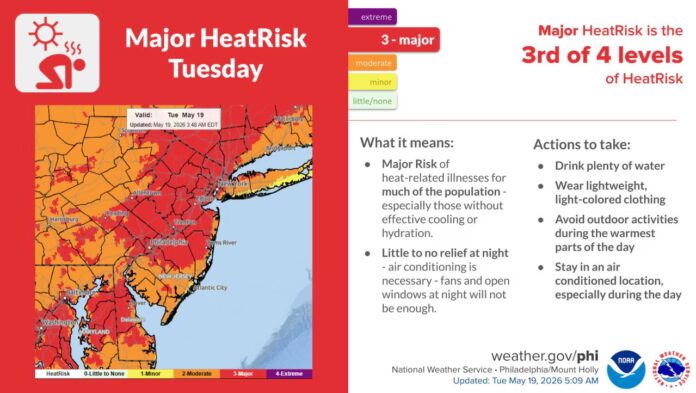

New Jersey is entering one of the most volatile and dangerous weather stretches of the year as oppressive summer-like heat surges across the state ahead of an approaching cold front expected to unleash thunderstorms, damaging wind potential, heavy downpours, lightning, and dramatic temperature swings that could send conditions crashing from near-100-degree heat into chilly, rain-soaked air within less than 48 hours.
Forecasters are warning that much of the state could experience heat index values approaching triple digits as temperatures rocket into the 90s under strengthening humidity and intense late-spring sunshine, while severe weather concerns continue building for Wednesday afternoon and evening as atmospheric instability intensifies across the Mid-Atlantic region.
The current weather pattern represents one of the strongest early-season heat surges New Jersey has seen this spring.
Heat advisories are now active across much of the state, excluding only Atlantic, Cape May, Cumberland, Salem, and Sussex counties, while air quality alerts stretch across nearly every county outside portions of the southern coastal region. Officials are warning residents that the combination of heat, humidity, stagnant air, and elevated ozone levels could create hazardous conditions, particularly for children, older adults, outdoor workers, and individuals with respiratory conditions.
The most intense heat is expected to target inland portions of New Jersey, especially the Interstate 95 urban corridor and northeastern regions where temperatures are forecast to surge into the mid- and upper-90s. Some locations could flirt with the century mark if atmospheric heating overperforms during peak afternoon hours.
At the same time, overnight temperatures are expected to remain unusually warm, with lows struggling to fall below the upper 60s and low 70s in portions of Central and South Jersey. That lack of nighttime cooling significantly increases heat stress because buildings, pavement, and urban infrastructure retain accumulated daytime warmth, limiting recovery overnight.
Several historic temperature records established during the infamous heat of 1962 are now within reach.
Newark Liberty International Airport’s record for May 19 stands at 98 degrees, while Atlantic City International Airport and Trenton Mercer Airport each hold records of 96 degrees for the same date. Meteorologists say portions of inland New Jersey may approach or challenge those long-standing marks depending on cloud cover and localized heating conditions.
The current setup is being driven by a powerful upper-level ridge positioned over the Eastern United States.
Meteorologists explain that the upper jet stream remains displaced well north of New Jersey, allowing atmospheric heights to build aggressively across the Mid-Atlantic region. At the surface, this translates into compressed hot air, mostly sunny skies, light southwest winds, and rapidly increasing humidity that together create classic early-season heatwave conditions.
The result feels far more like July than mid-May.
Monday already delivered widespread low-to-mid 90s across much of inland New Jersey, while Tuesday is expected to intensify the heat further. Even traditionally cooler coastal zones are expected to push into the lower 80s, although the immediate Jersey Shore will remain significantly cooler than inland areas because of ocean temperatures still trapped in the 50s.
That coastal moderation once again highlights one of New Jersey’s defining meteorological characteristics.
Few states experience such dramatic weather contrasts across relatively short geographic distances. While inland communities swelter under dangerous heat, shore communities may remain 10 to 20 degrees cooler thanks to the Atlantic Ocean’s lingering spring chill and the development of marine air layers.
But meteorologists warn that the heat itself is only the first phase of a much more unstable weather sequence now unfolding.
As the upper jet stream begins dipping southward on Wednesday, a powerful stormfront is expected to move directly through the region, colliding with the hot and moisture-rich atmosphere now building over the state. That collision could trigger scattered thunderstorms capable of producing damaging wind gusts, intense lightning, localized flooding downpours, and isolated hail.
The most favorable severe weather dynamics are expected farther west of New Jersey, but forecasters stress that portions of western and central New Jersey could still experience isolated severe thunderstorm development during Wednesday afternoon and evening.
Meteorologists are emphasizing that while the marine layer may weaken storms approaching the coast, that protection is not guaranteed for all areas.
Communities across North Jersey, western counties, and portions of Central Jersey remain vulnerable to rapidly intensifying storms capable of producing dangerous conditions with little warning. Atmospheric instability created by the extreme heat and humidity will provide ample fuel for thunderstorm development once the cold front begins interacting with the region.
The timing of the storms also raises concerns.
Afternoon and evening thunderstorm development could impact commuters, outdoor activities, schools, athletic events, and early Memorial Day travel movement throughout portions of the state. Some districts have already announced early dismissals due to the heat, while emergency management officials continue urging residents to monitor forecasts closely as conditions evolve.
The combination of severe heat and storm potential reflects an increasingly erratic spring weather pattern that has become more common throughout New Jersey in recent years.
Rapid transitions between extreme warmth, severe thunderstorms, sharp cool-downs, and extended rain periods are becoming increasingly frequent as seasonal boundaries fluctuate more aggressively across the Northeast. Residents are now routinely experiencing compressed weather cycles where summer, spring, and even autumn-like conditions can unfold within the same week.
And once the front passes, New Jersey’s atmosphere is expected to shift dramatically yet again.
By Thursday, temperatures are forecast to collapse into the low-to-mid 70s statewide, with coastal communities potentially remaining in the upper 60s under much more comfortable humidity levels. Winds will shift northwesterly behind the departing front, bringing significantly drier and more stable air into the region.
The relief, however, may be short-lived.
By Friday and through much of Memorial Day weekend, temperatures are expected to remain trapped primarily in the 60s while waves of rain and cloud cover move across the state. Forecasters currently expect Saturday to be the wettest day of the upcoming holiday weekend, although Sunday may also feature periodic showers and generally unsettled conditions.
The cooler weather could become especially disappointing for outdoor tourism interests, shore destinations, campground operators, festival organizers, and hospitality businesses that typically depend heavily on Memorial Day weekend as the unofficial start of the summer tourism season.
Still, meteorologists stress that the weekend does not currently appear to be a total washout.
Instead, conditions may feature periods of on-and-off rain beneath mostly cloudy skies, interrupted occasionally by drier stretches depending on how the stalled frontal boundary ultimately behaves offshore.
Looking beyond the holiday weekend, forecasters are cautiously optimistic that a more stable pattern may begin emerging by the final week of May.
A more zonal atmospheric flow could return temperatures to the 70s while reducing the intensity of extreme swings temporarily. Meteorologists currently expect another prolonged stretch of pleasant spring weather after Memorial Day before the next major heatwave potentially develops near the transition into June.
But for now, New Jersey residents are being forced to navigate one of the state’s most chaotic seasonal transitions in recent memory.
Extreme heat, poor air quality, oppressive humidity, dangerous thunderstorms, dramatic cooldowns, and holiday rain threats are all unfolding almost simultaneously as the atmosphere struggles to settle into a stable late-spring pattern.
The current setup is also a powerful reminder of how quickly weather conditions can change across New Jersey.
Within a matter of days, residents may go from near-record heat and dangerous humidity to temperatures in the 60s beneath cloudy skies and cold rain. It is a volatility unique to the Mid-Atlantic and Northeast climate system, where competing continental and marine air masses constantly battle for dominance during transitional seasons.
For now, emergency officials and meteorologists continue urging residents to take the heat seriously.
Hydration, limiting outdoor activity during peak afternoon hours, checking on vulnerable neighbors, monitoring air quality conditions, and remaining alert for rapidly changing weather Wednesday afternoon could all become critical over the next several days.
Because while summer may not officially arrive for another month, New Jersey’s atmosphere is already delivering a powerful preview of just how intense the 2026 warm-weather season may become.



