


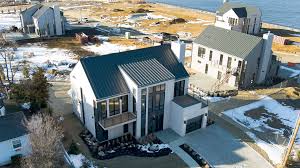

New Jersey is experiencing its most aggressive housing expansion in more than 30 years, a development surge that is rapidly transforming skylines, suburban corridors, waterfront districts, commuter communities, and demographic patterns across the state while redefining how and where residents live, work, invest, retire, and build wealth in one of America’s most densely populated regions.
According to a major new housing analysis tied to the 42nd edition of the Rutgers Regional Report, New Jersey constructed an average of 36,596 homes annually between 2020 and 2024 — the fastest pace of residential development the state has seen in three decades. The remarkable surge was driven overwhelmingly by explosive activity in Hudson County, Ocean County, and Bergen County, which together became the epicenter of a housing transformation reshaping the state’s economy, demographics, infrastructure systems, and long-term development trajectory.
The report, authored by James W. Hughes and Connie Hughes through the Edward J. Bloustein School of Planning and Public Policy, paints a picture of a state undergoing one of the most consequential real estate and migration shifts in modern New Jersey history.
“The scale of development in the 2020s was a bit surprising,” Hughes observed, a statement that reflects just how dramatically New Jersey’s housing landscape has accelerated in the post-pandemic era.
But beneath the numbers lies a much larger story.
This is not simply a construction boom.
It is a structural reshaping of how New Jersey functions economically, socially, geographically, and politically as changing migration patterns, remote work flexibility, generational lifestyle preferences, religious community expansion, luxury development, infrastructure reuse, and metropolitan spillover pressures converge simultaneously across the state.
No county illustrates that transformation more dramatically than Hudson County.
Long viewed as New Jersey’s urban gateway to Manhattan, Hudson County added an extraordinary 5,777 housing units annually between 2020 and 2024, cementing its position as the dominant engine of residential growth statewide. Cities like Jersey City, Hoboken, Bayonne, and surrounding waterfront communities continue evolving into high-density mixed-use environments increasingly defined by luxury residential towers, converted industrial properties, transit-oriented development, and integrated live-work-play ecosystems.
The rise of Hudson County reflects a broader generational shift that has been building for years but accelerated sharply during and after the pandemic.
Millennials, particularly those leaving New York City, increasingly sought communities offering urban energy without Manhattan-level costs while still preserving direct access to employment centers, transportation networks, entertainment districts, and waterfront lifestyles. Developers responded aggressively by converting former warehouses, factories, shipping facilities, and industrial sites into residential towers and apartment complexes supported by existing infrastructure systems.
This adaptive reuse model became one of the defining development stories of modern New Jersey.
Rather than pushing entirely outward into undeveloped territory, much of the state’s housing boom emerged through the reinvention of previously industrialized urban corridors already equipped with utilities, transportation access, and public infrastructure capacity.
That dynamic helped fuel Jersey City’s extraordinary evolution from industrial port city into one of the Northeast’s most aggressively expanding residential and financial centers.
At the same time, Ocean County experienced a very different — but equally powerful — housing surge.
Ocean County added nearly 4,000 housing units annually during the same period, driven largely by two enormous demographic forces: the continued expansion of Orthodox Jewish communities and the explosive growth of active adult and retirement housing developments.
The county now contains 93 separate 55-and-over communities encompassing more than 62,000 housing units, creating one of the most concentrated retirement development markets in the region. Simultaneously, towns throughout portions of Lakewood and surrounding communities have experienced rapid population growth tied to expanding Orthodox Jewish residential demand.
Those developments have fundamentally altered the county’s economic and demographic landscape.
Retail infrastructure, school systems, transportation patterns, healthcare demand, religious institutions, and commercial development throughout portions of Ocean County increasingly reflect the needs of rapidly growing family-oriented and retirement-oriented populations simultaneously.
Real estate professionals describe the county’s appeal as uniquely positioned between suburban affordability, community continuity, and expanding support infrastructure.
Unlike isolated exurban development zones requiring entirely new community ecosystems from scratch, portions of Ocean County already possessed the institutional framework — including schools, religious services, kosher markets, healthcare systems, and family networks — necessary to sustain accelerated growth organically.
That community continuity became especially attractive during the pandemic-era migration wave.
As residents fled denser urban apartment environments in Brooklyn, Manhattan, and other high-cost metropolitan zones, many sought suburban communities capable of offering more space, stronger communal structures, and long-term housing flexibility while remaining within reach of larger metropolitan economies.
Meanwhile, Bergen County’s housing growth reflected yet another distinct New Jersey development pattern: luxury suburban reinvention tied to New York City proximity.
Bergen County added approximately 3,648 housing units annually during the five-year period, fueled by intense redevelopment activity in communities including Hackensack, Edgewater, and Fort Lee.
The county’s proximity to Manhattan remains one of the strongest real estate drivers in the Northeast.
Developers increasingly demolished older residential properties to construct larger luxury homes and higher-density developments targeting affluent buyers seeking suburban prestige combined with direct metropolitan access. Luxury property values surged accordingly, with upscale communities continuing to establish new pricing benchmarks across the region.
One recent Englewood Cliffs sale reportedly reached $5.4 million for an 11,000-square-foot residence, underscoring how dramatically the upper end of Bergen County’s housing market continues appreciating.
This divergence between urban density growth, suburban luxury expansion, and community-centered residential development reveals how multifaceted New Jersey’s housing surge has become.
The state is not experiencing a single housing boom.
It is experiencing several overlapping housing transformations simultaneously.
Urban redevelopment dominates Hudson County. Community-driven expansion shapes Ocean County. Luxury suburban reinvention defines portions of Bergen County. Together, they reflect broader national trends reshaping metropolitan America after the pandemic.
Remote and hybrid work arrangements accelerated these shifts enormously.
Many younger professionals realized they no longer needed to remain physically tethered to Manhattan offices five days a week. That flexibility allowed thousands of residents to reconsider housing priorities entirely, prioritizing larger homes, outdoor space, community environments, schools, and quality-of-life considerations over ultra-close proximity to office towers.
New Jersey became one of the largest beneficiaries of that recalibration.
The state’s geographic position — wedged between New York City and Philadelphia while offering extensive commuter infrastructure, suburban inventory, waterfront access, and relatively diverse housing options — made it uniquely positioned to absorb pandemic-era migration flows.
The timing also mattered economically.
New Jersey has now avoided a major recession for approximately 15 years, creating one of the longest sustained economic expansion periods supporting residential development in recent state history. That stability helped maintain construction momentum even amid broader national uncertainty.
The contrast with the aftermath of the 2008 financial crisis is particularly striking.
New home production collapsed to just over 12,000 units during the Great Recession, a fraction of today’s construction pace. The current cycle therefore represents not merely recovery, but a dramatic reversal fueled by demographic pressure, migration demand, and prolonged economic expansion.
Still, the housing boom is also generating mounting concerns.
Infrastructure strain, traffic congestion, school overcrowding, environmental stress, affordability challenges, stormwater management pressures, utility capacity demands, and political battles over zoning and density continue intensifying throughout many fast-growing regions of the state.
Communities across New Jersey increasingly find themselves divided between residents welcoming economic growth and others fearing overdevelopment, congestion, displacement, and changing neighborhood character.
Affordable housing obligations remain especially contentious.
As luxury construction accelerates in many areas, state and local governments continue wrestling with how to balance market-rate development with affordability mandates and broader housing accessibility concerns. The state’s longstanding housing shortage remains unresolved even amid elevated construction levels because demand continues outpacing supply across many markets.
Climate resilience also looms over future development patterns.
Much of New Jersey’s housing expansion is occurring in coastal or flood-sensitive regions increasingly vulnerable to rising sea levels, severe storms, heat events, and infrastructure stress tied to climate change. Future development decisions will likely become more deeply intertwined with environmental adaptation and resiliency planning.
Yet despite those challenges, the overall direction remains unmistakable.
New Jersey is undergoing one of the largest residential development surges in modern state history, driven by generational migration shifts, evolving work patterns, changing family structures, demographic expansion, and the enduring economic gravitational pull of the New York metropolitan region.
Hudson, Ocean, and Bergen counties now stand at the center of that transformation.
And together, they are redefining not only where New Jersey residents live, but what the future identity of the state itself may ultimately become.



