


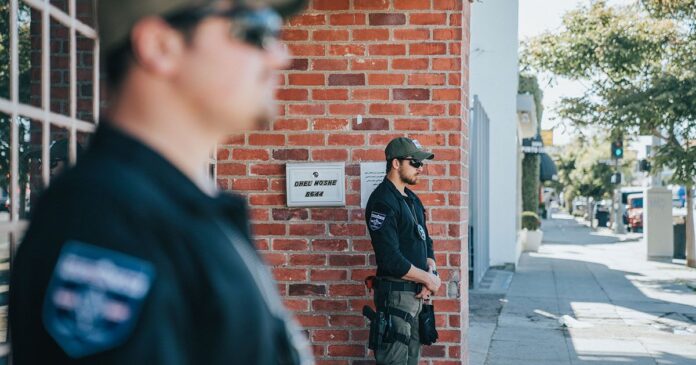

Across New Jersey, synagogues and Jewish community institutions are undergoing a profound and costly transformation—one driven not by expansion or modernization in the traditional sense, but by the urgent need to protect congregants in an era defined by heightened threat awareness. What was once a background consideration has now become a central operational priority, as religious institutions commit millions of dollars annually to security infrastructure, personnel, and technology in response to a sustained rise in antisemitic incidents both locally and nationally.
This shift is not theoretical. It is measurable, visible, and deeply embedded in the day-to-day realities of congregational life. From Bergen County to Central Jersey and down through the southern part of the state, synagogues are reconfiguring their physical spaces and financial priorities to meet a new standard of vigilance. The result is a layered security environment that reflects both the seriousness of the threat landscape and the growing expectation that houses of worship must now function with the same level of preparedness as other high-risk public venues.
At the institutional level, the financial impact is substantial. Individual congregations are allocating significant portions of their annual budgets to security-related expenses, in some cases exceeding 15 percent of total operating costs. For many, this translates into hundreds of thousands of dollars each year dedicated solely to safeguarding facilities and the people within them. On a national scale, Jewish organizations are collectively investing hundreds of millions annually in protective measures, underscoring the breadth of the response and the scale of the challenge.
In New Jersey, these expenditures are being directed toward a comprehensive, multi-layered approach to security. Personnel remains a critical component, with many institutions employing trained security professionals, including retired law enforcement officers and armed guards, to maintain a visible and immediate presence during services, events, and school operations. These roles are not symbolic; they are integral to response readiness, often serving as the first line of defense in the event of an incident.
Technology is playing an equally significant role. Advanced surveillance systems, including AI-enabled cameras capable of real-time monitoring and threat detection, are being deployed alongside integrated alarm networks, panic buttons, and communication systems designed to connect directly with local law enforcement. These tools are transforming how institutions monitor their environments, shifting from passive observation to active threat identification and response coordination.
Physical infrastructure is also being reimagined. Traffic bollards and reinforced entry points are now common features, designed to prevent vehicular attacks and control access to facilities. Bullet-resistant glass, secure vestibules, and controlled entry systems are becoming standard, reflecting a broader trend toward “hardening” spaces that were historically designed to be open and welcoming. These modifications, while effective from a security standpoint, represent a fundamental change in how these institutions present themselves to their communities.
The cultural implications of this transformation are significant. Rabbis and community leaders have openly acknowledged the tension between maintaining a welcoming environment and implementing measures that can create a more fortified, controlled atmosphere. The concept of a house of worship as an open, accessible space is being redefined in real time, as safety considerations necessitate new protocols for entry, monitoring, and engagement. For many congregants, this shift is both reassuring and sobering—a reflection of the realities that now shape communal life.
To manage the financial burden, New Jersey institutions are relying on a combination of state, federal, and private funding sources. State-level support has been directed toward coordinated security initiatives, including funding allocations that assist Jewish federations in strengthening regional safety networks. At the federal level, programs designed to support nonprofit security enhancements have become a critical resource, providing grants that help offset the costs of equipment, training, and personnel.
Advocacy efforts are intensifying as demand for these funds continues to outpace availability. Policymakers representing New Jersey have been active in pushing for increased federal investment in nonprofit security programs, recognizing that the current funding structure is insufficient to meet the growing needs of at-risk communities. This push reflects a broader acknowledgment that security for religious and cultural institutions is not a localized issue, but a national priority requiring sustained attention and resources.
Regional organizations are also playing a pivotal role. Jewish federations across the state have facilitated access to millions of dollars in grant funding, enabling institutions to implement critical upgrades and participate in advanced training programs, including active shooter preparedness and emergency response coordination. These networks are not only financial conduits but also strategic partners, helping to standardize best practices and ensure that institutions are equipped with both the tools and knowledge necessary to respond effectively to emerging threats.
Private philanthropy has emerged as another key component of this ecosystem. Dedicated security funds have been established to provide targeted support for communal spaces, including early childhood centers and educational facilities, which face unique vulnerabilities. These contributions are helping to bridge gaps in public funding and accelerate the implementation of protective measures across a wider range of institutions.
The broader context for this surge in security investment is the rising number of antisemitic incidents reported across the country. High-profile attacks, including those targeting places of worship, have reinforced the urgency of proactive measures. In New Jersey, where Jewish communities are deeply rooted and widely distributed, the response has been both immediate and comprehensive, reflecting a collective commitment to safety and resilience.
Coverage within the state’s law and order reporting continues to highlight how these developments intersect with broader public safety strategies. The integration of advanced technology, coordinated funding, and inter-agency collaboration is not unique to Jewish institutions, but the scale and immediacy of the response within this community have positioned it at the forefront of a wider shift in how vulnerable populations approach security.
What is unfolding in New Jersey is not a temporary adjustment. It is a structural evolution in how religious institutions operate, allocate resources, and engage with their communities. The investments being made today are shaping a new standard for safety—one that prioritizes preparedness without losing sight of the values that define these spaces.
As synagogues and community centers continue to adapt, the balance between openness and security will remain a central consideration. The challenge is not only to protect, but to preserve the sense of connection and belonging that these institutions represent. In meeting that challenge, New Jersey’s Jewish communities are demonstrating a level of resilience and adaptability that extends beyond physical infrastructure, reflecting a commitment to continuity in the face of changing realities.
The result is a landscape where security is no longer an auxiliary function, but a core component of institutional identity. It is a shift that carries financial weight, operational complexity, and cultural significance—and one that will continue to shape the future of community life across the state.