


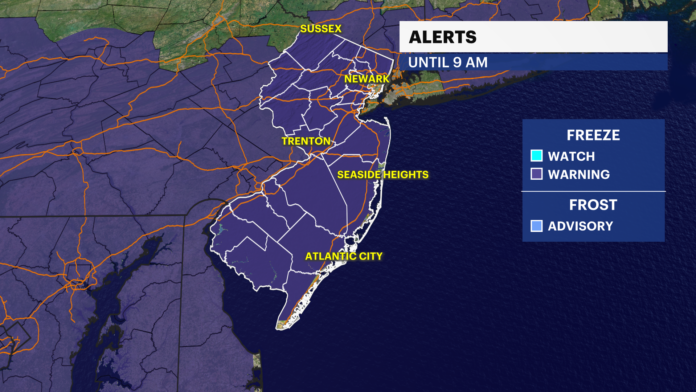

New Jersey is waking up to a sharp and telling reminder that April remains one of the most volatile months on the regional weather calendar, as a frigid start to the week has given way to bright skies, cool daytime temperatures, and a forecast that is already pivoting toward a dramatic warmup. Across the state, conditions this morning reflect the tail end of a cold air mass that pushed overnight temperatures dangerously close to record lows, triggering Freeze Warnings in multiple regions and forcing residents, businesses, and agricultural operators to take precautionary measures rarely associated with late April.
By mid-morning Tuesday, the state has stabilized under mostly sunny skies, but the lingering chill remains evident. Temperatures hovering around 40 degrees are accompanied by a “feels like” reading in the upper 30s due to light northerly winds, reinforcing the presence of cold air still anchored near the surface. Humidity levels remain notably low, contributing to crisp visibility and dry conditions that, while visually appealing, underscore the abrupt drop from the near-spring warmth experienced just days earlier.
The broader significance of this cold snap is not limited to isolated readings. It reflects a classic trough-dominated pattern in the atmosphere, where lower geopotential heights allow colder air from higher latitudes to settle over the region. This setup has not only driven temperatures downward but has also introduced instability in the upper levels of the atmosphere, resulting in scattered showers capable of producing small hail—an occurrence that can easily be mistaken for sleet but is instead tied to convective activity within colder air aloft. While not indicative of severe weather, this pattern has added complexity to an already dynamic forecast.
As the day progresses, conditions across New Jersey are expected to remain stable but cool. Afternoon highs will struggle into the mid-50s, with abundant sunshine dominating the sky through most of the day. By early evening, a gradual increase in cloud cover will begin to signal the next transition phase, as moisture starts to return ahead of an approaching system that will bring scattered showers late tonight and into Wednesday morning.
Regionally, the temperature profile remains consistent but slightly varied based on geography. In North and Central Jersey, including urban corridors such as Newark and New Brunswick, highs are expected to peak between 54 and 56 degrees under clear skies. South Jersey and coastal communities will see a similar but slightly more moderate range, with Atlantic City holding near the mid-50s and inland areas such as Cherry Hill pushing closer to the upper 50s. These differences, while subtle, reflect the influence of both elevation and proximity to the Atlantic, which continues to act as a stabilizing factor even during colder periods.
The real story, however, lies in what comes next. This cold pattern is already in the process of breaking down, with the atmospheric trough expected to exit the region by Wednesday morning. As it does, New Jersey will begin transitioning into a more favorable setup characterized by rising heights and the development of a ridge. This shift will allow warmer air to advance into the state, setting the stage for a rapid and noticeable increase in temperatures.
Wednesday itself will serve as a transitional day. After a cold start with lingering clouds and the potential for early showers, conditions are expected to improve steadily through the afternoon, with highs approaching 60 degrees. By Thursday, the change becomes unmistakable. Temperatures will surge into the low to mid-70s across much of the state, delivering what can best be described as a true spring reset. Away from the coastline, inland areas will experience the full effect of this warmup, while coastal regions will remain slightly cooler due to marine influence, generally holding in the upper 60s.
Friday continues this trend, with sustained warmth and a comfortable atmospheric profile that combines mild temperatures, light winds, and intervals of sunshine. These conditions represent a temporary but welcome stabilization in what has otherwise been a highly variable weather pattern. For residents and businesses alike, Thursday and Friday are shaping up to be the most favorable days of the week, offering a window of consistency before the next shift arrives.
Looking ahead to the weekend, the pattern begins to flatten into a more zonal flow, allowing cooler air from the west and northwest to re-enter the region. This will bring temperatures back down into the upper 50s to near 60 degrees, accompanied by increased cloud cover and intermittent showers. While not expected to produce severe conditions, the unsettled nature of the weekend forecast reinforces the broader theme of variability that has defined this stretch of April weather.
This sequence of rapid transitions—from freeze warnings and near-record lows to a midweek surge into the 70s—illustrates the dynamic nature of springtime meteorology in the Mid-Atlantic. It is a period where competing air masses frequently collide, and where temperature swings of 20 to 30 degrees within a matter of days are not only possible but increasingly common.
Ongoing coverage within the state’s weather reporting continues to emphasize the importance of monitoring these rapid changes, particularly for sectors that are directly impacted by temperature variability. Agriculture, construction, transportation, and outdoor commerce all operate within narrow environmental margins, and shifts like those seen this week can influence everything from crop protection strategies to project timelines and consumer activity.
For New Jersey residents, the immediate takeaway is one of preparation and adaptability. The cold start to the week serves as a reminder that winter’s influence has not fully retreated, even as the calendar advances. At the same time, the imminent warmup offers a glimpse of the more stable conditions that lie ahead as the region moves deeper into spring.
What this week ultimately represents is a microcosm of the season itself—unpredictable, transitional, and constantly evolving. New Jersey’s weather is not simply changing; it is recalibrating in real time, moving from one atmospheric regime to another with remarkable speed. For those watching closely, it is a clear indication that the state is on the threshold of a more sustained seasonal shift, even if a few final fluctuations remain before that transition is complete.