


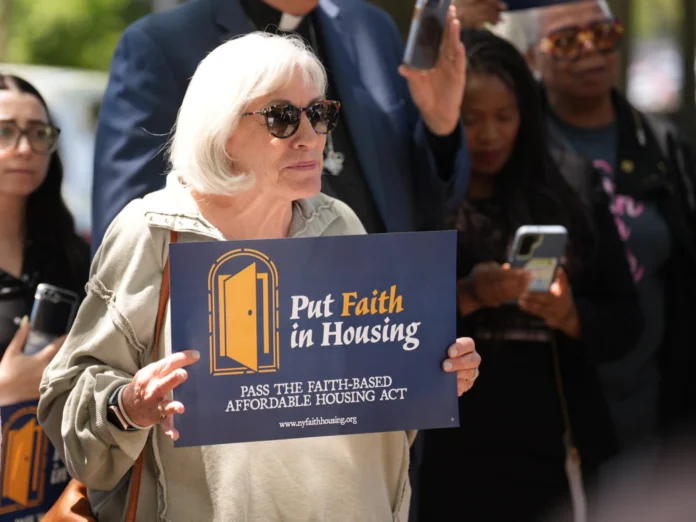

New Jersey’s housing market has reached a level of structural imbalance that policymakers are now openly defining as unsustainable, with a deficit of more than 200,000 affordable homes driving up costs, displacing residents, and reshaping the long-term economic outlook of the state. In response, a new legislative proposal is advancing a targeted but potentially high-impact solution—unlocking underutilized land owned by faith-based institutions and nonprofit organizations to accelerate the development of inclusionary housing across local communities.
The scale of the challenge is no longer abstract. Rising rents, limited housing inventory, and escalating home prices have converged into a system where affordability is increasingly out of reach for working families, first-time buyers, and even long-established residents. In many cases, households are now allocating more than half of their income to housing-related expenses, a threshold that economists widely recognize as a marker of financial instability. The result is not only personal strain but also broader economic consequences, including reduced consumer spending, workforce displacement, and diminished regional competitiveness.
Against this backdrop, the proposed legislation introduces a framework that seeks to convert a largely overlooked asset into a meaningful part of the housing solution. Across New Jersey, houses of worship and nonprofit institutions collectively hold significant parcels of land, much of which remains underutilized relative to its potential. These properties, often located within established communities and near existing infrastructure, represent a unique opportunity to develop housing without the need for large-scale land acquisition or disruptive rezoning initiatives.
The legislative approach is structured to enable these organizations to develop portions of their land into inclusionary housing, with clear requirements to ensure that affordability remains central to the outcome. Under the proposal, at least 20 percent of units within any qualifying development would be designated for very low-, low-, or moderate-income households. This requirement is designed to maintain a balance between market-rate viability and community-focused affordability, ensuring that projects contribute directly to addressing the state’s housing gap.
Importantly, the framework does not bypass local governance. Municipal planning boards would retain full authority over site-plan approvals, including assessments of traffic flow, environmental impact, infrastructure capacity, and emergency access. This preservation of local oversight is a critical component of the proposal, addressing concerns that accelerated development could come at the expense of community standards or long-term planning objectives. Instead, the legislation is positioned as a mechanism to remove procedural bottlenecks rather than eliminate regulatory safeguards.
The timing of this initiative aligns with broader conversations taking place during Fair Housing Month, as policymakers, advocates, and community leaders reflect on the legacy and ongoing relevance of the Fair Housing Act. While the original legislation focused on eliminating discriminatory practices, today’s challenges are increasingly centered on availability and access. The question is no longer solely about who can access housing, but whether sufficient housing exists to meet demand in the first place.
Faith-based and nonprofit organizations are uniquely positioned within this context. Many already operate as service providers within their communities, offering food assistance, shelter programs, and other forms of support to residents facing economic hardship. Expanding their role into housing development represents a natural extension of these missions, allowing them to address root causes rather than symptoms. By enabling these institutions to leverage their existing assets, the state can foster a more distributed and community-driven approach to housing development.
From a real estate and development perspective, the proposal introduces a model that could significantly alter how projects are initiated and executed across New Jersey. Traditional development pipelines often involve lengthy approval timelines, complex financing structures, and high upfront costs associated with land acquisition. By contrast, projects originating from faith-based or nonprofit land holdings may benefit from reduced initial costs and stronger community alignment, potentially accelerating timelines and improving feasibility.
This approach also reflects a broader trend toward adaptive land use, where existing properties are reimagined to meet evolving societal needs. In a state as densely populated as New Jersey, where available land is both limited and expensive, the ability to repurpose underutilized space is a critical advantage. It allows for incremental growth that integrates into existing neighborhoods rather than relying solely on large-scale, ground-up developments.
Coverage across the Real Estate section of Sunset Daily News continues to highlight how policy, market forces, and community initiatives are intersecting to shape the future of housing in the state. This latest legislative effort stands out as a particularly targeted intervention, focusing on a specific category of land ownership that has historically been excluded from mainstream development strategies.
The potential impact of this policy extends beyond the immediate creation of housing units. By enabling development within established communities, it can help stabilize neighborhoods, support local economies, and reduce the displacement pressures that often accompany housing shortages. For younger residents, it may provide a pathway to remain in the state rather than relocating in search of more affordable options. For seniors, it can create opportunities to downsize within their communities while maintaining access to familiar services and support networks.
At the same time, the proposal raises important considerations about implementation. The success of such initiatives will depend on effective coordination between state agencies, local governments, and the organizations themselves. Financing mechanisms, construction capacity, and long-term property management will all play critical roles in determining whether these projects can be delivered at scale and sustained over time.
What is clear is that the status quo is no longer sufficient. The magnitude of New Jersey’s housing shortage demands solutions that are both innovative and practical, capable of leveraging existing resources while navigating the complexities of local governance and market dynamics. By turning attention to land that already exists within communities and aligning it with a clear policy framework, this legislation offers a pathway that is both grounded and forward-looking.
As the state continues to grapple with rising costs and limited supply, the conversation around housing is shifting from incremental adjustments to systemic change. The integration of faith-based and nonprofit land into the development equation represents one of the more tangible strategies currently under consideration, with the potential to reshape how New Jersey approaches one of its most pressing challenges.