


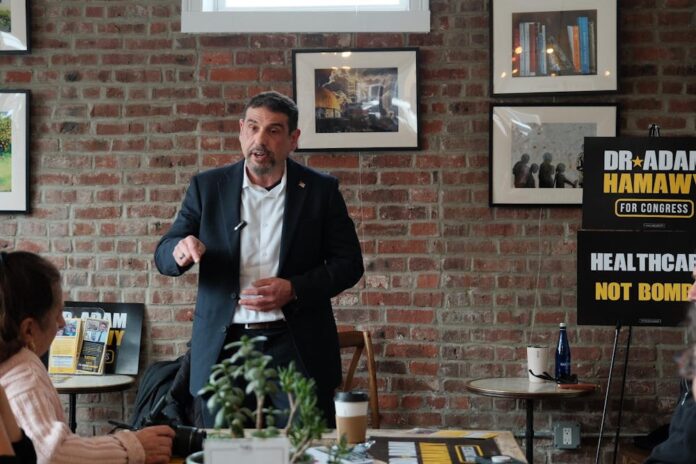

A significant development has reshaped the political landscape in New Jersey, as Bernie Sanders formally endorsed Adam Hamawy in the race for the state’s 12th Congressional District. The endorsement introduces national progressive weight into a competitive primary and signals a strategic alignment between one of the country’s most influential political figures and a candidate whose campaign is built on healthcare reform, economic equity, and a redefinition of federal priorities.
Sanders’ endorsement carries more than symbolic value. As a central architect of the modern progressive movement, his support has historically translated into increased visibility, grassroots mobilization, and fundraising acceleration. In backing Hamawy, Sanders framed the candidate as a leader shaped by direct experience in both crisis response and public service, highlighting a career that spans emergency medicine, military service, and humanitarian work in conflict zones.
Hamawy’s professional narrative is central to his campaign positioning. A physician and combat trauma surgeon, he has operated in some of the most challenging environments imaginable, including deployments in Iraq and medical missions in areas impacted by conflict and disaster. His work as a 9/11 first responder and his continued service in emergency rooms across New Jersey provide a foundation for his policy priorities, particularly his advocacy for systemic healthcare reform. For Hamawy, healthcare is not an abstract policy debate but a firsthand reality shaped by years of treating patients under pressure.
That perspective informs one of the campaign’s central pillars: support for a universal healthcare framework commonly referred to as Medicare for All. Hamawy’s alignment with Sanders on this issue reflects a broader effort to position the campaign within a progressive policy framework that emphasizes access, affordability, and structural reform. The argument is straightforward yet ambitious—healthcare should function as a guaranteed right rather than a market-driven commodity, a stance that continues to resonate within segments of the electorate seeking comprehensive change.
Beyond healthcare, the campaign’s platform extends into economic and political reform. Hamawy has articulated support for campaign finance restructuring aimed at reducing the influence of large-scale donors and corporate interests in federal elections. This position aligns with a growing concern among voters about the role of money in politics and the perceived imbalance it creates in representation. By advocating for systemic changes, the campaign is attempting to address both policy outcomes and the mechanisms through which those outcomes are determined.
Foreign policy also occupies a prominent place in Hamawy’s platform. Drawing on his military background, he has emphasized a shift away from prolonged military engagements, advocating instead for a more measured and strategic approach to international conflict. This perspective reflects a broader debate within national politics about the role of the United States on the global stage and the balance between defense commitments and domestic priorities.
The endorsement from Sanders is reinforced by a coalition of progressive organizations and political figures, creating a network of support that extends beyond New Jersey. Hamawy has secured backing from groups such as Justice Democrats and Our Revolution, along with endorsements from members of Congress and national advocacy organizations. This coalition provides both organizational infrastructure and ideological alignment, positioning the campaign within a broader movement that is actively shaping the direction of the Democratic Party.
Fundraising and organizational metrics further illustrate the campaign’s momentum. Hamawy has reported leading fundraising totals within the field, coupled with a strong showing in petition submissions required for ballot qualification. These indicators suggest a campaign that is not only ideologically aligned with progressive priorities but also operationally prepared to compete in a demanding electoral environment.
The 12th Congressional District itself represents a complex and dynamic political landscape. Anchored by communities such as Princeton and surrounding regions, the district encompasses a mix of academic, suburban, and professional populations. Voters in this area have historically demonstrated engagement with both policy substance and candidate credentials, making the race particularly sensitive to issues of experience, credibility, and vision.
Hamawy’s campaign is leveraging this context by emphasizing a combination of professional expertise and local connection. Having built a medical practice in the Princeton area while maintaining ties to the community where he was raised, he presents himself as both an insider to the district and an outsider to traditional political pathways. This dual positioning is designed to appeal to voters seeking both familiarity and change—a balance that has become increasingly important in contemporary elections.
The broader political implications of Sanders’ endorsement extend beyond the immediate race. It signals an ongoing effort to elevate candidates who align with a progressive agenda focused on structural reform, economic equity, and expanded public services. At the same time, it introduces a national dimension to what might otherwise be a localized contest, bringing additional scrutiny and attention to the district.
Within the evolving Sunset Daily News political landscape, the endorsement highlights a key trend shaping the 2026 election cycle: the intersection of national movements with local races. Candidates are no longer operating in isolation; they are part of broader coalitions that influence messaging, strategy, and voter engagement. This interconnected dynamic is redefining how campaigns are conducted and how outcomes are determined.
As the primary approaches, the race in New Jersey’s 12th District is expected to intensify, with candidates competing not only on policy positions but on their ability to mobilize support and articulate a compelling vision for representation. Sanders’ endorsement provides Hamawy with a significant platform from which to advance his campaign, but it also raises the stakes, placing greater emphasis on execution and voter engagement.
For voters across New Jersey, the decision will ultimately hinge on how these elements come together—experience, policy, and the capacity to deliver results in a complex and often divided political environment. Hamawy’s campaign, now bolstered by one of the most prominent endorsements in American politics, is positioned to play a central role in that decision-making process, shaping not only the outcome of the primary but the broader conversation about the future direction of representation in the district.