


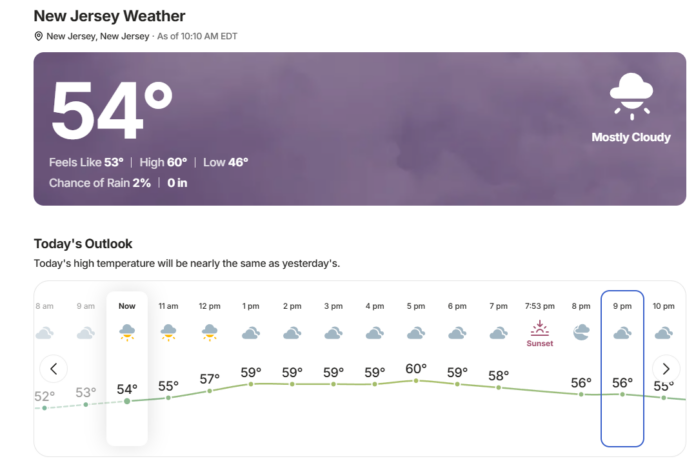

New Jersey’s early May weather pattern is delivering a clear signal to residents, businesses, and seasonal industries alike: volatility is defining the spring transition. Across New Jersey, a cool and mostly overcast Saturday has settled in, with temperatures hovering in the mid-50s under persistent cloud cover and elevated humidity. While conditions remain relatively calm, the broader forecast reveals a dynamic and shifting atmospheric pattern that will carry the state from below-average temperatures into a rapid warming cycle—and back again—over the coming days.
Current Conditions (10:10 AM):
Hourly Forecast for Today, May 2
| Hour [1, 2, 3, 4, 5] | Sky Condition | Temperature | Chance of Rain |
|---|---|---|---|
| 11 AM | 56°F | 20% | |
| 12 PM | 57°F | 20% | |
| 2 PM – 4 PM | 59°F – 60°F | 10% | |
| 6 PM | 59°F | 10% | |
| 10 PM | 50°F | 10% |
Daily Forecast
| Day [1, 2, 3, 4, 5] | Sky Condition | Temperature | Chance of Rain |
|---|---|---|---|
| Sat, May 2 | 60°F / 42°F | 20% | |
| Sun, May 3 | 59°F / 43°F | 10% | |
| Mon, May 4 | 72°F / 49°F | 10% | |
| Tue, May 5 | 84°F / 56°F | 10% |
As of mid-morning, temperatures are registering around 55 degrees, with a “feels like” reading closer to 51 due to light northwest winds. Humidity levels remain moderately high, contributing to the damp, subdued feel across much of the state. Cloud cover is widespread, and while rainfall is expected to remain light and intermittent, the potential for scattered showers throughout the afternoon introduces just enough instability to keep outdoor plans uncertain.
Through the midday hours, brief pockets of light rain are possible, particularly between late morning and early afternoon, before conditions stabilize into a mostly cloudy pattern. Temperatures are expected to peak near 60 degrees, a modest high that reflects the influence of a broader trough system dominating the northeastern United States. By evening, skies remain overcast, and temperatures begin a gradual decline, setting the stage for a notably cooler overnight period.
What makes this stretch of weather particularly significant is not any single day’s forecast, but the larger atmospheric structure shaping the region. A series of flat troughs—broad, low-pressure systems moving across the Northeast—are establishing a pattern of alternating cool and warm phases. This setup creates a “roller coaster” effect in temperature trends, where brief surges of warmth are followed by rapid returns to cooler conditions. For New Jersey, that means the current stretch of subdued weather is only the beginning of a more dynamic sequence.
Saturday night is expected to bring one of the more pronounced temperature drops of the period. As cloud cover begins to thin and any remaining precipitation moves offshore, overnight lows could fall into the upper 30s and low 40s across much of the state. In higher elevations, particularly in northwestern regions, temperatures may approach freezing, raising the potential for localized frost. This late-season chill underscores the variability that continues to define early spring in the region.
Sunday offers a transitional moment within this broader pattern. While temperatures remain on the cooler side—generally in the upper 50s—sunshine is expected to return, providing a noticeable shift in overall conditions. Winds will remain light to moderate, and the increased solar exposure will create a more comfortable environment despite the relatively modest temperatures. For many residents, Sunday will represent a brief window of stability before the next phase of the pattern takes hold.
That next phase arrives quickly. By Monday, a significant warming trend begins to assert itself, driven by a shift in atmospheric flow that introduces warmer air from the south and southwest. Temperatures are expected to climb into the low 70s, marking a sharp departure from the cooler conditions of the weekend. By Tuesday, the warming intensifies further, with highs projected to reach into the low to mid-80s across much of the state. This rapid escalation—from near 60 degrees to the 80s within a span of 48 hours—highlights the intensity of the current pattern shift.
Such temperature swings are not merely a curiosity; they carry practical implications across multiple sectors. For homeowners, the abrupt transition from cool to warm conditions can influence energy usage, HVAC demand, and seasonal maintenance decisions. In the real estate market, weather variability plays a subtle but important role in buyer activity, open house attendance, and overall market momentum during the critical spring season. Extended periods of cool, cloudy weather can slow foot traffic and dampen enthusiasm, while sudden bursts of warmth often re-energize market activity.
Agriculture and landscaping sectors are also closely monitoring these shifts. The potential for frost followed by rapid warming creates a challenging environment for early-season planting and crop management. Timing becomes critical, as growers must balance the risk of cold damage against the opportunity presented by warmer conditions. This delicate calibration is a recurring theme in New Jersey’s spring climate, where variability is the norm rather than the exception.
Compounding these dynamics is the ongoing drought warning affecting all 21 counties in the state. Despite the presence of scattered showers, precipitation levels have not been sufficient to alleviate broader moisture deficits. This creates a paradoxical situation in which short-term weather events—such as light rain or cloudy conditions—do little to address longer-term hydrological concerns. The persistence of drought conditions adds another layer of complexity to the forecast, influencing water management policies, agricultural planning, and even residential landscaping decisions.
Looking beyond the immediate forecast, the pattern suggests continued oscillation between cooler and warmer periods. After the early-week warm-up, conditions are expected to moderate again, with another potential cool-down heading into the following weekend. This cyclical behavior—cool, warm, cool, then warm again—reflects the underlying influence of the trough-driven pattern, which allows for periodic surges of warm air ahead of each system before cooler air reasserts itself.
For residents across New Jersey, the takeaway is clear: flexibility will be essential in navigating the weeks ahead. Whether planning outdoor activities, managing property maintenance, or tracking market conditions, the ability to adapt to rapidly changing weather will define the early May experience. The current pattern does not lend itself to predictability in the traditional sense; instead, it demands a more responsive approach, where short-term forecasts carry heightened importance.
Within the broader Sunset Daily News weather and real estate landscape, this moment underscores the interconnected nature of climate, economics, and daily life. Weather is not an isolated variable—it is a driver of behavior, a factor in decision-making, and a backdrop against which broader trends unfold. As New Jersey moves deeper into the spring season, the interplay between atmospheric dynamics and real-world impacts will continue to shape the rhythm of life across the state.
The coming days will bring both relief and renewed variability, with warmer temperatures offering a glimpse of summer even as underlying patterns signal that cooler conditions are never far behind. In this environment, awareness and adaptability remain the most valuable tools, as New Jersey navigates a spring defined by contrast, movement, and constant change.