


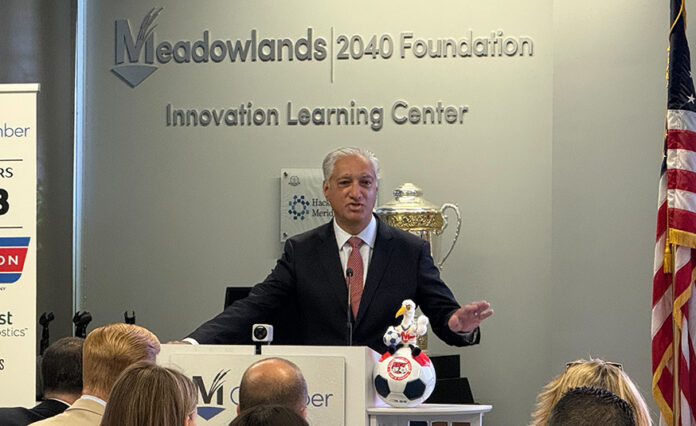

As New Jersey positions itself at the center of one of the largest global sporting events in modern history, the conversation around infrastructure, mobility, and regional coordination is accelerating with urgency. That reality was on full display May 1, when the Meadowlands Chamber hosted its latest “Eggs & Issues: Transportation and Mobility” forum at its headquarters in Lyndhurst, bringing together top officials, planners, and industry leaders to address the complex logistics surrounding the upcoming FIFA World Cup 2026.
With matches scheduled to take place at MetLife Stadium in East Rutherford, the Meadowlands region will serve as a focal point for global attention—and a critical test of transportation systems under unprecedented demand. The forum provided a comprehensive look at how state agencies, private partners, and international stakeholders are aligning to ensure that millions of visitors can move efficiently, safely, and predictably through one of the most densely trafficked corridors in the country.
Delivering the keynote address, Kris Kolluri—who serves as President and CEO of NJ Transit and Executive Director of the New Jersey Turnpike Authority—outlined the scale of preparation already underway. His remarks emphasized that the state is not approaching the World Cup as a short-term event, but as a long-term infrastructure milestone. Investments in rail, bus, and roadway systems are being calibrated not only to meet tournament demand, but to leave a lasting impact on regional mobility.
Central to the discussion was a message that resonated across every level of the panel: public transportation will be the backbone of World Cup movement in the Meadowlands. While the region is accustomed to handling large-scale events, including NFL games and major concerts, the World Cup introduces a different level of volume and global complexity. The consensus among speakers was clear—traditional reliance on private vehicles will not be viable at scale.
That message was reinforced by Alex Lasry, CEO of the FIFA World Cup 2026 New York/New Jersey Host Committee, who delivered one of the day’s most direct assessments. His guidance to attendees was unequivocal: fans should plan for a “full stop” on private car usage when attending matches. The unpredictability of traffic flow, combined with security protocols and access restrictions, means that personal vehicles cannot be guaranteed timely entry or exit. Instead, mass transit systems—particularly rail connections and coordinated shuttle services—are being positioned as the most reliable means of access.
This shift in transportation strategy represents a significant operational pivot for the region. It requires not only infrastructure readiness, but also behavioral change among attendees, many of whom may be unfamiliar with local transit systems. To address this, organizers are developing integrated solutions that include direct rail access, enhanced bus routes, and park-and-ride options designed to streamline the journey from arrival points to the stadium.
Among the logistical frameworks discussed were planned shuttle services connecting key hubs, including routes from Manhattan’s Port Authority and satellite parking locations such as the Hackensack Meridian School of Medicine campus in Clifton. These systems are intended to distribute traffic, reduce congestion, and create predictable movement patterns that can be scaled across multiple match days.
The expert panel further expanded on these strategies, offering technical and strategic perspectives from across the transportation sector. Dan Baer, Senior Vice President at WSP, addressed the engineering and planning considerations required to support such a large-scale operation, while Dennis Martin of HNTB provided insights into infrastructure integration and long-term system resilience. Together, the panel outlined a coordinated approach that blends immediate event needs with broader regional development goals.
For the Meadowlands business community, the forum served as both an informational briefing and a strategic call to action. Local organizations, from hospitality providers to retail operators, will play a critical role in supporting the influx of international visitors. Understanding transportation patterns, access points, and timing will be essential for aligning operations with the realities of World Cup logistics.
The implications extend beyond the event itself. As highlighted throughout the discussion, the World Cup presents an opportunity to accelerate improvements that will benefit the region long after the final match is played. Enhanced transit connectivity, upgraded infrastructure, and refined operational protocols have the potential to elevate New Jersey’s overall transportation framework, positioning it as a model for future large-scale events.
Coverage across Explore New Jersey continues to track these developments, recognizing the intersection of global events and local infrastructure as a defining theme for the state’s next phase of growth. While the World Cup will bring unprecedented attention to the Meadowlands, it is the systems being built behind the scenes that will determine its long-term impact.
The “Eggs & Issues” forum made one point unmistakably clear: preparation is not optional—it is essential. With timelines tightening and expectations rising, New Jersey’s ability to deliver a seamless transportation experience will be central to its role on the world stage. The groundwork is being laid now, with collaboration, planning, and execution driving a coordinated effort that aims to meet the moment with precision.
As 2026 approaches, the Meadowlands is not just preparing to host matches—it is preparing to demonstrate how a region moves at scale, under pressure, and in full view of the world.



