


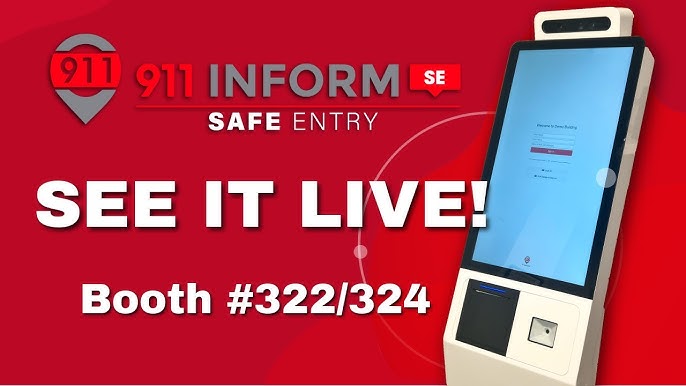

New Jersey’s role at the forefront of public safety innovation continues to expand as 911inform officially launches Safe Entry, a browser-based visitor management system engineered to extend real-time emergency intelligence from the core of a facility directly to its front door. The release represents a strategic evolution in how buildings—particularly schools, healthcare facilities, and government institutions—approach access control, situational awareness, and coordinated emergency response in an era where seconds define outcomes.
Safe Entry is not positioned as a standalone administrative tool. It is an extension of 911inform’s broader software-as-a-service platform, which has been designed to bridge the longstanding communication gap between internal building systems and first responders during active emergencies. By integrating visitor management into that ecosystem, the company is effectively transforming entry points into active nodes within a larger security network—where identity verification, access permissions, and emergency readiness converge in real time.
At its core, the platform introduces a modernized approach to managing who enters a building and how that access is monitored, recorded, and controlled. Traditional visitor logs and badge systems, often siloed from security infrastructure, are replaced with a digital interface that operates seamlessly through any browser. This design eliminates the need for specialized hardware while ensuring that data is immediately accessible across devices, locations, and authorized personnel. The result is a system that is both scalable and responsive, capable of adapting to the operational demands of institutions that manage high volumes of daily foot traffic.
What distinguishes Safe Entry within the broader visitor management landscape is its integration with emergency response workflows. During a 911 call, the platform does not simply provide a record of who is inside the building—it becomes part of a live intelligence stream. First responders can access detailed information about occupants, entry points, and building layouts, enabling a level of situational awareness that has historically been difficult to achieve in the early moments of an incident. This capability aligns directly with 911inform’s foundational mission: to ensure that critical information flows instantly between on-site personnel and emergency services when it matters most.
The implications for New Jersey are particularly significant. The state has already established itself as a leader in adopting advanced safety technologies, driven in part by legislative frameworks such as Alyssa’s Law, which mandates the installation of silent panic alarms in public schools. Platforms like 911inform’s have been instrumental in helping institutions meet these requirements, providing not only compliance but enhanced functionality that extends beyond the minimum standard. Safe Entry builds on that foundation, offering a proactive layer of security that begins at the point of entry rather than reacting after an incident has escalated.
Operational deployments across the state illustrate the platform’s impact. School districts in communities such as Union City and South Plainfield, along with institutions like the Morris County School of Technology, have integrated 911inform’s systems into their safety protocols. These implementations demonstrate how real-time data—ranging from interactive floor plans to live camera feeds—can be leveraged to create a unified response environment where administrators, security personnel, and first responders operate with shared visibility.
The company’s partnership with the Monmouth County Sheriff’s Office further underscores its role in advancing coordinated emergency response. As one of the first law enforcement agencies in the state to integrate directly with 911inform’s platform, the partnership established a model for how dispatch systems can interface with building-level intelligence. Safe Entry extends that model by ensuring that the very first point of contact—the front door—is fully integrated into the same network of information and control.
From a technological perspective, the platform’s architecture reflects a broader shift toward cloud-based, interoperable systems that prioritize speed, accessibility, and security. By operating as a browser-based solution, Safe Entry reduces deployment complexity while maintaining the ability to integrate with existing infrastructure, including surveillance systems, access controls, and communication networks. This interoperability is critical in environments where multiple systems must function cohesively under pressure, and where delays or fragmentation can have significant consequences.
The release of Safe Entry also highlights a growing convergence between physical security and digital intelligence. As buildings become increasingly connected, the distinction between access management and emergency response is narrowing. Systems that once operated independently are now expected to share data, automate actions, and support decision-making in real time. 911inform’s platform embodies this convergence, creating an environment where entry management is not just about controlling access, but about enhancing overall safety and operational readiness.
Within the broader Sunset Daily News real estate and infrastructure landscape, this development signals an important evolution in how properties are designed and managed. Security is no longer an isolated feature—it is becoming a core component of building value, influencing everything from tenant expectations to regulatory compliance. For developers, property managers, and institutional leaders, the integration of advanced safety technologies is increasingly seen as essential, not optional.
The connection to New Jersey’s wider infrastructure ecosystem adds another layer of relevance. Companies such as New Jersey Resources illustrate how the state’s industries are leveraging technology to manage complex systems at scale, whether in energy delivery or building operations. While operating in different sectors, both organizations reflect a shared emphasis on reliability, innovation, and the use of technology to enhance safety and efficiency across critical services.
As Safe Entry moves into full commercial deployment, its impact is expected to extend beyond early adopters. The platform’s scalability and adaptability make it applicable across a wide range of environments, from educational institutions and healthcare facilities to corporate campuses and government buildings. In each case, the underlying objective remains consistent: to ensure that access control and emergency response are not separate functions, but integrated components of a unified safety strategy.
For New Jersey, the launch reinforces the state’s position as a testing ground and proving ground for next-generation public safety solutions. The combination of legislative support, institutional adoption, and technological innovation creates an environment where advancements can be implemented, evaluated, and refined in real-world conditions. 911inform’s Safe Entry platform is a direct product of that ecosystem, translating years of development and operational experience into a solution that addresses one of the most critical aspects of building security.
In a landscape where the stakes of safety continue to rise, the ability to manage access and respond to emergencies with precision and speed is becoming a defining characteristic of modern infrastructure. With the introduction of Safe Entry, 911inform is not only advancing its own platform—it is contributing to a broader shift in how buildings, communities, and emergency services operate together in pursuit of a safer, more responsive future.



