


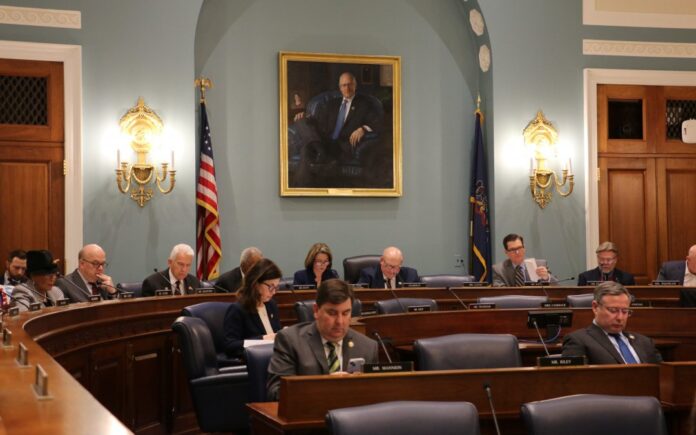

In a moment that underscores both the fragility and urgency of federal policymaking, Congress has once again found itself navigating a high-stakes legislative bottleneck, where timing, political leverage, and national consequence intersect. A trio of critical measures—the long-delayed farm bill, a sweeping federal budget framework, and the renewal of key foreign intelligence authorities—has forced lawmakers into a prolonged and uncertain negotiation cycle, halting House floor action for hours as leadership scrambled to secure the votes necessary to move forward.
The paralysis on Capitol Hill was not merely procedural. It revealed a deeper structural strain within the legislative branch, where competing priorities and ideological divisions continue to complicate even the most essential functions of government. For New Jersey, where federal funding, agricultural policy, and national security decisions all carry tangible downstream impacts, the stakes are anything but abstract.
At the center of the impasse is the farm bill, a massive piece of legislation that extends far beyond agriculture into nutrition programs, conservation funding, and rural economic development. Though often framed as a rural issue, its reach extends directly into New Jersey’s economy, particularly in South Jersey’s agricultural corridors and food distribution networks. The bill’s renewal has become a flashpoint for broader debates over spending priorities and social safety nets, placing lawmakers in a difficult position as they balance fiscal restraint with economic necessity.
Simultaneously, Congress is under pressure to finalize a federal budget plan that avoids disruption to government operations while setting the tone for fiscal policy in an election-year environment. The budget blueprint carries implications for infrastructure investment, healthcare funding, and regional development initiatives that directly affect New Jersey municipalities and industries. Delays or compromises at the federal level can ripple into state-level planning, influencing everything from transportation projects to public education funding.
Perhaps most consequential from a national security perspective is the looming expiration of foreign intelligence surveillance authorities, widely regarded as a cornerstone of the country’s counterintelligence framework. The debate over extending these powers has reignited concerns around privacy, oversight, and the evolving nature of global threats. For lawmakers, the challenge lies in striking a balance between maintaining robust intelligence capabilities and addressing civil liberties concerns that have become increasingly prominent in public discourse.
The convergence of these three legislative priorities has created a pressure cooker scenario inside the House of Representatives, where procedural votes—typically routine—have become high-stakes battlegrounds. Leadership’s struggle to secure consensus reflects a broader trend of fragmentation within Congress, where narrow majorities and internal divisions can stall even widely acknowledged priorities.
For New Jersey, the implications of this federal standoff are multifaceted. The state’s diverse economy—spanning agriculture, logistics, healthcare, and technology—relies heavily on federal alignment to maintain stability and growth. Delays in passing the farm bill could disrupt funding streams that support local farmers and food programs. Uncertainty around the federal budget introduces challenges for state agencies that depend on predictable allocations. And the outcome of intelligence policy debates carries broader implications for industries tied to defense, cybersecurity, and innovation.
As covered extensively through ongoing reporting and analysis in NJ Spotlight News, the intersection of federal policy and state-level impact continues to define the current political landscape. What unfolds in Washington does not remain confined there—it shapes economic trajectories, policy implementation, and community outcomes across New Jersey.
The temporary halt in House proceedings is a reflection of a legislative body under strain, but also one that is acutely aware of the urgency of its responsibilities. The coming days will determine whether Congress can navigate its internal divisions and deliver on these must-pass measures, or whether continued gridlock will deepen uncertainty at a moment when clarity and decisiveness are in high demand.
In the broader context, this episode serves as a reminder that governance is not merely about passing legislation—it is about maintaining the functional integrity of institutions in the face of competing pressures. For New Jersey residents, businesses, and policymakers, the outcome of this congressional standoff will carry lasting implications, reinforcing the reality that even the most distant political debates have a direct and measurable impact at home.



