


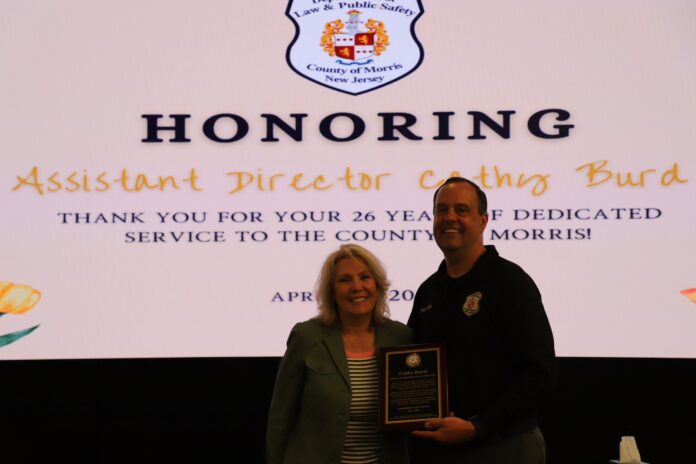

In a moment that reflects both institutional continuity and the closing of a remarkable chapter in public service, Morris County formally recognized the retirement of Cathy Burd, Assistant Director of Law & Public Safety, honoring more than 26 years of dedicated leadership that has shaped the operational backbone of one of New Jersey’s most complex and high-performing county systems. The recognition, held during a retirement gathering at the Morris County Public Safety Training Academy, brought together a wide cross-section of county officials, first responders, and colleagues—underscoring the breadth of Burd’s influence across departments that collectively define the county’s public safety and emergency response infrastructure.
Burd’s career trajectory reflects a rare combination of institutional knowledge, cross-functional leadership, and operational discipline. Beginning her tenure in 1999 within the county’s Personnel Division, she entered public service with a foundation in finance and human resources—two disciplines that would later inform her strategic approach to governance and administration. Within a year, she advanced to Assistant Director of Finance, initiating a progression through increasingly complex leadership roles that would ultimately position her as one of the most trusted and versatile figures within county government.
Her path through Morris County’s administrative structure was not linear, but deliberately expansive. She served as Director of Employee Resources and Risk Management, Assistant County Administrator, and Director of Operations—each role adding a layer of operational perspective that would later prove essential in overseeing multi-agency coordination within Law & Public Safety. By the time she assumed the role of Assistant Director in 2020, Burd had developed a comprehensive understanding of the county’s internal systems, fiscal frameworks, and personnel dynamics, enabling her to operate with a level of precision that few in public administration achieve.
The timing of her appointment to Law & Public Safety was particularly consequential. Taking on the role at the onset of the COVID-19 pandemic, Burd entered a leadership environment defined by uncertainty, urgency, and unprecedented demand on public resources. In that context, her ability to maintain continuity of operations while supporting the rapid deployment of emergency services became a defining aspect of her tenure. Among her most notable contributions during this period was her involvement in the establishment and execution of the COVID-19 testing site at the County College of Morris, a critical initiative that required coordination across health services, emergency management, and logistical operations at a scale rarely seen in local government.
Her responsibilities extended across a wide spectrum of county functions, reflecting the integrated nature of modern public safety operations. Under her oversight, departments including the Office of Emergency Management, the Communications Center, the Public Health Division, the Medical Examiner’s Office, the Fire Marshal’s Office, and the Public Safety Training Academy operated within a coordinated framework designed to ensure responsiveness, accountability, and efficiency. This level of integration is not incidental; it requires leadership capable of aligning diverse operational units toward shared objectives while maintaining compliance with regulatory standards and performance expectations.
Colleagues consistently point to Burd’s leadership style as a defining factor in her effectiveness. Described as both approachable and precise, she cultivated an environment where collaboration was not only encouraged but operationalized. Her ability to translate complex administrative and technical issues into actionable strategies allowed teams across departments to function cohesively, even under pressure. This approach proved particularly valuable in a county environment where interagency coordination is essential to delivering consistent and reliable public services.
Christine Myers, who presented Burd with a formal Resolution of Honor, emphasized the impact of her contributions across multiple phases of county governance. Her remarks highlighted not only Burd’s technical expertise but also her willingness to serve as a resource for colleagues navigating the complexities of public administration. That combination of knowledge and accessibility is often cited as a defining characteristic of effective leadership within government systems, where clarity and communication can directly influence operational outcomes.
Similarly, Scott DiGiralomo underscored the depth of trust that Burd earned over more than two decades of collaboration. In high-stakes environments such as public safety, where decisions carry immediate and far-reaching consequences, the ability to rely on experienced leadership is invaluable. DiGiralomo’s remarks reflect a broader recognition within the department that Burd’s presence contributed not only to operational stability but to the confidence with which teams approached their responsibilities.
From a law enforcement perspective, James M. Gannon acknowledged the consistency and impact of Burd’s support across multiple bureaus and agencies. Her role extended beyond administrative oversight, influencing how departments coordinated, communicated, and executed their missions. In a county that has built a reputation for efficiency and effectiveness, contributions at this level are integral to maintaining performance standards.
Beyond her professional accomplishments, Burd’s career has been shaped by a deeply personal commitment to service and resilience. Her connection to family, including the influence of her late siblings, informed a perspective that emphasized empathy alongside execution. This balance between personal values and professional discipline is often what distinguishes long-serving public officials who leave a lasting imprint on the institutions they serve.
As she transitions into retirement, Burd leaves behind a framework that will continue to influence Morris County’s operations. The systems she helped refine, the relationships she built, and the standards she established will remain embedded within the county’s approach to public safety and administration. Her departure represents not just the end of a career, but the transfer of a legacy that will inform future leadership.
For Morris County, the recognition of Cathy Burd’s service is both a reflection of past achievements and a reaffirmation of the values that underpin effective governance. In an era where public institutions are increasingly scrutinized for performance and accountability, careers defined by consistency, integrity, and measurable impact serve as benchmarks for what public service can and should represent.
Within the broader Sunset Daily News law and public safety landscape, this moment underscores the importance of leadership continuity and institutional knowledge. As counties across New Jersey navigate evolving challenges—from public health crises to technological transformation—the contributions of experienced leaders like Cathy Burd provide a foundation upon which future progress can be built.



