



New Jersey enters a dynamic and transitional stretch of spring weather this weekend, beginning with a relatively calm and seasonable Saturday before pivoting into a more complex pattern that will bring rain, cooler air, and localized impacts across the state. As of this morning, conditions across much of New Jersey are stable and comfortable, with mostly sunny skies, temperatures hovering in the upper 50s, elevated humidity levels, and a light easterly breeze signaling the influence of an onshore flow that will define much of the day’s temperature contrast between inland and coastal regions.
Today’s Forecast Summary: Expect high temperatures to vary significantly across the state. Inland areas will reach the mid-70s, while the coast will stay much cooler in the upper 50s to near 60°F due to an onshore breeze. Clouds will collect this evening, with occasional showers and potential fog developing after midnight as a cold front approaches.
| Day | Sky Condition | Temperature | Chance of Rain |
|---|---|---|---|
| Sat, Apr 18 | 63°F / 49°F | 10% | |
| Sun, Apr 19 | 56°F / 37°F | 40% | |
| Mon, Apr 20 | 51°F / 31°F | 35% | |
| Tue, Apr 21 | 52°F / 32°F | 0% | |
| Wed, Apr 22 | 69°F / 47°F | 25% |
Upcoming Weather Alerts
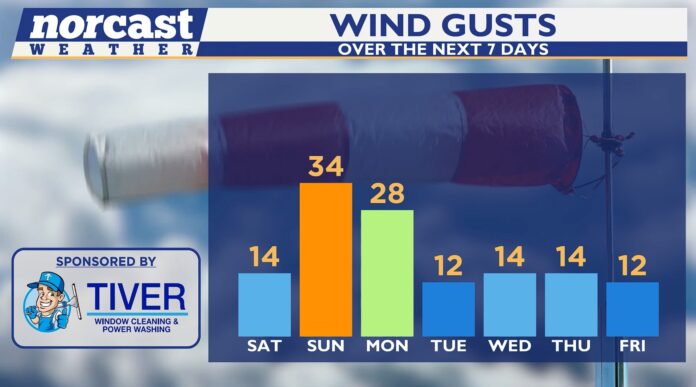
- Sunday Storm: A stronger system will bring widespread rain and a sharp temperature drop tomorrow. Highs will barely reach the mid-50s.
- Frost Advisory: A dramatic cool-down follows the rain. Expect widespread frost on Monday night into Tuesday morning as temperatures dip toward freezing (30°F–35°F).
- Coastal Flooding: The National Weather Service has issued coastal flood advisories for tonight’s high tide due to astronomical high tides and onshore winds.
Saturday, April 18 is shaping up to be the most balanced and usable outdoor day of the immediate forecast window, though it is not without nuance. Inland communities are expected to warm into the low-to-mid 70s under filtered sunshine, while shoreline areas remain significantly cooler, struggling to move beyond the upper 50s to near 60 degrees due to persistent ocean-driven airflow. This divergence is a classic New Jersey spring setup, where proximity to the Atlantic sharply moderates temperatures and introduces variability even across short geographic distances. Skies will gradually transition from mostly sunny to increasingly cloud-covered as the day progresses, setting the stage for a more unsettled overnight period.
By late evening and into the overnight hours, atmospheric conditions begin to shift more decisively. A developing system tied to an approaching cold front will introduce scattered showers and the potential for areas of fog, particularly in regions already influenced by marine air. Visibility reductions and damp conditions are likely to become more widespread after midnight, creating a markedly different environment from the relatively calm daytime hours. This evolution is part of a broader pattern change that will define the early portion of the upcoming week.
Sunday represents the inflection point. As the frontal boundary moves through New Jersey, rain becomes more consistent and temperatures begin to fall. Highs will struggle to climb beyond the mid-50s for much of the state, with some coastal zones briefly experiencing slightly milder conditions before the cooler air mass fully settles in. While the rainfall is expected to be beneficial in addressing recent dry conditions, the system may also carry embedded instability, raising the possibility of isolated thunderstorms, though widespread severe activity is not anticipated at this time.
The more significant story emerges in the aftermath of the front. As the system exits, a pronounced drop in temperatures will take hold, driven by a trough pattern settling over the region from Sunday night through midweek. Overnight lows will fall sharply, with some areas dipping into the low 30s and even upper 20s in higher elevations. This rapid cooling introduces the potential for frost formation, particularly late Monday night into Tuesday morning, creating concerns for early-season vegetation and agricultural interests across parts of the state.
This colder stretch will extend into Monday and Tuesday, with daytime highs largely confined to the 50s—well below the recent warmth that gave the state an early preview of summer-like conditions earlier in the week. That warmth has now been effectively displaced, replaced by a more seasonally typical, if not slightly below-average, temperature profile. The transition underscores the volatility of mid-April weather in New Jersey, where rapid swings between warm and cool air masses are not only common but expected.
Adding another layer to the forecast are coastal considerations. Elevated astronomical tides combined with persistent onshore winds have prompted advisories for minor coastal flooding during high tide cycles. While not expected to reach major thresholds, these conditions can still impact low-lying roadways and shoreline infrastructure, particularly in areas already prone to tidal influence. The interaction between ocean-driven winds and incoming weather systems is a key factor in these localized impacts, reinforcing the need for awareness in coastal communities.
Looking ahead to the middle and latter part of the week, the pattern begins to moderate. By Wednesday, temperatures are projected to rebound into the upper 60s and low 70s, signaling a return to more stable spring conditions. This gradual warming trend is expected to continue into the following weekend, restoring a more typical seasonal baseline after the early-week chill. However, the broader pattern remains active, suggesting that variability will continue to define the region’s weather in the near term.
This evolving forecast aligns with the broader trends and updates tracked in the Weather Report section of Sunset Daily News New Jersey, where shifting seasonal patterns, coastal influences, and regional dynamics are consistently shaping daily conditions across the state. New Jersey’s geographic diversity—from urban corridors to coastal zones and inland elevations—ensures that no single forecast tells the entire story, and this weekend’s setup is a clear example of that complexity in motion.
What emerges from this sequence is a classic mid-spring transition: a brief window of comfortable, balanced conditions giving way to a more unsettled and cooler pattern before stabilizing again. For residents and businesses alike, the key takeaway is timing. Saturday offers the most favorable conditions for outdoor activity, while Sunday introduces rain and a cooling trend that will carry into the early part of the week. By midweek, a return to more moderate temperatures provides a reset, but not before New Jersey experiences a full spectrum of spring weather in just a matter of days.
In a region where weather can shift quickly and dramatically, this stretch serves as a reminder of both the variability and predictability of the season. The systems at play are familiar, but their timing and intensity continue to shape how each day unfolds—across cities, suburbs, and shorelines alike.