


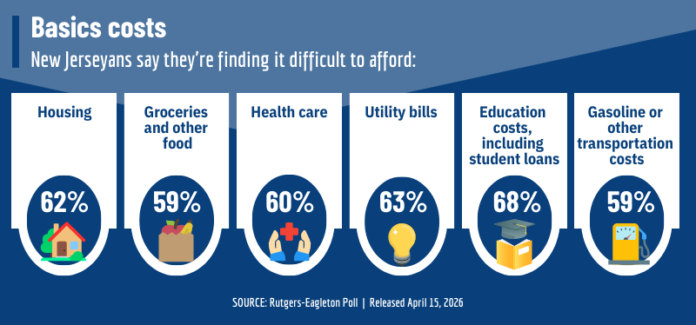

A newly released statewide survey is delivering one of the clearest signals yet about the economic mood across New Jersey—and the findings point to a growing sense of strain among residents navigating rising costs, tax burdens, and uncertain financial outlooks. The latest Rutgers-Eagleton Poll, conducted in partnership with NEW JOBS, captures a moment where economic frustration is no longer isolated to specific sectors or demographics, but has expanded into a broad-based sentiment shaping how New Jerseyans view both their state and the national economy.
The data reflects a pronounced shift toward pessimism. Three out of every four residents—75 percent—rate New Jersey’s economy negatively, with nearly one-third describing conditions as outright poor. Another significant portion characterizes the economy as merely “fair,” underscoring a perception that while collapse may not be imminent, meaningful progress remains out of reach. Only a small fraction of respondents express confidence in the state’s economic trajectory, a gap that highlights the disconnect between macroeconomic indicators and lived experience.
The national outlook fares even worse in the eyes of respondents. Nearly 80 percent of those surveyed describe the U.S. economy in negative terms, suggesting that broader concerns about inflation, wage stagnation, and economic stability are reinforcing local frustrations. This alignment between state and national pessimism signals a compounded effect, where residents are not only dissatisfied with conditions close to home but also see little relief coming from the broader economic environment.
At the center of this sentiment is a single, defining issue: affordability. The cost of living in New Jersey has long been a point of contention, but the latest data suggests that it has reached a critical threshold. An overwhelming 84 percent of residents report dissatisfaction with how the state is addressing cost-of-living challenges, with a majority expressing strong dissatisfaction. This level of concern places affordability at the forefront of public discourse, surpassing even long-standing issues such as taxation and infrastructure.
Taxes remain a closely related pressure point, with nearly four out of five respondents indicating dissatisfaction with the state’s approach. For many households, the combination of rising everyday expenses and a perceived lack of relief through policy has created a sense of financial compression—where income growth fails to keep pace with the cost of maintaining a standard of living. This dynamic is particularly pronounced in a state known for its high property taxes and overall cost structure, factors that continue to shape both resident sentiment and broader economic behavior.
What makes the current moment distinct is not just the intensity of dissatisfaction, but its expansion into areas that have historically been more stable. According to the poll’s findings, concerns are now extending into sectors such as healthcare and transportation—areas that had previously maintained more balanced or even positive public perception. This shift suggests that economic pressure is no longer confined to isolated categories, but is influencing how residents evaluate a wide range of public services and policy outcomes.
Despite the overall negative tone, the data does reveal areas where the state continues to maintain public confidence. A majority of respondents express satisfaction with crime and safety, indicating that public safety efforts are being recognized even amid broader dissatisfaction. Education also remains a relative strength, with more residents reporting satisfaction than dissatisfaction, though the margin appears more fragile than in previous years. These pockets of confidence highlight the complexity of public sentiment, where specific areas of performance can still earn approval even as the overall outlook remains challenging.
From a policy perspective, the implications are significant. The poll results point to a narrowing margin for government credibility, where fewer areas are generating positive feedback and more issues are trending into negative territory. This creates an environment where incremental improvements may not be sufficient to shift perception; instead, residents appear to be signaling a need for more visible, tangible progress on the issues that most directly affect their daily lives.
Business leaders and economic stakeholders are interpreting the findings as both a warning and an opportunity. The data reinforces the urgency of addressing affordability and supporting job growth, while also highlighting the importance of maintaining a competitive environment for businesses operating within the state. As New Jersey continues to position itself within a broader regional and national economy, the ability to balance cost pressures with economic opportunity will be central to its long-term trajectory.
The survey, conducted between March 27 and March 30 with a sample of 1,568 adults and a margin of error of plus or minus 3.2 percent, provides a statistically grounded snapshot of public opinion at a time of heightened economic awareness. While polls capture sentiment rather than definitive outcomes, the consistency and scale of the findings suggest that the concerns being expressed are both widespread and deeply felt.
Coverage of these trends, along with ongoing developments in policy, public safety, and governance, continues to be tracked through the Sunset Daily News Business section, where the intersection of economic conditions and public policy remains a central focus.
As New Jersey moves further into 2026, the challenge for policymakers, business leaders, and institutions will be to translate awareness into action. The message emerging from this poll is direct and unmistakable: residents are feeling the cumulative weight of economic pressures, and they are looking for solutions that deliver measurable impact. The path forward will require coordination, innovation, and a clear understanding of the factors driving dissatisfaction—because in a state as dynamic and complex as New Jersey, perception is often shaped by results that people can see, feel, and sustain over time.