


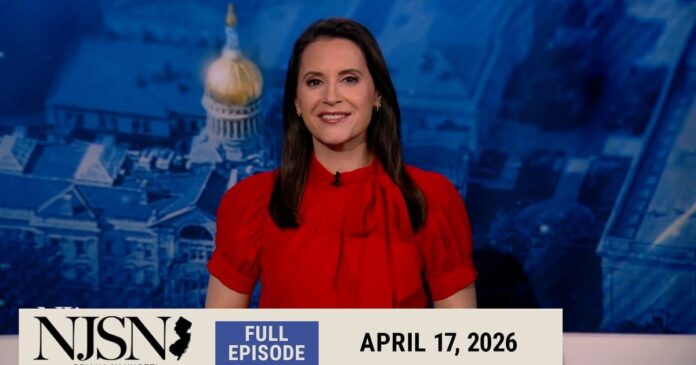

New Jersey’s political landscape has entered a new phase of acceleration and recalibration following the outcome of the April 16 special election in the 11th Congressional District, a result that is already reverberating across state and national political strategy. The April 17, 2026 edition of NJ Spotlight News’ Reporters Roundtable captured the magnitude of that moment in real time, framing Analilia Mejia’s commanding victory not simply as a routine partisan win, but as a structural signal about voter alignment, party identity, and the trajectory of power heading into the next federal election cycle.
Mejia’s 60 percent to 40 percent win over Republican Joe Hathaway was decisive on its face, but the deeper story lies in where and how that margin materialized. This was not a narrow consolidation of expected Democratic strongholds. Instead, the results showed measurable movement in areas that had historically leaned Republican, including Morris County municipalities that for decades formed the backbone of GOP electoral reliability. That geographic shift is not incidental. It reflects a continued redefinition of suburban political identity in New Jersey, where demographic change, national political sentiment, and local issue alignment are converging in ways that are reshaping outcomes district by district.
The Roundtable, hosted by Joanna Gagis and featuring veteran political observers Colleen O’Dea, Brent Johnson, and Charlie Stile, approached the election with a clear analytical lens: results matter, but perception may matter even more. In modern political cycles, particularly in special elections with compressed timelines and uneven turnout patterns, the narrative constructed in the immediate aftermath often carries equal weight to the vote totals themselves. Within that framework, Mejia’s margin became the headline—not just her victory.
Her win fills the congressional seat vacated by Governor Mikie Sherrill and extends Democratic representation in the district through January 2027. At the national level, the outcome marginally narrows the Republican majority in the U.S. House, but more importantly, it introduces a data point that both parties will study closely as they calibrate messaging, candidate positioning, and turnout strategies ahead of the midterm elections. Special elections are frequently treated as directional indicators, and this one arrives at a time when national political dynamics are already under strain.
The discussion surrounding Hathaway’s campaign highlighted another layer of complexity. His central argument—that Mejia represented a more ideologically progressive wing of the Democratic Party—was not without factual grounding. Mejia had emerged from a crowded primary field as one of its most left-leaning candidates and had taken firm positions on international issues, including sharp criticism of Israeli leadership. Yet those contrasts failed to gain meaningful traction with voters in the general election. The disconnect between campaign messaging and electoral impact underscores a broader reality: in the current environment, national political headwinds can override traditional issue-based contrasts, particularly in districts that are already trending away from their historical alignments.
Underlying that dynamic is the continued influence of national figures on local races. The Roundtable and subsequent political analysis pointed to the broader environment surrounding the Republican brand in New Jersey, where approval ratings and policy debates at the national level are filtering directly into down-ballot contests. Economic pressures, foreign policy debates, and high-profile political rhetoric are shaping voter perception in ways that extend far beyond district-specific concerns. In that context, Hathaway’s campaign operated within constraints that were not entirely of his own making.
His post-election response reflected both acknowledgment of the outcome and an attempt to frame the conditions under which it occurred, citing turnout patterns and election structure as contributing factors. However, the mechanics of the election—including vote-by-mail access and statutory timing requirements—applied uniformly across the electorate. The broader takeaway is less about procedural debate and more about engagement: the voters who participated ultimately defined the result, and their distribution across party lines and geographic areas tells a clear story about current momentum.
Beyond the election itself, the April 17 Roundtable expanded into a broader examination of key issues shaping New Jersey’s policy environment. Cybersecurity emerged as a growing priority, with calls for the state to strengthen its digital infrastructure in response to an evolving landscape of data breaches and systemic vulnerabilities. This is not a theoretical concern. As government operations, public services, and private sector systems become increasingly interconnected, the resilience of those networks becomes a central component of public safety and economic stability.
At the federal level, New Jersey’s delegation is also navigating shifting positions on international policy. Senator Cory Booker’s recent vote to block certain weapons packages to Israel marked a notable departure from his previous stance, reflecting the complexity of balancing geopolitical alliances with evolving perspectives on conflict and humanitarian considerations. These developments are not isolated; they are part of a broader recalibration of policy positions that will continue to influence both legislative priorities and electoral narratives.
Economic signals, meanwhile, remain mixed in perception but steady in official assessment. While public sentiment reflects concern about inflation, energy costs, and long-term stability, state officials continue to characterize New Jersey’s economy as fundamentally strong. Labor market performance, infrastructure investment, and sector-specific growth are contributing to that assessment, even as voters weigh their personal financial experiences against broader economic indicators.
Taken together, these threads—electoral outcomes, policy debates, and economic signals—form a cohesive picture of a state in transition. The 11th Congressional District serves as a case study within that larger framework, illustrating how historical patterns can shift rapidly when multiple forces align. The transformation of the district itself is particularly striking when viewed through a longer historical lens. For more than two decades, it was represented by Rodney P. Frelinghuysen, a figure deeply rooted in a political legacy that extended back to the founding era of the country. Today, it transitions to representation by Analilia Mejia, the daughter of Colombian and Dominican immigrants, reflecting not only a change in political affiliation but a broader evolution in identity and representation.
That evolution did not happen overnight. Governor Sherrill’s tenure served as an intermediary phase, bridging the district’s historical Republican foundation with its current Democratic alignment. Mejia’s victory builds on that trajectory while also expanding its scope, reinforcing the idea that demographic change, voter priorities, and national political currents are converging to redefine what districts like NJ-11 represent.
For readers following these developments across the state, the ongoing coverage within NJ Spotlight News continues to provide essential context, tracking how these individual moments connect to larger trends in governance, policy, and public sentiment.
As the political cycle moves forward, the implications of this election will continue to unfold. Campaign strategies will adjust, messaging will evolve, and both parties will reassess how they engage with a New Jersey electorate that is demonstrating both consistency in direction and complexity in motivation. The April 17 Reporters Roundtable captured that moment with clarity, but the story it outlined is still being written—across districts, across policy arenas, and across a state that is actively redefining its political identity in real time.



