


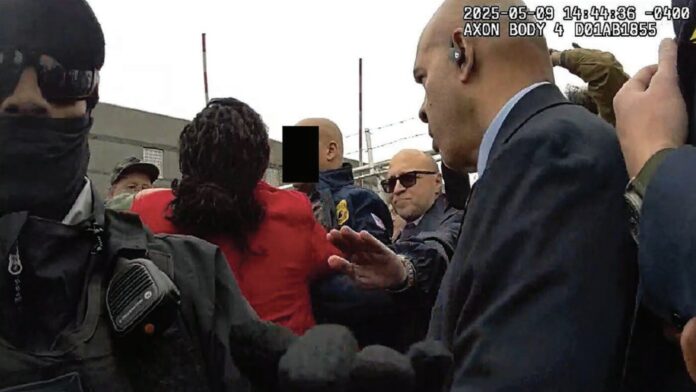

A rapidly escalating legal case centered in Newark is drawing national attention while placing New Jersey at the forefront of a complex intersection between law enforcement authority, political oversight, and constitutional protections. The case involving U.S. Representative LaMonica McIver has evolved into one of the most closely watched legal disputes in the region, anchored in a brief but highly contested 68-second encounter outside the Delaney Hall federal detention facility on May 9, 2025. What prosecutors describe as an assault on federal officers, McIver’s legal team frames as a chaotic, defensive reaction within an uncontrolled and volatile environment.
As developments continue to unfold within the Law & Order landscape, the case is no longer confined to a single incident. It has expanded into a broader examination of how federal authority is exercised, how elected officials engage in oversight, and how prosecutorial decisions are interpreted within a politically charged climate.
At the center of the case is a moment captured on video—an intense, tightly packed confrontation involving federal agents, elected officials, and a rapidly shifting crowd dynamic. According to federal prosecutors, McIver engaged in physical actions that meet the threshold for assault, a charge that carries significant legal consequences, including the potential for a lengthy prison sentence. The government’s position rests on the assertion that the congresswoman’s movements during the encounter constituted intentional contact with law enforcement personnel.
The defense, led by former U.S. Attorney Paul Fishman, presents a sharply contrasting narrative. Rather than a deliberate act of aggression, McIver’s legal team describes the scene as a “jostling scrum,” where movement was dictated by crowd pressure rather than individual intent. Video evidence, they argue, shows the congresswoman both pushing and being pushed as federal agents moved to detain Newark Mayor Ras Baraka, creating an environment where physical contact was unavoidable.
Within this context, the defense emphasizes that McIver’s actions were reactive rather than aggressive. They contend that she was attempting to intervene in what she perceived as an unsafe and potentially unlawful situation, acting to protect both herself and others amid a rapidly escalating confrontation. The movements cited by prosecutors as “strikes” are characterized instead as incidental contact—natural responses to being caught in a tightly compressed and physically unstable crowd.
A key element of the defense’s argument is the absence of documented injury. No specific harm to federal officers has been formally identified, raising questions about whether the threshold for a felony assault charge has been met. This point is being used to challenge not only the severity of the charges but also the interpretation of the events themselves, suggesting that the legal framing may not align with the actual impact of the encounter.
Beyond the immediate facts of the case, McIver’s legal team and supporters are advancing a broader argument that shifts scrutiny toward the actions of federal agents. Statements from individuals present at the scene, including fellow elected officials, assert that McIver herself may have been subjected to physical force during the confrontation. Allegations that an agent initiated contact by shoving the congresswoman have added another layer of complexity, raising questions about proportionality, escalation, and accountability within the incident.
This dynamic has contributed to a narrative that extends beyond legal interpretation into the realm of political context. The prosecution is being overseen by interim U.S. Attorney Alina Habba, a figure with prior high-profile legal affiliations, and the defense has characterized the case as an instance of selective enforcement. The argument centers on the assertion that McIver, a sitting member of Congress, has been singled out despite the presence of multiple officials within the same confrontation who have not faced similar charges.
The disparity in legal outcomes tied to the same event has become a focal point. Trespassing charges initially brought against Newark Mayor Ras Baraka were ultimately dropped, while McIver continues to face severe allegations. This divergence is being cited by the defense as evidence of inconsistency in prosecutorial decision-making, reinforcing claims that the case may be influenced by factors beyond the immediate facts.
The legal trajectory of the case has already included a significant ruling that will shape its next phase. A federal judge denied McIver’s motion to dismiss the charges under the Constitution’s Speech or Debate Clause, which provides certain protections for legislative activities. The court determined that the actions in question did not fall within the scope of official legislative duties, allowing the case to proceed. This decision represents a critical inflection point, narrowing the legal avenues available to the defense while setting the stage for further judicial review.
As of April 2026, McIver is actively appealing that ruling, seeking to reestablish the argument that her presence and actions at the facility were part of her oversight responsibilities as an elected official. This appeal introduces a constitutional dimension to the case, one that could have broader implications for how members of Congress engage with federal agencies in oversight capacities.
The stakes extend well beyond the immediate parties involved. At its core, the case raises fundamental questions about the boundaries between oversight and enforcement, the interpretation of intent within chaotic environments, and the role of prosecutorial discretion in politically sensitive situations. For New Jersey, it represents a moment where local events intersect with national legal and political frameworks, drawing attention to the state’s role in shaping broader conversations about governance and accountability.
The 68 seconds at the center of this case have become a focal point for competing narratives—one emphasizing enforcement and legal thresholds, the other highlighting context, intent, and systemic dynamics. As the case advances toward a potential trial, each argument will be examined in greater detail, with video evidence, witness testimony, and legal interpretation all playing critical roles.
What remains clear is that this is not a routine legal proceeding. It is a case that encapsulates the complexity of modern public life, where legal standards, political realities, and real-time events converge in ways that challenge straightforward interpretation. As proceedings continue, the outcome will not only determine the future of those directly involved but will also contribute to a broader understanding of how law, authority, and public service intersect in moments of crisis.