


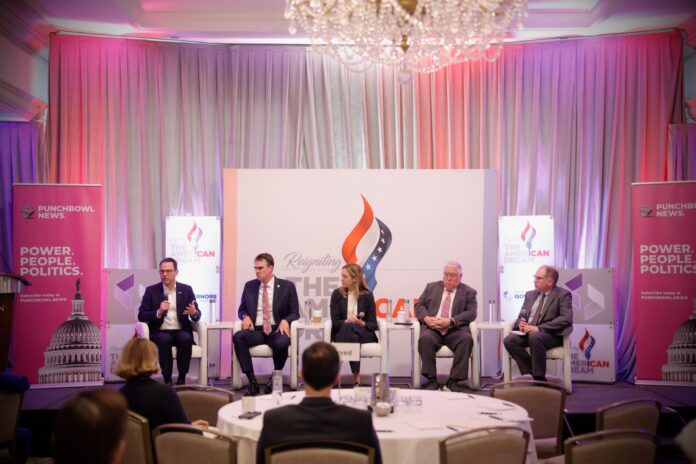

A rare moment of bipartisan alignment unfolded in Philadelphia as a coalition of governors from across the country stepped forward with a unified message: America’s energy future—and its economic trajectory—hinges on the ability to build faster, smarter, and with greater regulatory clarity. The gathering, anchored by a cross-section of political leadership that included Oklahoma, Pennsylvania, Delaware, West Virginia, and New Jersey, marked a defining escalation in the national conversation around energy infrastructure, federal permitting reform, and the mounting pressure on states to act where Washington has stalled.
At the center of the discussion was New Jersey Governor Mikie Sherrill, whose remarks positioned the Garden State not only as a participant in the conversation, but as a critical voice shaping the direction of policy tied to affordability, energy expansion, and consumer protection. Her emphasis was direct and rooted in the lived realities of residents: rising utility costs, increasing pressure on working families, and the urgent need to align infrastructure development with economic relief.
The Philadelphia summit, tied to the broader national initiative led by Oklahoma Governor Kevin Stitt, reflects a growing consensus that the United States is falling behind in its ability to execute large-scale energy projects. Despite vast natural resources and technological capability, the current permitting landscape remains one of the most complex and time-consuming among developed nations. That disconnect—between potential and execution—has become the focal point of a coordinated push among governors who are increasingly unwilling to wait for federal reform to materialize.
Pennsylvania Governor Josh Shapiro underscored that states are already proving what is possible when regulatory systems are modernized. As one of the nation’s top energy-producing states, Pennsylvania has aggressively pursued streamlined processes designed to reduce uncertainty and accelerate timelines without compromising oversight. The message resonated throughout the room: efficiency is not a theoretical goal—it is already being implemented at the state level.
Delaware Governor Matt Meyer added a sharper edge to the conversation, framing the issue as a national imperative rather than a policy preference. His administration has moved to dramatically compress permitting timelines, signaling a shift toward urgency that reflects both economic pressures and the competitive realities of attracting investment. The philosophy is clear—projects that generate jobs, expand energy capacity, and strengthen infrastructure should not be delayed by outdated bureaucratic frameworks.
West Virginia Governor Patrick Morrisey reinforced the connection between energy development and long-term economic mobility, particularly in regions historically tied to resource-based industries. His focus on ensuring that consumers are not burdened by the costs of expansion speaks to a broader tension within the national dialogue: how to balance growth with fairness, and innovation with accountability.
For New Jersey, however, the stakes carry a uniquely immediate dimension. Governor Sherrill’s position reflects a state navigating both high energy demand and elevated cost pressures, where policy decisions translate quickly into household impact. Her call to address utility rate increases and stabilize costs signals a proactive approach that aligns with the broader goals of the bipartisan coalition, while remaining grounded in the economic realities facing residents across the state.
This convergence of leadership is not occurring in isolation. It is part of a larger national framework tied to a yearlong initiative focused on economic opportunity, workforce development, and the infrastructure required to support next-generation technologies—including artificial intelligence and advanced manufacturing. Energy, in this context, is no longer just a sector—it is the foundation upon which future growth will be built.
The urgency behind permitting reform is also being shaped by global competition. As other nations accelerate infrastructure deployment and invest aggressively in energy systems, the United States risks ceding both economic and technological ground if it cannot modernize its own processes. Governors, positioned at the intersection of policy and implementation, are increasingly stepping into that gap—driving reforms at the state level while applying coordinated pressure for federal action.
For readers tracking the evolving political landscape, broader context and ongoing developments can be explored through Sunset Daily’s dedicated politics coverage, where policy shifts, leadership strategies, and national initiatives continue to unfold in real time.
What emerged from Philadelphia was not simply a policy discussion, but a strategic alignment that signals where the momentum is heading. Bipartisan cooperation on energy permitting—once considered unlikely—has now become one of the most actionable areas of agreement in a deeply divided political environment. The implications extend far beyond infrastructure timelines; they touch economic growth, cost of living, technological advancement, and the long-term competitiveness of the United States.
New Jersey’s role in that conversation is increasingly central. As affordability concerns intensify and demand for reliable energy continues to rise, the decisions made now—both at the state and federal level—will shape the trajectory of the region for years to come. The Philadelphia summit may ultimately be remembered not as a standalone event, but as a turning point—where governors moved from dialogue to coordinated action, and where the path toward a more efficient, responsive, and economically aligned energy system began to take clearer form.



