


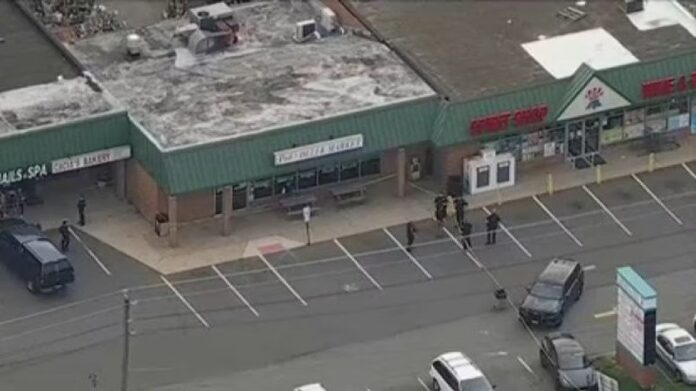

A violent shooting in a busy commercial corridor in Cherry Hill has escalated into a first-degree attempted murder case, with prosecutors outlining a sequence of events and forensic findings that are now placing the accused at the center of a high-stakes criminal proceeding. The incident, which unfolded in a Route 70 strip mall parking lot, has drawn renewed attention to public safety concerns in high-traffic retail areas across South Jersey, while also underscoring the evidentiary standards shaping modern weapons prosecutions.
Authorities have charged 52-year-old Terrence Roberts of Cherry Hill with first-degree attempted murder along with multiple weapons-related offenses following an alleged shooting that left a 61-year-old man with a gunshot wound to the chest. The severity of the charge signals the gravity with which prosecutors are approaching the case, as first-degree attempted murder in New Jersey requires proof of intent to cause death—placing the burden on the state to demonstrate not just the act itself, but the mindset behind it.
According to charging documents, the shooting occurred in a public parking lot along Route 70, a heavily traveled commercial artery lined with retail establishments, dining locations, and service businesses. The location is not incidental. Incidents of this nature in open, public-facing environments introduce heightened risk factors, including potential bystander exposure and rapid escalation in spaces not designed for conflict containment. In that context, the case is already being viewed as more than an isolated act—it is part of a broader discussion about safety, visibility, and response in densely utilized suburban commercial zones.
Investigators moved quickly following the incident, building a case that appears to rely heavily on both physical evidence and post-incident forensic analysis. A search of Roberts’ residence reportedly yielded weapons and ammunition, while examination of his vehicle revealed the presence of gunshot residue. That detail is particularly significant. Gunshot residue analysis can serve as a critical corroborative element in firearms cases, linking individuals to the discharge of a weapon within a defined timeframe. While not dispositive on its own, when combined with other evidence, it can substantially strengthen prosecutorial arguments regarding involvement and proximity to the act.
The victim, who sustained a gunshot wound to the chest, survived the attack, a factor that directly informs the legal framing of the case. In New Jersey, attempted murder charges hinge on both the intent to kill and the execution of an act that could reasonably result in death. The survival of the victim does not diminish the seriousness of the charge; rather, it shifts the legal focus toward reconstructing intent through evidence, witness accounts, and contextual factors surrounding the incident.
From a procedural standpoint, the case is expected to move through a series of pretrial phases where evidentiary challenges, motions, and potential plea negotiations will shape its trajectory. The presence of physical evidence recovered from a residence and vehicle introduces questions around search protocols, chain of custody, and admissibility—issues that defense counsel will likely examine closely. At the same time, prosecutors will aim to establish a cohesive narrative that aligns forensic findings with witness testimony and any available surveillance or digital evidence.
The broader implications of the case extend into ongoing law enforcement and public safety efforts across New Jersey. Incidents involving firearms in commercial districts continue to be a focal point for both local police departments and county prosecutors, particularly as communities seek to balance accessibility and economic activity with safety and deterrence. High-visibility corridors like Route 70 are central to regional commerce, making any disruption or threat within those spaces a matter of both public concern and policy response.
Within the context of statewide coverage, cases like this are part of a larger pattern tracked in the Law & Order section of Sunset Daily News New Jersey, where developments in criminal justice, enforcement strategy, and prosecutorial action intersect with everyday life across the state. The Cherry Hill case, while specific in its facts, reflects broader themes that continue to shape how law enforcement agencies respond to violent crime in suburban environments.
As the legal process unfolds, attention will remain focused on how the evidence is presented and challenged, and how the courts interpret the threshold for intent in attempted murder cases involving firearms. For Cherry Hill and the surrounding region, the incident serves as a stark reminder of how quickly routine environments can become the setting for serious criminal activity—and how critical the subsequent investigative and judicial processes are in delivering accountability.
The coming months will determine how this case ultimately resolves, but its significance is already clear. It is a convergence of violent crime, forensic investigation, and legal scrutiny playing out in one of New Jersey’s most active suburban corridors, with implications that extend beyond a single defendant to the broader systems tasked with maintaining public safety.



