



New Jersey woke up Tuesday morning to the aftermath of a volatile weather event that delivered everything from damaging wind gusts to widespread power outages, forcing residents and emergency crews into immediate response mode across multiple counties. After a late-afternoon and evening setup primed for severe weather, the system intensified overnight, pushing through with force before exiting offshore by sunrise—leaving behind a colder, wind-driven pattern that now defines the rest of the week.
The story unfolding across the Garden State is one of sharp contrast: a dramatic overnight transition from springlike warmth and storm energy into a raw, wind-chilled landscape that feels more like late winter than mid-March.
Overnight Storm System Unleashes Widespread Damage
The storm system that moved through New Jersey was not just another round of rain—it was a high-impact atmospheric event fueled by strong wind shear, a volatile warm sector, and a fast-moving cold front that accelerated beyond earlier forecast expectations.
Beginning Monday afternoon, conditions rapidly deteriorated as a pre-frontal trough delivered heavy rain and embedded thunderstorms across the state. Between roughly 2 p.m. and early evening, New Jersey experienced its most intense period of weather, with torrential downpours and powerful wind gusts capable of producing structural damage and downing trees.
As the evening progressed, the atmosphere remained unstable. The National Weather Service issued tornado alerts across much of the region, citing a dangerous combination of warm southerly flow clashing with cyclonic circulation—an environment capable of spinning up brief tornadoes. While confirmation of tornado touchdowns is still under investigation, early reports indicate extensive wind-related damage throughout multiple communities.
By the time the cold front swept through overnight, the storm transitioned into a narrower but intense line of heavy rain and gusty winds. Newark Liberty International Airport recorded a peak wind gust of 71 mph—an indicator of just how powerful this system became as it crossed the region.
Power Outages and Infrastructure Impact Across the State
The aftermath has been significant. Tens of thousands of residents across New Jersey were left without power as high winds knocked down utility lines and uprooted trees. Emergency crews have been working continuously since the overnight hours to clear debris, restore electricity, and assess structural impacts.
Reports of fallen trees and damage to buildings have surfaced from multiple counties, underscoring the widespread reach of the storm. While the full extent of the damage is still being evaluated, the early picture points to a classic high-wind event with localized severe impacts rather than a single concentrated zone.
A Dramatic Temperature Drop: Winter Returns Overnight
As quickly as the storms arrived, they exited—replaced by a much colder and drier air mass now dominating the region.
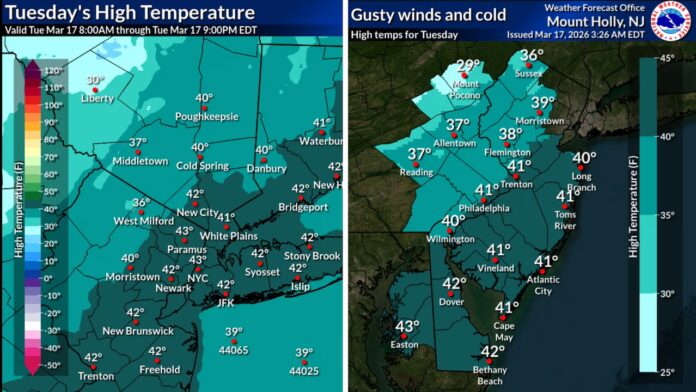
Tuesday’s high temperatures are struggling to reach the upper 30s to low 40s statewide, a stark contrast to the mild conditions experienced just 24 hours earlier. However, the bigger story is the wind: gusts up to 35 mph throughout the day are driving wind chill values down into the 20s and 30s, making it feel significantly colder than the actual temperature.
The shift in wind direction—from southerly ahead of the storm to westerly and northwesterly behind the front—marks the arrival of this colder pattern. While winds will gradually diminish later Tuesday and into the evening, the chill will remain locked in.
By Tuesday night, temperatures are expected to drop into the 20s across much of the state, reinforcing the late-winter feel.
Midweek Outlook: Cold but Quiet Across New Jersey
The good news for residents and recovery efforts is that the active weather pattern has now settled.
Wednesday continues the colder-than-average trend, with highs hovering near 40 degrees and some areas—particularly in higher elevations and along the coast—remaining stuck in the upper 30s. Winds will be lighter compared to Tuesday, but the air mass will remain firmly on the cold side.
Skies will feature a mix of sun and clouds early before trending cloudier into the afternoon and evening. Overnight lows will once again dip into the mid-20s to low-30s range statewide.
Gradual Moderation Begins Thursday
By Thursday, a noticeable shift begins as temperatures recover closer to seasonal norms. Highs will reach into the upper 40s to near 50 degrees, offering a more typical mid-March feel across New Jersey.
Conditions will remain relatively calm, with a mix of sun and clouds and light winds. Overnight temperatures will stay above freezing for most areas, signaling the beginning of a more stable pattern heading into the end of the week.
Friday into the Weekend: Spring Showers Return, But No Severe Threat
Looking ahead, Friday introduces the next weather system, though it lacks the intensity of the storm that just moved through.
Temperatures will rise into the 50s and even approach 60 degrees in parts of the state away from the immediate coastline. Clouds will increase throughout the day, with scattered showers developing Friday night into early Saturday.
Unlike Monday’s severe setup, this system appears far less aggressive. Current expectations point to typical springtime rain showers rather than widespread severe weather. However, in northern and western portions of New Jersey, there is a possibility that some precipitation could briefly mix with snow, particularly during overnight hours—though little to no accumulation is expected.
Saturday trends milder, with temperatures climbing well into the 50s and potentially touching 60 degrees in select areas. Sunday brings a slight cooldown along with additional chances for light rain.
No Major Snow Signals as Winter Window Closes
One of the more notable takeaways from the evolving forecast is the absence of any significant snowstorm signals on the horizon. While minor wintry mixes remain possible in elevated or inland areas, the broader atmospheric pattern suggests that the window for major snowfall is rapidly closing.
With each passing system trending milder and more progressive, New Jersey appears to be transitioning out of its winter phase and into a more typical early spring pattern.
What This Means for New Jersey Residents
This week’s weather evolution highlights the volatility of March in the Northeast—where severe thunderstorms, damaging winds, and winter-like cold can all occur within a 24-hour window.
For residents, the immediate focus remains on recovery and cleanup following the overnight storms, particularly in areas hit hardest by power outages and tree damage. At the same time, the colder conditions serve as a reminder that winter’s influence has not fully released its grip just yet.
As the week progresses, conditions become more manageable, offering a stretch of quieter weather before the next round of rain arrives heading into the weekend.
New Jersey’s weather story this week is one of resilience and rapid transition—an atmospheric reset that underscores just how dynamic the season can be.



