


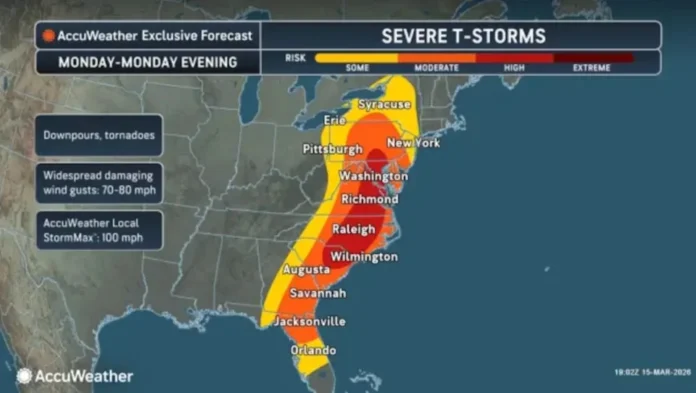

New Jersey is entering a volatile stretch of weather as a powerful storm system moves toward the region, prompting meteorologists to issue a Red Alert for Monday, March 16, 2026. Forecasters warn that the developing system could bring severe thunderstorms, damaging winds, torrential rain, and even isolated tornadoes as it sweeps through the state late Monday afternoon and evening.
The most dangerous window for severe weather is expected between 4:00 p.m. and 11:00 p.m. Monday, although the overall storm pattern will impact the region beginning late Sunday night and continuing into early Tuesday morning. As conditions rapidly evolve, residents across New Jersey are being urged to prepare for potentially hazardous weather conditions that could disrupt travel, cause power outages, and produce damaging wind gusts.
Severe weather events like this serve as a reminder of how quickly conditions can change across the Garden State, especially as winter transitions toward spring. Across the state’s major urban centers, suburban communities, and coastal towns, local infrastructure and residential properties must remain resilient in the face of increasingly dynamic weather patterns. Coverage of housing trends, infrastructure resilience, and regional development continues across the Sunset Daily News real estate section, where issues affecting homeowners and communities throughout New Jersey are closely monitored.
The approaching system is tied to a rapidly intensifying low-pressure center forming over the western Great Lakes. Meteorologists describe the system as “bombing out,” meaning it is strengthening quickly as it tracks across the Midwest. This strengthening storm is dragging a powerful cold front across the eastern United States while pulling unusually warm and moist air northward into the Mid-Atlantic region.
This combination of ingredients creates an environment favorable for severe weather development.
Ahead of the cold front, New Jersey will find itself inside the system’s warm sector, where unstable atmospheric conditions can allow thunderstorms to intensify rapidly. In this zone, warm air rising from the surface interacts with cooler air moving through the upper atmosphere, creating the type of vertical instability that fuels strong storm systems.
When these atmospheric forces collide, thunderstorms can organize into powerful storm lines capable of producing damaging straight-line winds, heavy rainfall, and rotating updrafts that occasionally develop into tornadoes.
The highest threat for severe winds and potential tornadic activity appears to be concentrated across southwestern portions of New Jersey, though the entire state remains at risk for strong storms and heavy rain.
Forecasters say residents west of an imaginary line stretching from Cape May through Trenton and into northwestern New Jersey are most likely to experience the strongest storm activity.
Communities east of that line, including portions of northeastern New Jersey and coastal areas, may see slightly reduced severe wind potential but will still experience widespread rain, strong gusty winds, and possible thunderstorms as the system passes through.
Wind will be one of the most significant hazards associated with this storm.
Meteorologists expect sustained gusts between 40 and 50 miles per hour, with isolated bursts potentially reaching 75 miles per hour in stronger thunderstorms. Such winds can bring down tree limbs, scatter unsecured outdoor objects, and cause localized power outages.
Because of these risks, a Wind Advisory has been issued across the region beginning at 2:00 p.m. Monday and lasting until 2:00 a.m. Tuesday.
Heavy rain will also accompany the storm system.
Rather than a continuous downpour, forecasters expect waves of rain and thunderstorms moving across the state throughout the day and evening. Periods of rain may be followed by brief breaks, creating a pattern of repeated showers that could lead to localized flooding in areas with poor drainage.
The storm timeline begins late Sunday night, when warmer air begins pushing into the region ahead of the advancing system.
Rain showers are expected to begin developing around midnight Sunday night, moving gradually from south to north across the state. These early rounds of precipitation will help establish the warm, humid conditions necessary for stronger storms to develop later.
By Monday morning, temperatures will climb rapidly as the warm sector strengthens. Despite the calendar still reading March, daytime highs could reach the mid-60s to low-70s, creating unusually mild conditions for this time of year.
The warmth will play a key role in determining the severity of the storms later in the day.
Meteorologists closely watch a phenomenon known as diurnal heating, which refers to how much the sun warms the ground and destabilizes the atmosphere during daylight hours. If cloud cover limits solar heating, storm intensity may remain somewhat limited.
However, if the sun breaks through the clouds for extended periods during the afternoon, the atmosphere could become significantly more unstable.
In weather forecasting circles, this scenario is sometimes summarized with the phrase “sun’s out, guns out.” The more sunlight that reaches the surface, the more energy thunderstorms can draw from the atmosphere later in the evening.
That means the weather conditions between midday and late afternoon Monday will play an important role in determining how intense the evening storm line becomes.
Current projections suggest the most organized storm activity will arrive in southwestern New Jersey around 7:00 to 8:00 p.m. Monday evening.
From there, the storm front will move rapidly northeast across the state, pushing through central New Jersey and eventually reaching northeastern counties sometime between midnight and 2:00 a.m. Tuesday morning.
As the system moves eastward, it will gradually weaken due to several stabilizing atmospheric factors.
One of these influences comes from the Atlantic Ocean. As the storm approaches the coast, cooler marine air flowing inland may help reduce the intensity of thunderstorms, transforming severe storm cells into more traditional rain showers accompanied by gusty winds.
Another factor is the loss of daytime heating once the sun sets. Without solar energy fueling the storms, atmospheric instability begins to diminish.
By the early morning hours of Tuesday, the storm system is expected to move offshore, leaving behind cooler temperatures and clearing skies.
In some of the higher elevations of northwestern New Jersey and neighboring areas of the Poconos, the departing system could even produce a brief wintry mix or light snow as colder air rushes in behind the cold front.
The shift will be dramatic.
Temperatures that climbed into the 60s on Monday could drop sharply overnight, leading to chilly conditions Tuesday with highs near the low 40s and brisk winds lingering throughout the day.
Looking beyond the storm itself, the seven-day outlook for New Jersey suggests a pattern of fluctuating temperatures typical of late winter transitioning toward early spring.
Tuesday will be sunny but cold and windy following the storm’s departure. Midweek conditions remain cool, with highs in the low 40s before temperatures gradually moderate later in the week.
By Thursday and Friday, readings should climb back into the low to mid-50s, just in time for the arrival of the spring equinox, marking the official start of the new season.
While Monday’s storm may be brief, its intensity underscores the importance of preparation during severe weather events.
Residents across New Jersey are encouraged to secure loose outdoor items such as patio furniture, trash cans, and decorations that could become airborne during strong wind gusts. Drivers should exercise caution, particularly those operating high-profile vehicles that may be affected by crosswinds.
Power outages are also possible if strong winds bring down tree limbs or power lines, so households may want to prepare emergency supplies such as flashlights, batteries, and fully charged mobile devices.
The approaching storm system represents one of the most dynamic weather setups New Jersey has experienced so far this year.
7-Day Forecast for New Jersey
| Day | Conditions | High / Low |
|---|---|---|
| Mon, Mar 16 | Severe Storms / Heavy Rain | 66°F / 33°F |
| Tue, Mar 17 | Mostly Sunny, Windy & Cold | 41°F / 25°F |
| Wed, Mar 18 | Partly Sunny and Chilly | 42°F / 28°F |
| Thu, Mar 19 | Mostly Cloudy and Milder | 52°F / 34°F |
| Fri, Mar 20 | Clouds and Sun (Spring Equinox) | 56°F / 39°F |
| Sat, Mar 21 | Mostly Cloudy, Few Showers | 56°F / 35°F |
| Sun, Mar 22 | Partly Sunny | 52°F / 32°F |
From late Sunday night through early Tuesday morning, the state will move through several distinct phases of weather—from warm springlike conditions to heavy rain, strong thunderstorms, and ultimately a return to colder air.
For residents across the Garden State, it will be a reminder that March often delivers some of the most unpredictable and dramatic weather patterns of the year.
As meteorologists continue monitoring the evolving system, New Jersey communities are preparing for a powerful night of weather that could include heavy rain, damaging winds, and potentially severe storms before calmer conditions return later this week.