


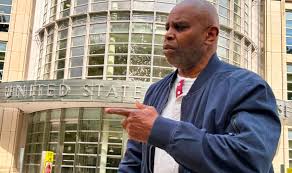

A sprawling federal fraud case centered around a commercial property transaction in Freehold, New Jersey is rapidly escalating into one of the region’s most explosive real estate and public corruption scandals in recent memory, after federal prosecutors accused a former New York Supreme Court justice and a Brooklyn real estate developer of orchestrating an alleged multimillion-dollar escrow fraud scheme that authorities say manipulated judicial credibility, exploited investor trust, and diverted millions of dollars tied to a supposedly distressed Monmouth County property deal.
Federal prosecutors with the United States Attorney’s Office for the Eastern District of New York have charged former Brooklyn Supreme Court Justice Edward Harold King and Brooklyn developer Sam Sprei with wire fraud conspiracy after investigators alleged the pair orchestrated a scheme involving approximately $6.5 million connected to what authorities describe as a fraudulent escrow arrangement tied to a commercial property in Freehold.
The allegations have sent shockwaves through legal, political, and real estate circles throughout both New Jersey and New York because the case combines several of the most sensitive pressure points inside modern commercial development simultaneously: judicial integrity, escrow trust manipulation, bankruptcy-linked property transactions, interstate real estate speculation, and allegations involving the misuse of legal authority to secure investor confidence.
At the center of the federal complaint is the accusation that King’s judicial position was leveraged as a core component of the scheme itself.
According to prosecutors, Sprei approached two real estate investors in late 2024 with what appeared to be a high-value opportunity involving a commercial property in Freehold allegedly tied to bankruptcy proceedings and an anticipated auction process. Prosecutors say investors were told substantial funds needed to be placed into escrow to demonstrate financial capacity and seriousness as bidders.
The escrow account, authorities allege, was presented as secure specifically because it would be controlled by King, whose status as a sitting judge allegedly became a central selling point in convincing the investors that their money would remain protected, refundable, and untouched pending the property process.
Federal investigators now claim that assurance was false.
According to the criminal complaint, once the investors transferred approximately $6.5 million into the escrow account, large portions of the funds were quickly moved out of the account and redirected into financial channels allegedly controlled by Sprei. Prosecutors allege the transfers violated the terms under which the funds had originally been deposited and were conducted without authorization from the investors themselves.
The mechanics of the alleged scheme reflect a form of financial manipulation prosecutors increasingly warn is becoming more sophisticated inside portions of the commercial real estate sector.
Modern real estate transactions — especially those involving distressed assets, bankruptcy proceedings, redevelopment opportunities, or competitive auction environments — often move rapidly and involve substantial sums placed into escrow under compressed timelines. Investors frequently rely heavily on attorneys, fiduciaries, title professionals, and judicial credibility when navigating complex transactions involving high-value properties.
That reliance on institutional trust is precisely what makes the allegations surrounding the Freehold case so politically and legally explosive.
Federal prosecutors allege that King did not merely function as a passive participant, but actively reinforced investor confidence by using the credibility associated with his judicial role. The complaint further alleges that when investors later became suspicious and demanded the return of their funds, additional misrepresentations were made involving supposed trustees, court-related transfer complications, and administrative obstacles allegedly preventing immediate repayment.
Authorities claim those explanations were fabricated.
The investors eventually discovered, according to prosecutors, that the actual auction process connected to the Freehold property required a deposit of only approximately $250,000 — a tiny fraction of the $6.5 million allegedly transferred into escrow.
By the time the investors fully recognized the alleged deception, federal authorities say only roughly $1.5 million had been returned, while the remaining funds were allegedly diverted and spent.
The case is drawing extraordinary attention not only because of the dollar amount involved, but because of the profile of the individuals accused.
Before his arrest, King had spent decades building a legal and judicial career within New York’s institutional framework. He previously served as counsel to the New York State Assembly and later worked as an administrative law judge connected to the city’s Parking Violations Bureau. He successfully won election to New York City Civil Court in Brooklyn before later being elevated to the state Supreme Court in 2024.
That trajectory made the allegations especially stunning inside legal circles.
Judges occupy uniquely powerful positions within the American legal system because the entire structure of commercial law, escrow protection, contractual enforcement, and fiduciary integrity depends heavily on public confidence in institutional neutrality and ethical conduct. Any allegation suggesting judicial status was used to facilitate financial deception therefore strikes directly at the credibility of legal systems themselves.
The scandal becomes even more damaging given the allegations surrounding King’s outside financial activity.
Federal prosecutors noted that King ultimately resigned from the bench following scrutiny tied to alleged side dealings and conduct potentially violating judicial ethics rules prohibiting full-time judges from engaging in outside fiduciary or legal business activities. The timing of that resignation now appears likely to receive intense additional scrutiny as investigators continue examining the broader financial relationships surrounding the case.
Sprei’s role is also attracting growing federal attention.
Prosecutors reportedly indicated during initial court proceedings that the Freehold-related allegations may represent only one component of a larger pattern of financial activity currently under federal investigation. Authorities referenced multiple schemes allegedly involving millions of dollars moving through accounts connected to Sprei, suggesting the Freehold matter may ultimately expand into a much broader inquiry involving commercial real estate transactions and investor activity.
That possibility is especially significant because commercial real estate fraud remains one of the most difficult forms of financial crime to detect quickly.
Unlike simpler consumer scams, sophisticated real estate fraud schemes often involve layers of legitimate documentation, corporate structures, escrow processes, banking channels, legal intermediaries, and rapidly moving transactional timelines that can initially appear entirely routine. The complexity of commercial property law itself frequently allows fraudulent actors to exploit investor assumptions regarding legitimacy, especially when institutional authority figures appear connected to transactions.
New Jersey’s booming redevelopment and commercial property environment creates particularly fertile conditions for this type of activity.
Over the last decade, communities throughout Monmouth County, Middlesex County, Hudson County, Essex County, and portions of South Jersey have experienced aggressive redevelopment activity involving distressed assets, mixed-use projects, logistics infrastructure, multifamily housing expansion, and speculative investment opportunities. Large pools of private capital continue flowing into the state seeking redevelopment returns tied to population density, transportation access, and proximity to New York City and Philadelphia.
That rapid investment activity has created enormous financial opportunity — but also heightened exposure to fraud risk.
The Freehold connection itself is especially notable because Monmouth County continues attracting significant investor attention as commercial corridors evolve and redevelopment pressures intensify throughout Central Jersey. Distressed or bankruptcy-linked properties can become particularly attractive targets for aggressive speculative investors seeking undervalued assets with redevelopment potential.
Federal investigators increasingly warn that sophisticated fraud actors often exploit precisely these types of fast-moving investment environments.
The broader legal implications of the case may become substantial.
Wire fraud conspiracy charges carry severe federal penalties because they involve misuse of interstate financial systems and electronic communications in furtherance of alleged criminal conduct. If convicted, both King and Sprei could face up to 20 years in federal prison.
Still, the allegations remain accusations at this stage, and both defendants remain entitled to the presumption of innocence while the case proceeds through federal court.
Yet regardless of the eventual outcome, the scandal is already raising larger questions about oversight, fiduciary accountability, escrow protection systems, judicial ethics enforcement, and the vulnerability of high-value real estate transactions to sophisticated manipulation.
For New Jersey’s commercial real estate world, the case serves as a stark reminder that institutional credibility itself can become one of the most valuable — and dangerous — currencies inside speculative property markets.
Because in modern development culture, where massive sums move rapidly between investors, attorneys, lenders, developers, and redevelopment entities, trust often becomes operational infrastructure itself.
And according to federal prosecutors, that trust is exactly what may have been weaponized inside the alleged Freehold scheme.



