


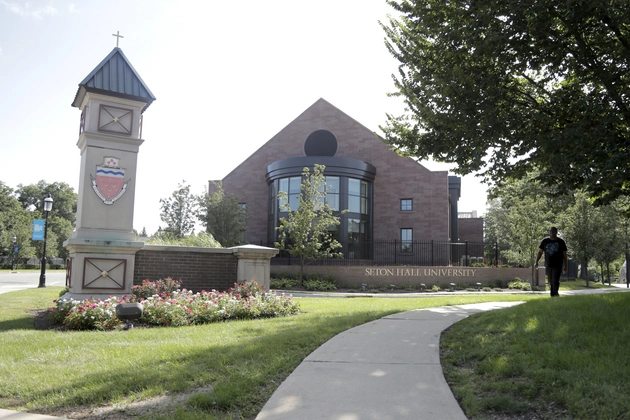

A growing legal confrontation involving Seton Hall University, allegations connected to former cardinal Theodore McCarrick, and a disputed internal report tied to clergy abuse handling is rapidly evolving into one of the most consequential institutional transparency battles currently unfolding in New Jersey’s higher education and religious landscape.
At the center of the dispute is Seton Hall’s effort to prevent the release of a report connected to the university’s handling of abuse-related matters involving McCarrick, with the school arguing that attorney-client privilege protects the document from disclosure despite a legal order seeking its release. Plaintiffs involved in the broader litigation are pushing back aggressively, arguing that the report’s alleged distribution beyond internal legal channels — including claims it was shared with the Vatican — undermines the university’s privilege argument and raises broader questions surrounding institutional accountability, disclosure obligations, and the long shadow of the Catholic Church abuse crisis.
The case is drawing increasing statewide and national attention because it sits at the intersection of several emotionally explosive issues simultaneously: clergy abuse allegations, institutional secrecy, legal privilege doctrine, higher education governance, survivor rights, religious authority, and public trust in powerful organizations.
For New Jersey, the controversy carries especially significant weight.
Seton Hall is not merely another private university. It remains one of the state’s most historically influential Catholic institutions, deeply tied to religious leadership, academic culture, legal education, political networks, and the broader identity of Catholic higher education in the Northeast. Any legal battle involving allegations of withheld information tied to abuse-related matters therefore extends far beyond ordinary civil litigation.
The dispute surrounding the report now threatens to reopen painful questions many institutions have spent years attempting to navigate following decades of revelations involving abuse, cover-ups, administrative failures, and systemic secrecy inside portions of the Catholic Church hierarchy.
McCarrick himself remains one of the most infamous figures connected to the broader clergy abuse scandal.
Once among the most powerful Catholic leaders in the United States, the former cardinal’s downfall sent shockwaves throughout the global Church and dramatically intensified public scrutiny surrounding institutional accountability, episcopal oversight, and the extent to which religious leadership structures may have failed to address allegations over extended periods of time.
The legal fight now unfolding involving Seton Hall reflects how unresolved many of those institutional questions remain.
At the core of the university’s argument is attorney-client privilege, one of the most foundational doctrines within the American legal system. Privilege protections exist to ensure confidential communications between attorneys and clients remain protected from disclosure, allowing organizations and individuals to seek legal advice candidly without fear that those discussions will later become public evidence.
Seton Hall’s legal position reportedly argues that the report falls within those protections and therefore should remain shielded from disclosure despite court pressure.
But plaintiffs challenging the university’s position argue that privilege protections may no longer apply if the document was distributed beyond confidential legal channels. Their claim that the report was shared with Vatican officials has become especially significant because attorney-client privilege can be weakened or waived if protected communications are broadly disseminated outside privileged relationships.
That legal distinction may become pivotal.
The outcome could shape not only this specific dispute, but broader standards involving institutional investigations, internal reports, religious organizations, and disclosure obligations in future abuse-related litigation.
The broader implications are enormous because modern institutions increasingly rely on internal investigations conducted by outside counsel during moments of crisis. Universities, corporations, religious organizations, nonprofits, government entities, and healthcare systems routinely commission legal reviews during scandals or allegations specifically to assess liability exposure, institutional response, and risk management.
Questions surrounding when those reports remain protected — and when disclosure may become legally required — are now becoming central battles in high-profile litigation across the country.
In this case, however, the emotional and moral dimensions dramatically intensify the stakes.
Abuse survivors and advocacy groups have spent decades arguing that institutional secrecy and legal maneuvering historically prevented public accountability and delayed justice in clergy abuse cases. Many survivors continue expressing deep skepticism toward claims of confidentiality involving reports connected to institutional handling of abuse allegations.
For critics of Seton Hall’s position, the legal battle is not simply about privilege doctrine.
It is about whether powerful institutions continue prioritizing internal protection over transparency surrounding matters involving alleged abuse and institutional oversight failures. The plaintiffs’ argument effectively reframes the issue as one involving public accountability rather than procedural confidentiality alone.
The university, meanwhile, faces an extraordinarily difficult balancing act.
On one hand, institutions routinely defend privilege protections because weakening them can create major legal and operational consequences extending far beyond any individual case. Universities, hospitals, corporations, and religious organizations all depend heavily on confidential legal review processes when confronting sensitive matters involving liability, governance, and internal investigations.
On the other hand, public trust surrounding institutional secrecy in abuse-related matters remains profoundly damaged.
That tension is now defining much of the legal and public relations struggle surrounding the case.
The involvement of the Vatican allegation adds another highly sensitive dimension because it potentially broadens the dispute beyond domestic institutional governance into questions involving global Church communication structures and ecclesiastical oversight relationships. If plaintiffs successfully demonstrate broader dissemination of the report, it could complicate privilege arguments significantly while intensifying pressure for disclosure.
The legal fight also arrives during a period when institutions nationwide continue confronting heightened public demands for transparency.
Universities in particular now operate under extraordinary scrutiny involving governance decisions, internal investigations, sexual misconduct allegations, administrative accountability, donor influence, and crisis management practices. Public confidence in institutional self-policing has weakened substantially over the past decade across multiple sectors of society.
For Catholic institutions, these pressures are magnified by the lasting damage created through decades of abuse revelations and accusations of systemic concealment.
Even years after the largest phases of the clergy abuse scandal first exploded publicly, legal disputes involving withheld documents, institutional investigations, or transparency battles continue generating intense public attention because many people believe full accountability has never been completely achieved.
Seton Hall therefore finds itself operating within an environment where legal strategy, moral perception, and institutional reputation are deeply intertwined.
The university’s handling of the dispute may ultimately shape not only courtroom outcomes, but broader public perception surrounding how modern Catholic institutions approach accountability and disclosure in the post-McCarrick era.
The educational implications are also significant.
Universities today increasingly function not simply as academic institutions, but as cultural and moral actors whose governance decisions are scrutinized through ethical, political, and social lenses. Students, faculty, alumni, donors, and the public increasingly evaluate institutions according to perceived transparency, accountability, and responsiveness during moments of controversy.
This evolution has transformed how higher education crises unfold publicly.
Internal legal disputes that once may have remained largely confined to court filings now rapidly become broader public debates involving institutional values, survivor advocacy, media scrutiny, and reputational legitimacy.
New Jersey itself occupies a particularly important place within these conversations because of the state’s deep Catholic institutional history and the significant role Catholic education continues playing throughout the region. Seton Hall’s prominence within both higher education and Catholic leadership circles ensures the case carries influence extending well beyond South Orange.
The broader legal community is also watching carefully.
Attorney-client privilege remains one of the most fiercely defended principles within American jurisprudence, and any high-profile case testing the boundaries of privilege waiver inevitably draws substantial attention from legal scholars, litigators, compliance experts, and institutional counsel nationwide.
At the same time, survivor advocacy movements continue pushing courts and institutions toward greater disclosure standards in abuse-related matters, arguing that secrecy historically enabled patterns of institutional protection at the expense of vulnerable individuals.
These competing forces now collide directly inside the Seton Hall litigation.
The emotional weight surrounding the McCarrick connection ensures the case cannot be viewed merely as a technical procedural dispute. McCarrick’s name itself remains deeply associated with larger questions involving institutional failure, ecclesiastical power structures, and whether organizations entrusted with moral authority adequately protected victims or confronted misconduct transparently.
That historical context fundamentally shapes public interpretation of the current legal battle.
Regardless of how the court ultimately rules, the dispute is already reinforcing broader societal questions about transparency, institutional credibility, and the limits of confidentiality when allegations involving abuse and organizational oversight enter the legal system.
For New Jersey residents, alumni, Catholic communities, and survivors alike, the case represents another chapter in a long and painful reckoning that continues reshaping how powerful institutions are viewed throughout American society.
Because the battle now unfolding is ultimately about far more than a single report.
It is about whether institutions confronting their most difficult histories can still rely on traditional systems of confidentiality and internal control in an era where public trust increasingly depends on openness, accountability, and the willingness to confront uncomfortable truths directly.