



New Jersey wakes up on April 16, 2026, at a moment that feels unusually concentrated with consequence. Across government, infrastructure, education, and even the emotional landscape of the state’s sports identity, multiple storylines are converging into a single, unmistakable signal: this is not a routine news cycle. This is a pivot point. From a high-stakes congressional special election to intensifying pressure on the state budget, from uncertainty in Washington representation to global-scale preparations in Newark, the Garden State is navigating a period where decisions made now will carry measurable weight well beyond the coming months.
The most immediate test of that moment is unfolding at the ballot box. Voters in New Jersey’s 11th Congressional District are casting ballots today in a special election that has drawn outsized attention not just because of the vacancy it fills, but because of what it represents. The seat, vacated when Mikie Sherrill ascended to the governorship, has created a political vacuum that both parties recognize as strategically significant. The race between Analilia Mejia and Joe Hathaway has crystallized around a theme that has come to define the broader New Jersey conversation: affordability. That word, once a recurring talking point, has now hardened into a central pressure point for residents across income levels, municipalities, and industries. Housing costs, property taxes, transportation expenses, and everyday economic strain are no longer abstract policy issues—they are shaping how voters evaluate leadership in real time.
What makes this election particularly consequential is not simply the outcome, but the signal it will send. The 11th District is often viewed as a bellwether for suburban sentiment in New Jersey, and the tone of this race reflects a deeper recalibration among voters who are increasingly demanding tangible, immediate results. Campaign messaging has leaned heavily into cost-of-living relief, economic stability, and accountability, reflecting a state electorate that is no longer satisfied with incremental progress. The winner of this race will step into a national legislative environment already defined by tight margins and heightened stakes, meaning that New Jersey’s influence in Washington could shift in ways that extend far beyond district lines.
As New Jersey voters head to the polls in the 11th Congressional District, the closing days of this special election have crystallized into something far more complex than a traditional partisan contest. What began as a race to fill a high-profile vacancy has evolved into a revealing test of political identity, voter alignment, and strategic positioning in a district that continues to reflect the broader shifts shaping New Jersey’s electorate. With Democrat Analilia Mejia and Republican Joe Hathaway facing off, the final stretch of the campaign has brought into focus a defining question: what does it mean to run as an independent voice within a party structure that is itself under scrutiny?
Hathaway’s approach has drawn particular attention, not because it follows a conventional Republican playbook, but because it deliberately steps outside of it in key areas. In recent public appearances, including a nationally televised interview, Hathaway emphasized his intention to prioritize district interests over party orthodoxy, a message that candidates across the political spectrum routinely deliver. What has distinguished his messaging, however, is his willingness to openly critique elements of former President Donald Trump’s policy approach—an uncommon posture within today’s Republican landscape, where intra-party criticism is often limited or carefully calibrated.
That divergence has been most visible in Hathaway’s comments on infrastructure and economic policy. His criticism of the handling of the Gateway Tunnel project, a cornerstone transportation initiative with direct implications for New Jersey commuters and regional commerce, signals an attempt to align with local priorities over national political alignment. By framing the issue in terms of tangible impact—delays, uncertainty, and economic consequence—Hathaway has positioned himself within a pragmatic lane that resonates with voters who view infrastructure not as an abstract policy debate, but as a daily lived experience tied to mobility, employment, and long-term growth.
Similarly, his remarks on tariffs and their effect on small businesses reflect an effort to connect national economic policy with localized outcomes. In a district that includes diverse commercial corridors and small business communities, the argument that federal trade decisions can directly influence operating costs and sustainability introduces a layer of economic realism that transcends partisan framing. Hathaway’s opposition to workforce reductions at Picatinny Arsenal further reinforces this strategy, grounding his campaign in issues that have immediate relevance to employment, defense infrastructure, and regional stability.
This positioning, while notable, unfolds within a political environment that remains structurally challenging for any Republican candidate in the district. The 11th District, spanning parts of Morris, Passaic, and Essex counties, carries a significant Democratic registration advantage—one that has historically shaped electoral outcomes and continues to influence campaign strategy. Early voting data underscores that reality. With more than 54,000 ballots already cast through mail-in and early voting channels, the distribution reflects a substantial lead for registered Democrats, creating a numerical gap that presents a steep path for Hathaway to overcome on Election Day.
For Mejia, the campaign has centered on reinforcing that advantage while maintaining a message that aligns with both district priorities and broader Democratic positioning. Her focus on affordability, economic equity, and policy differentiation has remained consistent, and her efforts to engage voters through both in-person outreach and virtual fundraising have extended the campaign’s reach into its final hours. A high-profile virtual event featuring Representative Ro Khanna adds another dimension, signaling continued national interest in the race and reinforcing the interconnected nature of local and federal political dynamics.
The campaign has also navigated more sensitive terrain, particularly around international issues and their domestic implications. Hathaway’s attempt to draw distinctions around voter concerns within specific communities introduces a layer of complexity that reflects the evolving nature of political discourse in diverse districts. Mejia, for her part, has emphasized a clear separation between criticism of foreign government policy and the safety and identity of local communities, framing the issue in a way that seeks to maintain clarity while addressing voter concerns. These exchanges highlight how even globally oriented topics can become localized in their impact, shaping voter perception and campaign narrative in real time.
What makes this election especially significant is not simply the contrast between two candidates, but the broader context in which it is unfolding. This is not a static political environment. New Jersey’s electorate continues to evolve, influenced by demographic changes, economic pressures, and shifting expectations around governance and accountability. The emphasis on affordability across both campaigns reflects a shared recognition that voters are increasingly focused on immediate, tangible outcomes—cost of living, access to resources, and economic stability—rather than abstract ideological positioning.
At the same time, the race offers insight into how candidates are navigating party identity in an era where alignment is often scrutinized as closely as policy. Hathaway’s willingness to critique elements of his party’s recent leadership approach represents one model of engagement, one that seeks to carve out space for independence within a defined political structure. Mejia’s campaign, grounded in established Democratic priorities while engaging with contemporary issues, reflects another approach—one that emphasizes continuity while addressing evolving voter concerns.
The early vote totals, while not determinative, provide a snapshot of the electoral landscape entering the final phase. A significant Democratic lead in early ballots suggests a structural advantage that aligns with the district’s registration profile. However, Election Day turnout, voter intensity, and last-minute momentum can still influence the final outcome, particularly in a race where messaging, perception, and turnout dynamics intersect in complex ways.
Beyond the immediate result, the implications of this election extend into the broader political and policy environment. The winner will enter Congress at a time of heightened legislative activity, where margins are narrow and individual votes carry amplified significance. For New Jersey, representation in Washington is not merely symbolic—it directly impacts funding, infrastructure development, and policy outcomes that shape the state’s trajectory.
Within the context of ongoing developments across New Jersey—from budget negotiations and education funding debates to infrastructure planning and global event preparation—the CD-11 election becomes part of a larger narrative. It reflects a state actively negotiating its priorities, balancing competing demands, and redefining what effective representation looks like in a rapidly changing environment.
As polls remain open and voters make their final decisions, the race stands as a clear example of how local elections can encapsulate national themes while remaining grounded in district-specific realities. Independence, party alignment, economic pressure, and voter engagement are all in play, creating a contest that is as much about direction as it is about outcome. In a state where political, economic, and social forces continue to converge, this election offers a focused lens into the evolving dynamics that will shape New Jersey’s future.
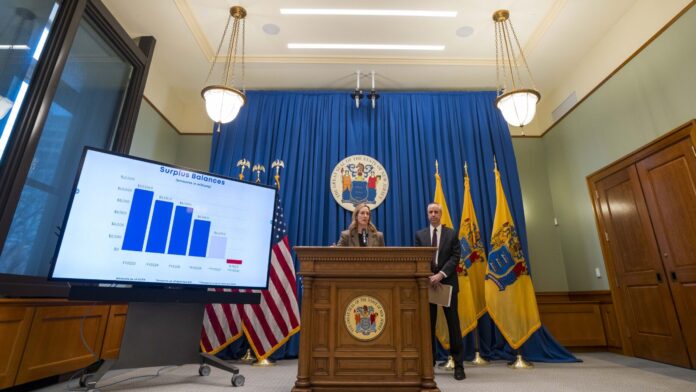
While voters decide representation at the federal level, lawmakers in Trenton are confronting a different kind of pressure—one rooted in numbers, projections, and competing priorities that refuse to align neatly. The latest budget hearings have underscored just how complex the state’s financial balancing act has become. Education funding, long a cornerstone of New Jersey’s policy identity, is now at the center of a debate that is both philosophical and structural. Education Commissioner Lily Laux’s extended testimony before the Assembly budget committee made one point unmistakably clear: while the state is committing record levels of funding to education, the system used to distribute those funds may no longer reflect the realities of today’s student population.
The phrase “financial free fall” has emerged in discussions not as hyperbole, but as a warning about the sustainability of a framework that was designed for a different era. Over two decades, demographic shifts, evolving student needs, and widening disparities have exposed cracks in a formula that once aimed to ensure equity. Today, those cracks are widening into gaps that affect some of the state’s most vulnerable students, particularly those requiring specialized services or additional support. The acknowledgment that the formula may require a comprehensive overhaul signals a significant policy inflection point. It is not simply about increasing funding levels—it is about redefining how that funding is allocated, measured, and justified in a system that must serve increasingly complex needs.
At the same time, the broader state budget is being pulled in multiple directions. Even as the governor proposes increased investment in critical areas like transportation, lawmakers are grappling with the reality that long-term obligations—from pension liabilities to healthcare costs—continue to exert pressure on available resources. NJ Transit has emerged as one of the most visible arenas where these tensions are playing out. Despite proposals to increase funding, the agency faces structural challenges that cannot be solved by short-term infusions alone. Riders, commuters, and businesses across the state are watching closely, aware that the reliability and modernization of transit infrastructure are directly tied to economic vitality and quality of life.
This layered financial environment is unfolding against a backdrop of uncertainty at the federal level, where New Jersey’s representation is itself under scrutiny. Concerns surrounding Representative Tom Kean Jr., who has not cast a vote in over a month due to an undisclosed health matter, have introduced a new dimension of unpredictability. In a legislative climate where margins are narrow and timing is critical, the absence of an active voting member carries implications that extend beyond state borders. For constituents, it raises questions about representation, transparency, and continuity. For policymakers, it underscores how individual circumstances can ripple outward into broader legislative dynamics.
Beyond government chambers and policy debates, New Jersey is also preparing to step onto a global stage. With less than 100 days until the 2026 FIFA World Cup, Newark has officially launched its fan engagement campaign, signaling the beginning of what is expected to be one of the most high-profile international events ever hosted in the region. The opportunity is undeniable. The World Cup brings with it global visibility, economic potential, and a chance to showcase New Jersey’s infrastructure, culture, and capacity on an unprecedented scale. But with that opportunity comes scrutiny.
Questions surrounding logistics, transit readiness, security coordination, and cost management remain central to the conversation. Large-scale events of this magnitude do not simply test a city’s ability to host—they test its ability to integrate multiple systems under pressure. Transportation networks must operate seamlessly. Public safety protocols must be both comprehensive and adaptable. Local businesses and communities must be positioned to benefit without being overwhelmed. Newark’s preparations are therefore being watched not only as a countdown to kickoff, but as a measure of how effectively the state can execute at the highest level.
Even within the realm of sports, where outcomes are often framed as wins and losses, New Jersey is experiencing a narrative that mirrors the broader themes of divergence and recalibration. The Philadelphia Flyers’ return to the playoffs after a five-year absence has injected renewed energy into the regional hockey landscape, demonstrating how quickly momentum can shift when a team finds cohesion at the right time. Their late-season surge and dramatic clinching victory over Carolina have positioned them as a team entering the postseason with both confidence and credibility.
In contrast, the New Jersey Devils find themselves in a markedly different position. Officially eliminated from playoff contention, the organization is now navigating the introspective phase that follows a season defined by inconsistency and unmet expectations. Exit interviews have become more than routine—they are part of a broader evaluation process that will shape the franchise’s direction heading into the 2026–27 season. For a team with a talented core and a fanbase that expects progression, this offseason carries weight that extends beyond roster adjustments. It is about identity, leadership, and the ability to translate potential into sustained performance.
Taken together, these developments paint a portrait of a state in motion, one where multiple systems—political, economic, infrastructural, and cultural—are all undergoing simultaneous stress tests. The common thread is not instability, but transformation. New Jersey is not standing still. It is actively negotiating its next phase, confronting challenges that demand more than incremental change and opportunities that require precise execution.
For residents, businesses, and stakeholders across the state, the significance of this moment lies in its interconnectedness. The outcome of a congressional race influences national representation. Budget decisions shape education, transportation, and long-term fiscal health. Federal uncertainty affects legislative momentum. Global events test local readiness. Even sports narratives reflect broader themes of resilience, recalibration, and expectation.
As the day unfolds, one thing is clear: April 16, 2026, is not just another date on the calendar. It is a snapshot of New Jersey at a critical juncture, where decisions, developments, and outcomes are aligning in ways that will define the trajectory of the state in the months and years ahead.