


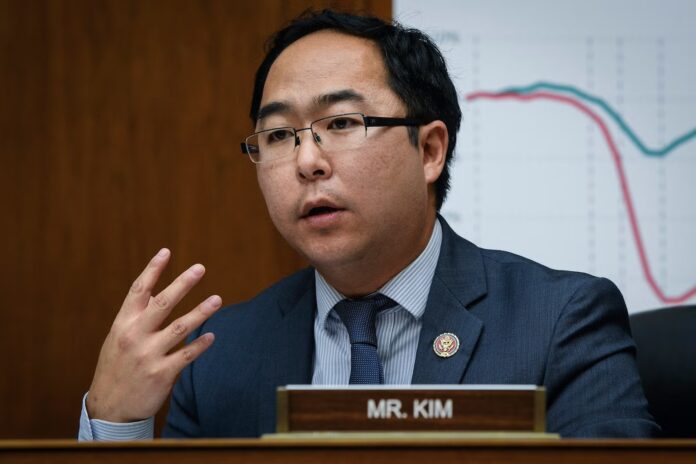

A growing coalition in the United States Senate is accelerating a high-stakes constitutional confrontation over war authority, and New Jersey is now firmly at the center of that moment. As momentum builds in Washington, Senator Andy Kim of New Jersey has joined a widening bloc of Democratic senators advancing a coordinated push to invoke the War Powers Act, forcing a formal Senate vote on continued U.S. involvement in the escalating conflict with Iran. This effort represents more than a procedural maneuver—it is a direct challenge to executive authority, a test of congressional oversight, and a defining moment for how war decisions are made in the modern era.
The expansion of this coalition marks a significant shift in both scale and urgency. Senators Jeff Merkley, Kirsten Gillibrand, Chris Van Hollen, Mark Kelly, and Raphael Warnock have aligned with an already active group that includes New Jersey’s own Cory Booker, alongside Senators Tim Kaine, Chris Murphy, Adam Schiff, Tammy Baldwin, and Tammy Duckworth. Together, they are leveraging one of the most powerful procedural tools available to Congress: the War Powers resolution. Unlike standard legislation, these resolutions are privileged, meaning they cannot be buried indefinitely. Within ten calendar days of filing, they can be brought directly to the Senate floor, compelling a vote that leadership cannot easily avoid.
For New Jersey, the involvement of both Senator Kim and Senator Booker elevates the state’s role in shaping this national debate. Booker has already been a leading voice in pressing for accountability, and Kim’s addition signals a unified front from New Jersey’s Senate delegation at a time when the stakes—both geopolitical and economic—are intensifying. Their participation underscores a broader theme emerging across the country: a growing demand for Congress to reassert its constitutional authority in decisions of war and peace.
At the heart of the issue is a fundamental constitutional question. The United States Constitution grants Congress—not the president—the authority to declare war. Over time, however, successive administrations have expanded executive power in military engagements, often operating without explicit congressional authorization. The current push in the Senate is an attempt to recalibrate that balance, bringing decision-making back into the legislative branch and forcing a transparent debate on the costs, risks, and long-term implications of military action against Iran.
The urgency driving this effort is tied not only to constitutional principles but also to the real-world consequences already unfolding. The conflict has reverberated far beyond the battlefield, influencing global energy markets, increasing economic pressure on American households, and raising concerns about long-term military entanglement. For a state like New Jersey—where families, small businesses, and industries are directly affected by fluctuations in fuel prices and economic instability—these issues are not abstract. They are immediate and tangible, shaping everything from daily commuting costs to broader economic confidence.
This is where the intersection between national policy and local impact becomes unmistakable. As highlighted across ongoing coverage within the <a href=”https://sunset-daily.com/category/politics/”>politics section on Sunset Daily</a>, the ripple effects of federal decisions are increasingly felt at the state and community level. New Jersey residents are not insulated from foreign policy decisions; they experience them through rising costs, shifting economic conditions, and the broader implications of sustained military engagement abroad. The Senate’s effort to force a vote is, in many ways, a response to those downstream pressures as much as it is a constitutional correction.
Senator Kim’s participation carries additional weight given his background and focus on national security and governance. His decision to join this coalition signals a clear position: that Congress cannot remain passive while military actions proceed without explicit authorization or accountability. This stance aligns with a broader sentiment among lawmakers who argue that prolonged conflicts without clear objectives or congressional approval risk not only strategic failure but also erosion of democratic norms.
The War Powers framework itself is designed precisely for moments like this. Established to prevent unilateral military action by the executive branch, it provides Congress with a mechanism to review, debate, and, if necessary, terminate involvement in armed conflicts. Yet its effectiveness depends entirely on lawmakers’ willingness to use it. The current wave of resolutions suggests that threshold has been reached, with senators prepared to force the issue onto the floor regardless of political resistance.
What makes this moment particularly consequential is the cumulative pressure being applied. Multiple resolutions, introduced in succession, create repeated opportunities for debate and voting, making it increasingly difficult for the issue to be sidelined. This strategy reflects a recognition that a single vote may not be sufficient to shift policy, but sustained legislative pressure can reshape the conversation and, ultimately, the outcome.
For New Jersey, the implications extend beyond representation in Washington. The state’s dual presence in this effort positions it as a focal point in the broader national dialogue about war, governance, and accountability. It reinforces the idea that New Jersey is not merely observing federal policy but actively influencing it, contributing to decisions that will shape both domestic conditions and international relations.
At the same time, this initiative highlights a deeper tension within American governance: the balance between swift executive action and deliberate legislative oversight. In an era defined by rapid geopolitical shifts, the temptation to centralize decision-making is strong. Yet the consequences of unchecked authority—particularly in matters as consequential as war—are equally significant. The Senate’s push represents an attempt to restore equilibrium, ensuring that decisions of this magnitude are subject to rigorous debate and collective judgment.
The coming days will be critical. As these War Powers resolutions move through the procedural timeline, the Senate will be compelled to confront the issue directly. The outcome of that confrontation—whether it results in a decisive vote to end involvement, a continuation of current policy, or an extended political standoff—will carry implications far beyond Washington. It will shape how future conflicts are approached, how authority is exercised, and how accountable leaders are to both the Constitution and the American people.
In New Jersey, where the effects of national policy are felt in everyday life, this moment resonates with particular clarity. The state’s leadership is actively engaged in a debate that goes to the core of democratic governance, and its outcome will influence not only the trajectory of U.S. foreign policy but also the economic and social realities at home. As the Senate prepares for what could be a defining vote, one thing is clear: the question is no longer whether Congress will engage, but how far it is willing to go to assert its role.