


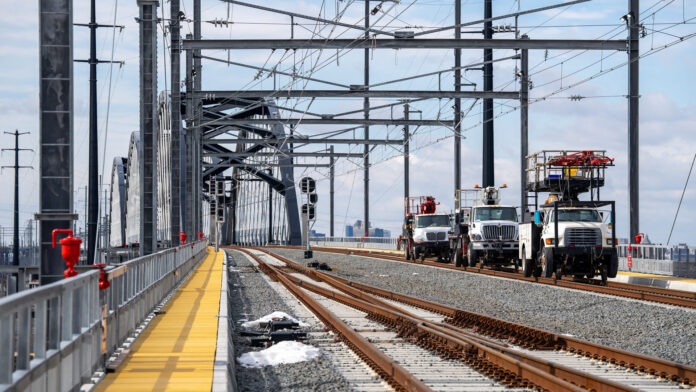

New Jersey’s transportation network is entering a defining moment—one shaped by urgency, innovation, and a fundamental rethinking of how the state moves people and goods. Two major developments now sit at the center of that transformation: the early opening of the new Portal Bridge, hailed as a breakthrough in modern rail infrastructure, and Governor Mikie Sherrill’s decision to reject a highway expansion plan for the Newark Bay Bridge in favor of a more environmentally conscious and forward-looking strategy.
Together, these moves represent more than isolated policy decisions or engineering milestones. They signal a broader shift in how New Jersey approaches mobility, infrastructure investment, and long-term sustainability—particularly across its most densely populated and economically vital corridors.
The Portal Bridge Moment: A Test Passed Under Pressure
When the newly constructed Portal Bridge was pressed into early service during emergency repairs to overhead power lines, it delivered exactly what modern infrastructure is supposed to provide: resilience under pressure. NJ TRANSIT leadership described the moment as nothing short of extraordinary—a real-world validation of years of planning, engineering, and execution.
The bridge, which replaces a century-old swing span that has long been a bottleneck along the Northeast Corridor, is a critical link in one of the busiest passenger rail lines in the United States. For decades, delays, mechanical failures, and congestion at the old bridge disrupted commutes and hindered regional mobility.
The new fixed-span structure changes that equation entirely. By eliminating the need to open for maritime traffic and significantly increasing reliability, the Portal Bridge is designed to support faster, more consistent rail service between New Jersey and New York City.
Its early deployment during an emergency scenario underscores a key reality: infrastructure is not just about capacity—it is about dependability. And in a state where hundreds of thousands rely on daily rail service, that dependability is transformative.
Newark Bay Bridge: A Policy Pivot with Statewide Implications
While the Portal Bridge represents progress through expansion and modernization, the Newark Bay Bridge decision reflects a different kind of evolution—one rooted in restraint and strategic redirection.
Governor Mikie Sherrill’s plan to move away from a previously proposed expansion of the Newark Bay Bridge marks a significant departure from traditional highway-focused infrastructure policy. The earlier proposal, part of a massive capital plan, would have added new lanes to the New Jersey Turnpike, effectively increasing capacity for vehicular traffic between Newark and Bayonne.
Instead, the new approach prioritizes replacement without expansion—an acknowledgment that simply adding lanes does not solve congestion and may, in fact, exacerbate it.
This concept, known as induced demand, has become increasingly influential in transportation planning. The principle is straightforward: expanding road capacity often leads to increased traffic volume, ultimately negating the intended benefits of congestion relief.
In New Jersey, where transportation is the leading contributor to both air pollution and greenhouse gas emissions, the implications are significant. Communities like Newark’s Ironbound—already burdened by heavy traffic and environmental stress—stand to benefit from a shift away from expansion-driven models.
Environmental Justice and Urban Impact
The Newark Bay Bridge debate has also brought environmental justice to the forefront of transportation policy. Urban communities connected by the bridge and surrounding highway infrastructure have long faced disproportionate exposure to pollution, noise, and traffic-related health impacts.
By rejecting a plan that would have increased vehicular flow through these areas, state leadership is signaling a more community-centered approach—one that considers not just mobility, but quality of life.
Local leaders in both Newark and Jersey City have supported this direction, emphasizing the need for solutions that address congestion without amplifying existing inequities. Their advocacy reflects a growing consensus that infrastructure decisions must balance economic efficiency with environmental and social responsibility.
A Unified Transportation Vision Emerging
Perhaps the most consequential element of this moment is not any single project, but the alignment of leadership and strategy across agencies. The decision to place NJ TRANSIT CEO Kris Kolluri at the helm of the New Jersey Turnpike Authority suggests a deliberate effort to integrate planning across rail and roadway systems.
This kind of coordination has historically been limited, with agencies operating in silos. Bringing them together opens the door to a more holistic approach—one that prioritizes moving people efficiently rather than simply moving vehicles.
It also creates opportunities to invest more aggressively in mass transit solutions, including rail, light rail, and bus networks that can absorb demand without increasing roadway congestion.
For ongoing coverage of how transportation policy and infrastructure projects are reshaping mobility across the state, visit Transportation on Sunset Daily News.
The Rise of Mass Transit and Changing Commuter Behavior
Data across New Jersey’s urban centers points to a clear trend: more residents are choosing transit over car ownership. In cities like Jersey City, nearly half of households are now car-free, reflecting a shift toward more sustainable and efficient modes of transportation.
Ridership on PATH trains and light rail systems has surged, while cycling and micromobility usage continue to grow. These changes are not just lifestyle preferences—they are responses to economic pressures, urban density, and evolving work patterns.
The challenge for policymakers is to meet this demand with infrastructure that is both scalable and accessible. Expanding light rail networks, improving bus service, and enhancing rail connectivity are all part of that equation.
Advocates are increasingly calling for investments that prioritize these modes, arguing that they offer more effective long-term solutions to congestion than highway expansion.
Infrastructure as Economic Strategy
Transportation in New Jersey has always been closely tied to economic performance. As a gateway state, its infrastructure supports not only local mobility but also regional and national supply chains.
Projects like the Portal Bridge are essential to maintaining that role, ensuring that rail corridors remain reliable and competitive. At the same time, policy decisions like the Newark Bay Bridge shift reflect an understanding that economic growth must be sustainable.
Balancing these priorities—efficiency, equity, and environmental impact—is the central challenge facing New Jersey’s transportation leaders today.
A Turning Point for How New Jersey Moves
What is emerging is a new framework for transportation in New Jersey—one that blends infrastructure investment with strategic restraint, and engineering innovation with policy evolution.
The early success of the Portal Bridge demonstrates what is possible when projects are executed with precision and purpose. The Newark Bay Bridge decision shows that sometimes the most impactful move is not to build more, but to build smarter.
Together, these developments mark a turning point. They suggest that New Jersey is not just reacting to transportation challenges, but actively redefining how they are addressed.
In a state where mobility underpins everything from daily commutes to economic growth, that shift carries profound implications. The decisions being made today are shaping not just how people travel, but how communities develop, how businesses operate, and how the state positions itself for the future.
New Jersey is moving forward—but it is doing so with a clearer sense of direction than ever before.



