


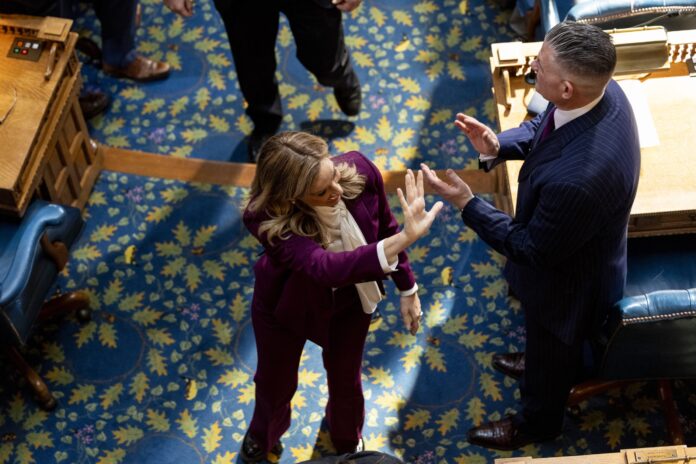

New Jersey politics entered a defining new chapter this week as Governor Mikie Sherrill delivered her first budget address to the Legislature, unveiling a record-setting $60.7 billion spending proposal for Fiscal Year 2027 and laying out a sweeping agenda centered on one theme that resonated throughout the speech: affordability.
In what quickly became one of the most consequential policy moments of the year in Trenton, Sherrill outlined a comprehensive fiscal plan designed to stabilize the state’s finances while continuing major investments in education, infrastructure, healthcare, and property tax relief. The proposal arrives during a challenging fiscal moment for New Jersey, as state officials confront a projected $3 billion structural deficit while attempting to maintain critical programs that millions of residents rely on.
Rather than introducing sweeping tax increases, the governor framed her budget as a disciplined recalibration of state spending — an effort to restore fiscal balance while prioritizing the middle-class families, workers, and seniors who increasingly feel squeezed by the high cost of living in the Garden State.
The proposal now moves to the Legislature for months of negotiation and review before a final state budget must be adopted prior to the July 1 deadline.
A Historic Budget Proposal at a Financial Crossroads for New Jersey
Governor Sherrill’s inaugural budget address arrives at a moment when New Jersey faces both economic strength and structural financial pressure.
State revenues remain robust compared with historic norms, yet long-term obligations — including pensions, education funding commitments, and public infrastructure — continue to demand sustained investment. At the same time, policymakers are increasingly focused on affordability concerns as residents confront rising housing costs, property taxes, healthcare expenses, and transportation challenges.
Against that backdrop, Sherrill presented what she described as a fiscally responsible path forward: a record $60.7 billion budget that attempts to narrow the state’s structural deficit without raising the individual income tax rate.
Central to the plan is a strategy aimed at reducing the state’s deficit from roughly $3 billion to approximately $1.6 billion. The administration proposes accomplishing this primarily through the elimination of certain one-time expenditures and by trimming roughly $2 billion in previously anticipated spending commitments.
The governor emphasized that stabilizing the state’s financial outlook is essential not only for responsible governance but also for protecting long-term investments that drive economic opportunity and quality of life in New Jersey.
Record Investments in Education Signal Continued Priority for Students and Families
Education funding stands as one of the most prominent components of the governor’s budget proposal.
The Fiscal Year 2027 plan includes a historic $12.4 billion allocation in school formula aid, marking the highest level of direct K–12 education funding in New Jersey’s history. The investment reflects a continuation of the state’s effort to fully implement its school funding formula while addressing disparities among districts.
In addition to traditional K–12 support, the governor’s proposal includes $1.4 billion dedicated to preschool education. That figure also represents a record investment and continues New Jersey’s expansion of early childhood education programs designed to provide universal access to high-quality preschool.
Education advocates have long argued that early childhood investment delivers long-term benefits ranging from improved academic outcomes to stronger workforce development. Sherrill’s proposal suggests the administration intends to continue building on that foundation.
By pairing record K–12 funding with expanded preschool access, the administration is attempting to position education policy as a cornerstone of long-term economic competitiveness and family stability within the state.
Property Tax Relief Remains a Central Theme
Few issues resonate more deeply with New Jersey residents than property taxes, which remain among the highest in the nation. As a result, the governor’s budget proposal continues to emphasize direct relief programs aimed at homeowners and seniors.
The spending plan maintains $4.2 billion in total property tax relief through programs including ANCHOR and Stay NJ, two initiatives designed to help residents offset the burden of rising property tax bills.
However, the proposal also introduces a significant change to the Stay NJ program — one that is already sparking debate across the political spectrum.
Under the governor’s plan, eligibility for Stay NJ would be capped at households earning $250,000 per year, a reduction from the previously established $500,000 income threshold.
The administration argues that the adjustment would allow the state to better target relief toward middle-class seniors while saving hundreds of millions of dollars annually. Critics, however, contend that the change could reduce benefits for some residents who had expected broader eligibility.
The debate highlights a recurring philosophical question in New Jersey fiscal policy: whether tax relief programs should be broadly distributed or more tightly focused on households with the greatest financial need.
As legislative negotiations unfold in the coming months, the future structure of the Stay NJ program is likely to become one of the most closely watched components of the final state budget.
Fully Funding the Pension System Signals Fiscal Discipline
Another major pillar of the governor’s proposal is the continued commitment to fully funding New Jersey’s public pension system.
The Fiscal Year 2027 budget includes a $7.3 billion pension contribution, maintaining the state’s policy of meeting its actuarially recommended payment in full.
This approach marks a continuation of a fiscal strategy aimed at restoring stability to a pension system that had faced decades of underfunding. By maintaining full contributions, state leaders hope to improve the long-term health of the pension fund while protecting retirement security for public employees including teachers, police officers, and other government workers.
Pension funding has historically represented one of the most complex financial challenges in New Jersey state government. Sustaining full payments is viewed by many fiscal analysts as a critical step toward maintaining investor confidence and preventing future budgetary shortfalls.
Major Investments in Transportation and Infrastructure
Infrastructure investment also features prominently in the proposed budget, particularly in support of New Jersey Transit.
The spending plan allocates $1 billion to the state’s transit system, reflecting the administration’s recognition that reliable public transportation remains essential to economic mobility and regional growth.
New Jersey Transit serves hundreds of thousands of daily riders across rail, bus, and light rail networks. Continued investment is seen as essential not only for maintaining existing infrastructure but also for modernizing service in an era when transportation reliability has become a major public concern.
The governor also highlighted broader infrastructure projects that support regional connectivity, including ongoing investments tied to the Gateway Tunnel project — one of the most significant rail infrastructure initiatives in the country.
These efforts are positioned as part of a broader economic strategy designed to strengthen the state’s transportation backbone while supporting job creation across multiple industries.
Launching SPARK: A New Youth Mental Health Initiative
Beyond fiscal and infrastructure policy, the proposed budget also introduces a new youth mental health initiative known as SPARK — short for School-based Partnerships for Access and Resilience for Kids.
The program aims to expand access to mental health services directly within schools, creating partnerships that connect students with counseling resources and support systems.
Youth mental health has emerged as one of the most pressing public health issues facing communities across the United States. Schools increasingly serve as front-line support networks for students coping with anxiety, depression, and other mental health challenges.
By embedding services within educational settings, the SPARK initiative aims to remove barriers that often prevent young people from receiving timely care.
The proposal reflects a broader trend among policymakers nationwide to integrate mental health resources more deeply into public institutions that interact with children and families every day.
Proposed Changes to Corporate Taxes and Business Fees
While the governor emphasized that the budget does not increase individual income taxes, the proposal does include several policy adjustments affecting corporations and business entities.
Among the changes under consideration are efforts to close certain corporate tax loopholes and place limits on specific deductions used by larger companies.
At the same time, the administration proposes lowering filing fees for smaller businesses and nonprofit organizations. The goal, according to the governor, is to create a more balanced tax environment that maintains fairness while supporting entrepreneurship and community-based organizations.
Business leaders have responded cautiously but constructively to the proposal, emphasizing the importance of continued dialogue between the administration and the private sector.
Maintaining New Jersey’s economic competitiveness remains a critical priority as neighboring states continue to compete for business investment and workforce growth.
Political Reactions Begin as Budget Negotiations Start
As expected, the governor’s proposal has already sparked debate among lawmakers.
Some Republican legislators argued that the budget does not go far enough in reducing taxes or addressing long-term spending growth. Others suggested that the administration should pursue deeper structural reforms related to corporate tax rates or the state sales tax.
At the same time, several lawmakers acknowledged that the governor’s effort to reduce the structural deficit without raising income taxes represents a politically significant balancing act.
The coming months will involve intense negotiation between the governor’s office and the Legislature as policymakers refine spending priorities and revenue assumptions.
New Jersey’s budget process traditionally culminates with a final agreement in late June, often following weeks of negotiation and last-minute adjustments as lawmakers work to meet the constitutional July 1 deadline.
A First Budget That Defines a New Administration
For Governor Sherrill, the Fiscal Year 2027 budget represents more than a financial document — it is a defining policy statement that signals the governing priorities of a new administration.
By emphasizing affordability, fiscal responsibility, and targeted investment in education, infrastructure, and mental health, the governor is attempting to navigate one of the most challenging balancing acts in modern state governance.
New Jersey remains one of the most economically dynamic states in the country, yet it also faces persistent cost-of-living pressures that shape everyday life for residents.
The administration’s budget proposal attempts to address those pressures while preserving investments that many policymakers believe are essential for long-term prosperity.
As legislative negotiations unfold and the details of the final budget begin to take shape, the debate surrounding affordability, fiscal discipline, and economic opportunity will remain at the center of New Jersey’s political conversation.
What began this week with the governor’s first budget address now evolves into a months-long process that will determine how the Garden State allocates more than $60 billion in public resources for the year ahead.



