


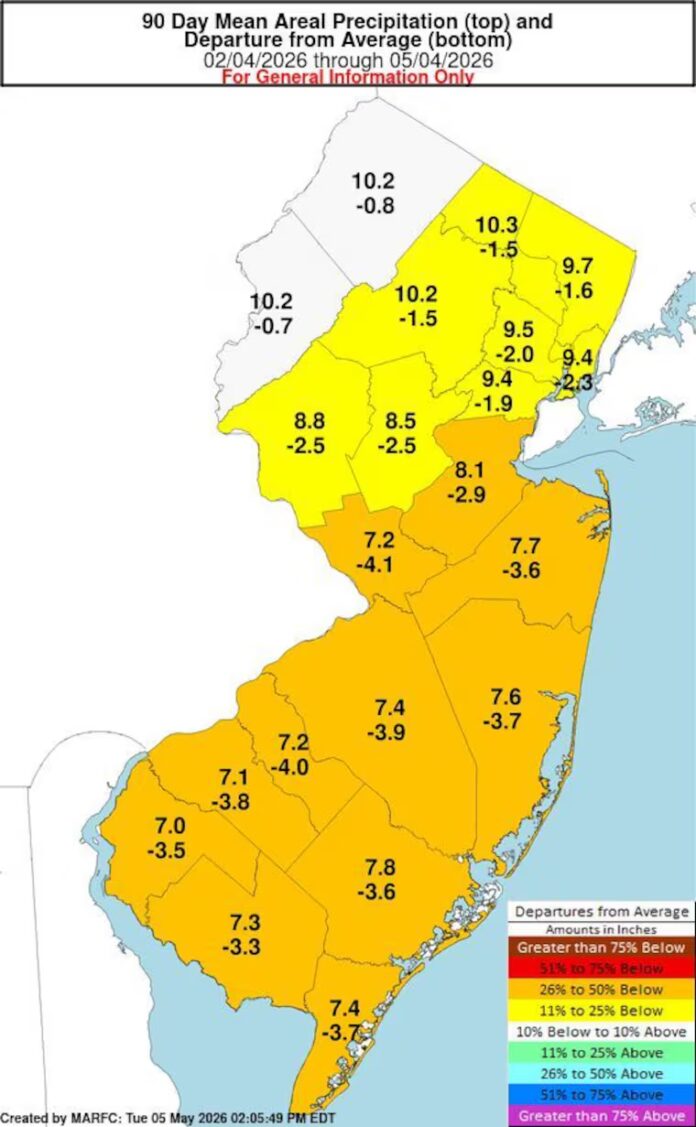

New Jersey may currently be enjoying an unusually cool and comfortable stretch of May weather that feels more like late October than the doorstep of summer, but climatologists and weather analysts are increasingly warning that beneath the pleasant temperatures lies a far more serious long-term concern: the state’s ongoing struggle with below-average rainfall patterns that continue raising alarms about drought vulnerability, groundwater stress, agricultural impacts, wildfire risks, and broader environmental instability throughout the region.
Current Conditions
- Feels Like: 56°F
- Wind Speed: 10 mph South
- Humidity: 73%
- UV Index: 0
Daily Weather Forecast
| Day | Sky Condition | Temperature | Chance of Rain |
|---|---|---|---|
| Wed, May 13 | 73°F / 55°F | 10% (Day) / 45% (Night) | |
| Thu, May 14 | 65°F / 49°F | 20% (Day) / 10% (Night) | |
| Fri, May 15 | 66°F / 50°F | 15% (Day) / 5% (Night) | |
| Sat, May 16 | 80°F / 54°F | 0% | |
| Sun, May 17 | 87°F / 62°F | 20% | |
| Mon, May 18 | 90°F / 65°F | 5% | |
| Tue, May 19 | 93°F / 69°F | 20% |
Hourly Forecast (Today)
| Hour [, 2, 3, 4, 5] | Sky Condition | Temperature |
|---|---|---|
| 8 AM | 59°F | |
| 10 AM | 67°F | |
| 12 PM | 72°F | |
| 2 PM | 73°F | |
| 4 PM | 71°F | |
| 6 PM | 67°F | |
| 8 PM | 63°F | |
| 10 PM | 60°F |
Marine Advisory
The National Weather Service has issued a Gale Warning for Western Atlantic Marine Zones from Sandy Hook to New York Harbor. South winds will reach 15 to 25 knots with gusts up to 35 knots, creating dangerous nearshore sea conditions.
While the immediate forecast points toward a coming transition into warmer temperatures and a prolonged stretch of above-average warmth beginning later this week, experts say the larger issue facing the Garden State is not simply temperature fluctuation but the increasingly inconsistent nature of precipitation itself — particularly across South Jersey, where some areas have now experienced approximately 21 consecutive months of below-normal rainfall totals.
The concern is not necessarily that New Jersey is entering an immediate catastrophic drought emergency. Instead, climatologists emphasize that the state is gradually accumulating long-term moisture deficits that could become increasingly problematic if steady, sustained precipitation patterns fail to normalize over time.
That distinction matters enormously.
Modern climate behavior throughout the Northeast is increasingly defined not by the complete absence of rainfall, but by the growing imbalance between occasional heavy downpours and the regular, moderate precipitation patterns ecosystems, groundwater systems, agriculture, forests, reservoirs, and infrastructure networks actually depend upon to remain healthy and stable.
In practical terms, one intense thunderstorm delivering several inches of rain over a short period often does far less long-term good than multiple steady rainfall events distributed consistently across weeks and months.
Much of New Jersey’s landscape cannot effectively absorb sudden extreme precipitation efficiently enough to fully replenish depleted groundwater systems. Instead, excessive rainfall delivered too quickly often increases runoff, flash flooding, drainage overflow, erosion, and stormwater pressure without meaningfully resolving underlying soil moisture deficits.
That is increasingly becoming one of the defining weather and climate challenges facing the region.
South Jersey remains particularly vulnerable due to its geography, sandy soils, agricultural concentration, aquifer dependency, pine forest ecosystems, and growing development pressures. Large portions of the region rely heavily on groundwater recharge systems that depend on sustained rainfall patterns over extended periods rather than isolated storm events.
When below-average precipitation persists month after month, those systems begin gradually weakening even if occasional storms temporarily improve short-term surface conditions.
Climatologists warn that the cumulative effects of prolonged rainfall deficits can eventually ripple across multiple sectors simultaneously.
Agriculture becomes increasingly stressed as soil moisture declines. Groundwater recharge slows. Reservoirs and streams become more vulnerable during hotter summer stretches. Wildfire risks intensify, particularly within the Pinelands region. Tree health deteriorates. Municipal water systems face growing long-term pressure. Ecological stability weakens. Heat impacts become more severe due to reduced moisture retention in soils and vegetation.
Many of those risks develop slowly and quietly long before residents recognize the seriousness of the underlying trend.
The concern is especially significant because New Jersey’s climate appears increasingly prone to volatility rather than stability.
Weather analysts monitoring current atmospheric patterns note that the state has recently experienced an unusual setup characterized by persistent troughing patterns delivering cooler-than-normal temperatures despite seasonal solar angles more typical of midsummer conditions. Residents across the state have experienced conditions that feel remarkably similar to late autumn, with cool mornings, crisp air masses, and daytime temperatures struggling to escape the 60s in many locations.
The atmospheric pattern responsible for that cool stretch is now expected to shift dramatically beginning this weekend.
Meteorologists indicate that the persistent trough configuration influencing the Northeast is finally preparing to eject eastward, allowing warmer southwest flow to establish itself across the region by Saturday morning. Once that transition occurs, forecasters expect a prolonged period of above-average temperatures capable of pushing much of New Jersey into sustained 70s and 80s patterns for an extended stretch.
The warming trend itself is not unusual for mid-May.
What concerns climatologists more is whether the anticipated warmer regime will deliver sufficiently regular precipitation to offset the longer-term rainfall deficits that continue accumulating beneath the surface.
Current projections suggest at least some additional rain opportunities may continue accompanying the warmer pattern, but experts remain cautious given how inconsistent precipitation distribution has become across portions of the Mid-Atlantic and Northeast during recent years.
The near-term forecast highlights the atmospheric transition currently underway.
Temperatures Tuesday are expected to remain relatively subdued statewide, with much of New Jersey topping out only in the 60s under mostly sunny skies and light west-to-northwest winds. Elevated areas and immediate coastal sections may struggle to move beyond the lower 60s while inland regions push into the upper 60s before overnight temperatures settle into the 40s and 50s statewide.
Wednesday begins introducing the more unsettled conditions tied to the departing trough pattern. High temperatures should recover into the mid-to-upper 60s statewide, with portions of Central and South Jersey potentially briefly touching the lower 70s near the Turnpike corridor. Meteorologists expect increasing cloud cover alongside passing showers and isolated thunderstorms as southerly flow strengthens throughout the region.
The potential for “boomers” — isolated thunderstorm activity — remains possible during both daytime and overnight periods as atmospheric instability increases ahead of the approaching transition zone.
Thursday’s pattern remains somewhat unsettled, though improving conditions are expected by afternoon as cooler northwest flow gradually begins reestablishing itself behind the departing system. Temperatures should remain largely in the mid-60s while lingering isolated showers remain possible into early Friday morning.
By Friday, the atmosphere begins transitioning more decisively toward the coming warm regime.
Temperatures are expected to rebound into the upper 60s and lower 70s across much of the state beneath mixed sun and clouds, with northwest winds gradually easing later in the day before warmer southwest flow establishes itself over the weekend.
Meteorologists now anticipate a significantly warmer and drier weekend statewide.
Current projections suggest both Saturday and Sunday should feature increasingly pleasant conditions alongside rising temperatures that may mark the beginning of a much more summer-like weather pattern across New Jersey. Forecasters note that after the current cool stretch ends, there may be relatively few opportunities for widespread sub-70-degree temperatures away from immediate coastal areas before autumn eventually returns later in the year.
The larger issue, however, remains precipitation consistency.
Climatologists increasingly emphasize that New Jersey’s long-term weather concerns are becoming less about individual storms and more about the changing reliability of seasonal rainfall patterns themselves.
The state has already experienced multiple years in which precipitation arrives in highly concentrated bursts separated by prolonged dry intervals. That pattern creates simultaneous flood risks and drought stress — a paradox becoming increasingly common throughout portions of the Northeast as climate volatility intensifies.
New Jersey’s infrastructure systems were largely designed around older precipitation assumptions involving steadier and more evenly distributed seasonal rainfall behavior.
Today’s increasingly erratic weather patterns challenge those systems in multiple ways simultaneously.
Heavy downpours overwhelm drainage systems and increase flooding risks, while prolonged dry periods strain water supplies, agriculture, vegetation health, and ecological stability. Municipal planners, environmental agencies, farmers, transportation officials, and utility managers throughout the state are increasingly forced to adapt to both extremes occurring within the same broader climate cycle.
South Jersey remains particularly exposed because of its unique environmental composition.
The region’s sandy soils drain rapidly and retain less moisture than denser northern soils. Large portions of the Pine Barrens ecosystem depend on delicate hydrological balance. Agricultural operations throughout Cumberland, Salem, Atlantic, and Burlington counties rely heavily on stable precipitation patterns and groundwater availability. Wildfire vulnerability also rises significantly when extended dry periods combine with warming temperatures and dense forest fuel conditions.
New Jersey already experienced multiple concerning wildfire events in recent years that forced evacuations, roadway closures, air quality concerns, and major firefighting operations throughout portions of the Pinelands region.
Meteorologists and climatologists alike stress that no immediate statewide crisis currently exists. Reservoir systems remain generally stable, and the upcoming pattern may still deliver periodic rain opportunities. But the persistence of long-term rainfall deficits continues raising concern among environmental experts monitoring broader hydrological trends beneath the surface.
The challenge moving forward may ultimately center on whether New Jersey can return to more reliable precipitation consistency rather than continuing oscillations between dry stretches and isolated heavy rainfall events.
As warmer temperatures prepare to return across the Garden State beginning this weekend, residents may understandably welcome the arrival of more traditional spring and summer conditions. Yet behind the comfortable forecast lies a growing environmental question that climatologists increasingly believe will define New Jersey’s long-term weather future: not whether rain falls, but whether it falls often enough, steadily enough, and consistently enough to sustain the increasingly stressed systems that depend upon it.