


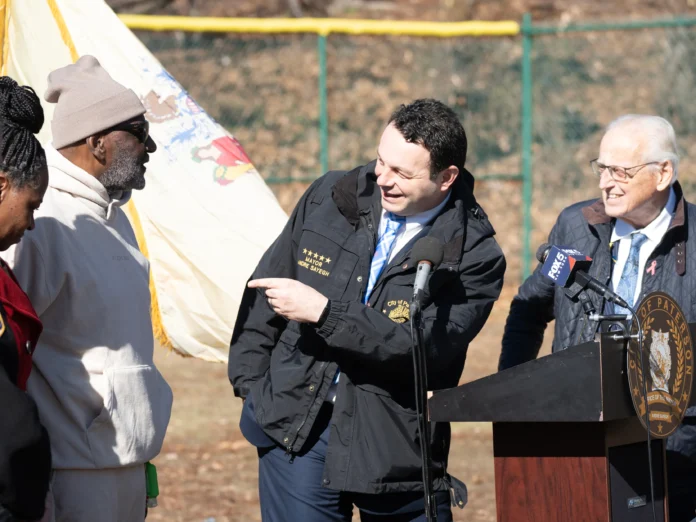

Paterson Mayor Andre Sayegh secured a historic political victory Tuesday night, winning reelection to a third consecutive four-year term and becoming the first mayor in the city’s modern history to achieve that milestone in one of New Jersey’s most politically volatile and ethnically complex urban battlegrounds.
The victory represents more than another successful reelection campaign. It solidifies Sayegh’s transformation from a once-struggling citywide candidate into one of the most durable and strategically disciplined municipal political figures in the state, a leader who spent two decades carefully constructing alliances across Paterson’s deeply fragmented political, ethnic, and neighborhood networks before ultimately building a coalition powerful enough to survive repeated electoral warfare inside one of New Jersey’s most difficult political environments.
Sayegh defeated longtime rival and City Council nemesis Alex Mendez by a margin of roughly 6,400 votes to 5,800, while also overcoming challenges from First Ward Councilman Mike Jackson and former Second Ward Councilman Mohammed Akhtaruzzaman.
The election outcome not only preserves Sayegh’s control over City Hall but also fundamentally reshapes Paterson’s political history.
For decades, Paterson has operated as one of the most unpredictable and factionalized political arenas in New Jersey politics, where coalition instability, shifting ethnic alliances, regional rivalries, and deeply personal political feuds routinely disrupt incumbencies and fracture governing power structures. The city’s electoral landscape is notoriously difficult to navigate because no single demographic or political bloc dominates the electorate consistently enough to guarantee long-term political security.
That reality makes Sayegh’s third consecutive victory especially significant.
Paterson’s political structure has historically punished incumbents. Mayors often find themselves trapped between competing ethnic constituencies, rival council factions, neighborhood-based political organizations, labor interests, business concerns, religious networks, and county-level political influence operations. Surviving one term can be difficult. Winning reelection is rarely simple. Capturing three straight four-year victories is unprecedented.
Sayegh’s political path makes the accomplishment even more remarkable.
Long before becoming mayor, Sayegh spent years building institutional credibility through local governance and community organizing. He first emerged politically through service on the Paterson Board of Education before transitioning into municipal government as the city’s Sixth Ward councilman. Those early years proved critical in helping him develop the extensive personal relationships and neighborhood-level political infrastructure that would later become central to his mayoral success.
Yet his rise was far from immediate.
Before finally capturing the mayor’s office in 2018, Sayegh suffered two unsuccessful citywide campaigns that exposed both the opportunities and brutal realities of Paterson’s fractured political ecosystem. Rather than disappearing politically after those defeats, however, he continued strengthening alliances, cultivating community relationships, and expanding his reach across multiple constituencies throughout the city.
That long-term political patience ultimately became one of his defining advantages.
By the time he won the mayoralty in 2018, Sayegh had assembled a uniquely broad coalition capable of competing across multiple demographic groups simultaneously. His reelection victory in 2022 further strengthened his political footing, but this latest win may ultimately represent his most important political achievement yet because it occurred under far more complicated electoral conditions.
This year’s race exposed significant vulnerabilities within several of the mayor’s traditional support structures.
The Bengali community — a growing and increasingly influential force within Paterson politics — appeared internally divided throughout portions of the campaign, weakening what had previously been a more consolidated base of support. At the same time, some prominent African American political leaders reportedly approached the election with greater caution and less unified enthusiasm than in previous cycles.
Under ordinary circumstances, those fractures could have proven politically fatal in a city where coalition instability often determines electoral outcomes.
Instead, Sayegh adapted by strengthening support within portions of Paterson’s Latino electorate, particularly among Dominican and broader Hispanic voting blocs where divisions reportedly emerged between some longtime Mendez supporters and the councilman’s current political operation.
That recalibration ultimately became central to the mayor’s survival strategy.
Paterson’s demographic complexity means successful citywide candidates must constantly balance relationships across multiple communities simultaneously while navigating shifting alliances capable of changing dramatically between election cycles. The city’s political map is rarely static, and Sayegh’s ability to offset softening support in some areas with gains elsewhere demonstrated the level of coalition management now required to maintain power in modern Paterson politics.
The mayor also benefited heavily from the continued strength of his governing alliance inside city government itself.
Council President Lilisa Mimms and Council Vice President Maritza Davila remained deeply integrated into Sayegh’s political structure throughout the campaign, reinforcing organizational strength at a moment when municipal governing coalitions often fracture under electoral pressure.
Both Mimms and Davila appeared positioned to secure reelection to their at-large council seats as part of the broader Sayegh-aligned political operation.
Meanwhile, one of the night’s more notable council contests involved Paula Alford overtaking incumbent Councilman Forid Uddin after trailing earlier in the evening, eventually opening a substantial advantage estimated at approximately 5,200 votes to 3,600.
The broader election results suggest that while Paterson politics remains deeply competitive and factionalized, Sayegh’s governing coalition retains substantial structural strength throughout key portions of the city.
Another important factor in the mayor’s reelection effort involved his increasingly close relationship with Mikie Sherrill, whose political endorsement last week provided both symbolic and operational reinforcement heading into the campaign’s closing days.
Sherrill’s appearance at Bonfire in Paterson to formally endorse Sayegh carried substantial political weight.
The endorsement not only strengthened the mayor’s ties to statewide Democratic leadership but also reinforced his growing role within the broader power structure of New Jersey Democratic politics. As urban political influence remains enormously important within statewide coalition building, maintaining strong relationships with major city mayors continues carrying significant strategic value for governors and statewide officeholders alike.
For Sayegh, the alliance with Sherrill signals increasing integration into higher-level Democratic leadership circles beyond purely municipal politics.
The mayor’s victory also reflects the continuing evolution of Paterson itself.
Long known historically as Silk City, Paterson remains one of New Jersey’s most culturally diverse urban centers, with large Arab American, Bengali, Latino, African American, and immigrant populations shaping the city’s political identity. Electoral campaigns within the city increasingly revolve around extraordinarily complicated demographic coalitions rather than traditional ideological divides alone.
That complexity makes sustained political dominance exceptionally difficult.
Successful candidates must simultaneously navigate local governance issues, ethnic representation concerns, neighborhood-level rivalries, economic development pressures, public safety debates, housing challenges, school system frustrations, immigration politics, infrastructure concerns, and deeply personal political loyalties that often transcend party labels or policy platforms.
Sayegh’s ability to maintain enough cross-demographic support to survive repeated electoral cycles suggests that his political operation has evolved into one of the more resilient urban coalitions currently operating in New Jersey municipal politics.
The emotional significance of the victory was also reflected in comments issued by First Lady Farhanna Balgahoom Sayegh following the election results.
Describing the moment as a “historic day for Paterson,” she acknowledged both the difficulty of securing three consecutive terms and the continuing pressure residents place on city leadership to deliver results. Her remarks emphasized gratitude for public trust while simultaneously signaling that the administration views the reelection not as an endpoint but as a mandate for continued governance and political work.
That messaging may prove important moving forward.
Winning reelection in Paterson does not eliminate the governing pressures facing City Hall. The city continues confronting serious challenges involving crime, economic inequality, infrastructure demands, housing pressure, education concerns, downtown redevelopment, public trust, and municipal service expectations. The same coalition-building skills that helped Sayegh win reelection will likely remain necessary throughout his next term as competing constituencies continue demanding results from local government.
Still, the historical significance of the election cannot be overstated.
For the first time in Paterson history, a mayor has successfully captured three straight four-year terms, a feat that many longtime political observers once considered nearly impossible within the city’s notoriously turbulent political environment.
After twenty years of relationship-building, strategic patience, electoral setbacks, coalition management, and relentless municipal campaigning, Andre Sayegh has now firmly established himself not simply as Paterson’s current mayor, but as one of the most consequential political figures in the city’s modern era.
And in a city where political survival itself often becomes an achievement, that may ultimately be the clearest measure of how profoundly Paterson’s political landscape has changed under his leadership.