


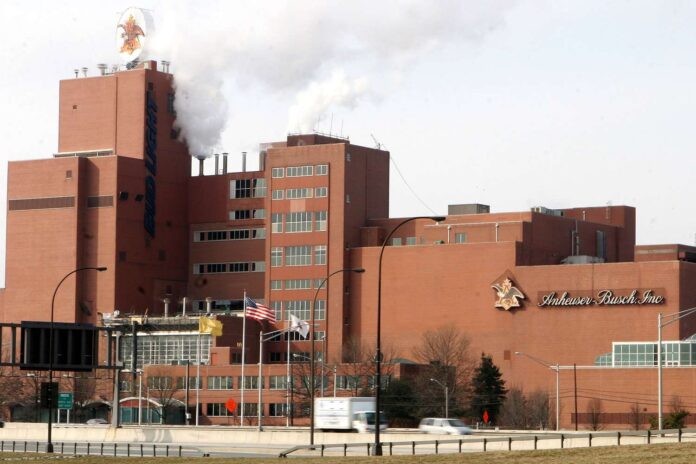

One of the most historically recognizable industrial properties in Newark has officially entered a new chapter as the former Anheuser-Busch brewery complex near Newark Liberty International Airport has been sold in a landmark $360 million transaction that could dramatically reshape a critical section of New Jersey’s logistics and industrial landscape for decades to come.
The sale, brokered by Newmark Group on behalf of Anheuser-Busch, transfers control of the sprawling 86-acre Newark property to Goodman Group, one of the world’s largest industrial real estate ownership and development firms. The transaction immediately becomes one of the most important industrial redevelopment deals completed in the Northeast this year and further reinforces Northern New Jersey’s position as one of the most strategically valuable logistics corridors anywhere in the United States.
For Newark, the deal closes the book on nearly 75 years of brewing history tied to a facility that long stood as both a major employer and a visible symbol of the city’s manufacturing identity. At the same time, it opens the door to what may become one of the largest and most influential industrial redevelopment projects currently planned within the New York metropolitan region.
The sheer scale of the site alone places the property in rare territory.
Containing more than 1.7 million square feet of existing industrial structures spread across approximately 86 acres adjacent to Newark Liberty International Airport, the former brewery property represents an increasingly uncommon asset class in the Northeast: large-scale, strategically positioned industrial land with direct multimodal transportation access inside one of America’s most supply-constrained urban logistics markets.
In modern industrial real estate, properties of this size and connectivity are becoming extraordinarily scarce.
The Newark parcel sits directly within one of the most economically important freight and transportation corridors in North America, offering immediate proximity to Port Newark, Port Elizabeth, Newark Liberty International Airport, Interstate 78, the New Jersey Turnpike, rail infrastructure, and one of the densest consumer populations in the country. More than 20 million residents live within a 15-mile radius of the property, while an enormous transportation and warehouse labor force operates throughout the surrounding region.
That combination of infrastructure access, workforce availability, zoning flexibility, and consumer proximity has transformed Northern New Jersey into one of the most competitive industrial real estate markets in the world.
The former brewery site now becomes one of the largest redevelopment opportunities available within that ecosystem.
According to Newmark executives involved in the transaction, the property’s unique characteristics position it to support an enormous range of future industrial and infrastructure uses. The site falls within Newark Liberty International Airport zoning districts that allow for extensive development flexibility involving logistics operations, industrial warehousing, airport-related facilities, data centers, commercial infrastructure, hospitality projects, and other large-scale operational uses.
Few sites anywhere in the region offer that degree of development optionality combined with direct connectivity to global transportation systems.
That reality helps explain the extraordinary valuation attached to the deal.
Industrial real estate throughout Northern and Central New Jersey continues operating under sustained demand pressure fueled by e-commerce expansion, freight growth, port activity, last-mile delivery competition, supply chain restructuring, and increasing demand for modern Class A logistics facilities. Large parcels located near major ports and airports have become especially valuable as companies aggressively compete for distribution positioning capable of supporting increasingly compressed delivery timelines.
The Newark site sits directly at the center of that transformation.
Its location less than one mile from Port Newark and Port Elizabeth alone places the property within one of the busiest cargo gateways in the United States. The ports continue serving as essential entry points for global shipping activity, while Newark Liberty International Airport remains one of the most strategically important air freight hubs on the East Coast.
Combined with immediate highway access and existing rail infrastructure, the property effectively connects maritime shipping, air cargo, trucking logistics, and rail freight within a single integrated transportation corridor.
That level of connectivity has become enormously valuable in the post-pandemic economy, where supply chain resilience, speed, and infrastructure redundancy increasingly dominate industrial site selection strategies.
The transaction also reflects broader structural shifts reshaping the American industrial economy.
Over the past decade, industrial real estate has evolved from a relatively overlooked commercial asset class into one of the most aggressively pursued sectors in global real estate investment. The explosion of e-commerce, same-day delivery expectations, data infrastructure growth, advanced logistics systems, and reshoring initiatives has dramatically increased demand for strategically located industrial land near major population centers.
Northern New Jersey sits directly at the center of those trends.
The region’s industrial market entered 2026 with substantial momentum as vacancy rates continued tightening and absorption remained positive across multiple quarters. Demand for modern logistics facilities has remained particularly strong near transportation hubs connected to port activity and large consumer populations.
For global industrial developers like Goodman Group, opportunities to acquire sites of this magnitude inside the New York metro area are exceptionally rare.
The redevelopment potential extends far beyond traditional warehousing alone.
Modern industrial redevelopment increasingly includes highly advanced logistics automation systems, cold storage operations, aviation-support infrastructure, robotics-enabled fulfillment centers, high-density distribution campuses, freight consolidation hubs, and hyperscale data center development. The Newark site’s airport-adjacent zoning flexibility creates opportunities for multiple forms of infrastructure-intensive redevelopment that align with rapidly evolving industrial market demands.
Data centers alone could become a major factor in the property’s long-term future.
As artificial intelligence expansion, cloud computing growth, and digital infrastructure demand continue accelerating nationally, large industrial sites with robust power access, transportation connectivity, and proximity to major population centers have become increasingly attractive for advanced data infrastructure projects. Newark’s position within the Northeast corridor further strengthens that potential.
At the same time, the site’s redevelopment will likely carry enormous economic implications for Newark itself.
Industrial redevelopment projects of this scale typically generate substantial long-term tax revenue, construction employment, infrastructure investment, logistics jobs, and secondary economic activity. Given the property’s visibility and strategic location, whatever ultimately emerges on the site could significantly influence Newark’s economic landscape for years to come.
Yet the emotional significance of the brewery’s closure remains deeply tied to the city’s industrial history.
For decades, the Anheuser-Busch facility represented one of Newark’s most recognizable manufacturing operations and one of the last major remnants of the city’s once-powerful brewing industry heritage. The plant’s closure marked the end of an era that connected generations of workers, families, and neighborhoods to Newark’s longstanding role as an industrial and manufacturing powerhouse.
The redevelopment therefore represents both economic transition and historical transformation simultaneously.
Across New Jersey, similar stories continue unfolding as older manufacturing sites are repositioned to serve the demands of the modern logistics and digital economy. Former factories, distribution yards, rail facilities, and industrial campuses increasingly become targets for redevelopment tied to e-commerce, freight movement, data infrastructure, and supply chain modernization.
The Newark brewery site may ultimately become one of the clearest examples of that transition anywhere in the state.
Its future redevelopment could help redefine an entire section of the Newark airport and port corridor while reinforcing New Jersey’s increasingly dominant role in national logistics infrastructure. The state already functions as one of the country’s most important freight and warehouse markets due to its geographic positioning between major East Coast population centers. Demand for industrial space near ports and transportation corridors continues intensifying as companies compete for operational efficiency and proximity to consumers.
The former Anheuser-Busch property fits directly into that broader economic transformation.
For Goodman Group, the acquisition offers control of a uniquely strategic asset at a time when industrial real estate fundamentals remain exceptionally strong throughout the Northeast. For Newark, the project represents another major redevelopment opportunity within a city continuing to evolve economically and physically through large-scale infrastructure investment, logistics expansion, airport growth, and commercial redevelopment.
And for New Jersey overall, the transaction underscores just how valuable strategically positioned industrial land has become in a global economy increasingly dependent on freight mobility, supply chain efficiency, and high-speed distribution networks.
The next chapter for the Newark brewery property will almost certainly look very different from the one that defined the site for nearly three-quarters of a century. The brewing tanks, production systems, and industrial traditions that once anchored the facility are giving way to the infrastructure priorities of a new economic era dominated by logistics, data, transportation integration, and industrial modernization.
But even as the property prepares for redevelopment, the significance of the site within Newark’s industrial history remains undeniable.
Now, one of the city’s most recognizable legacy manufacturing properties stands poised to become one of the Northeast’s most consequential redevelopment projects — a transformation that mirrors the larger evolution of New Jersey’s economy itself as the state continues strengthening its role as a national center for logistics, infrastructure, transportation, and industrial innovation.