



The luxury watch market has transformed dramatically over the last decade.
What was once considered a relatively niche collector community centered around enthusiasts, horology experts, jewelers, and long-established dealers has exploded into a global financial and cultural phenomenon fueled by social media influence, celebrity visibility, investment speculation, online resale platforms, and surging worldwide demand for high-end timepieces.
But according to some of the most respected voices in the industry, the modern Rolex market has also become increasingly crowded with misinformation, cosmetic manipulation, inexperienced buyers, and misunderstood assumptions about what truly creates value inside the world of vintage watches.
That reality became the focus of a revealing conversation hosted recently by Venus Jewelers, the long-established Somerset-based luxury watch and fine jewelry destination that has served New Jersey since 1979, alongside one of the most influential names in vintage Rolex collecting: legendary New York dealer John Buckley.
The discussion — which also featured Venus Jewelers watch specialist and GIA-trained gemologist Jason — evolved into something far larger than a standard luxury retail interview.
Instead, it became a rare insider-level examination of how authenticity, originality, condition, reputation, and preservation now define value within the modern luxury watch economy, particularly as newer collectors continue flooding into a market many seasoned experts believe has become increasingly distorted by hype and surface-level assumptions.
For serious watch collectors, John Buckley occupies near-mythological status.
Operating for decades out of New York City’s famous 47th Street diamond and jewelry district through his business Tuscany Rose, Buckley has long been regarded as one of the most trusted and influential vintage Rolex dealers in the world — a reputation built not through internet virality, but through years of deeply respected expertise inside one of the most competitive and scrutinized luxury marketplaces on Earth.
His credibility within collector circles became so influential that an entire Rolex dial variation ultimately took on his name.
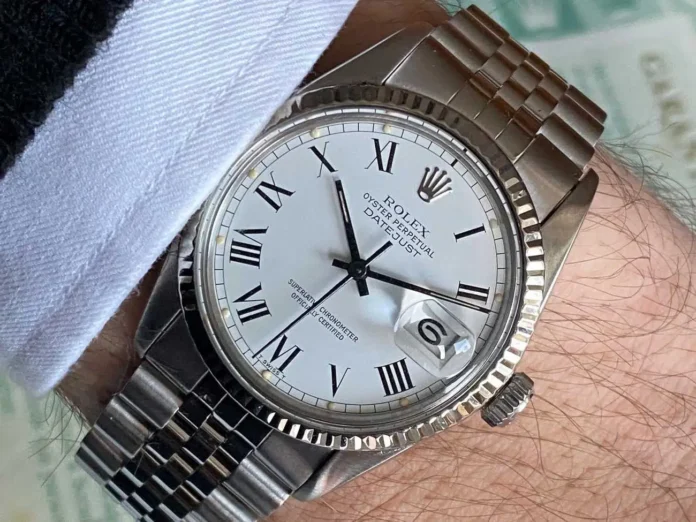
Known today as the “Buckley Dial,” the design traces back to a specific group of Rolex Datejust models produced during the 1970s and 1980s featuring painted Roman numerals rather than traditional applied metal markers. For years, those dials were largely ignored or undervalued within collector communities.
Buckley saw something different.
Long before vintage Rolex collecting exploded into mainstream culture, he aggressively sought out the unusual dials, recognizing aesthetic and rarity qualities others overlooked. Over time, collector sentiment shifted dramatically, and the watch community began informally referring to the configuration as the “Buckley Dial” in recognition of his foresight and advocacy.
Today, authentic Buckley Dial Rolex watches command significant premiums within the vintage market, reflecting how dramatically collector culture has evolved — and how influential certain dealers have become in shaping the historical narratives surrounding luxury timepieces.
That historical perspective formed the foundation of the conversation hosted by Venus Jewelers.
At a time when online marketplaces, social media influencers, and speculative buyers increasingly dominate portions of the luxury watch conversation, Buckley and Jason focused instead on what experienced collectors actually prioritize when evaluating watches worth purchasing, preserving, or collecting long term.
One of the most striking moments came when Buckley addressed what he believes beginner collectors consistently misunderstand: the obsession with “box and papers.”
Within luxury watch culture, original documentation and packaging have become heavily fetishized, often treated by inexperienced buyers as the defining benchmark of legitimacy and value. While Buckley acknowledged that original documentation absolutely matters — particularly for extremely rare references — he argued that many newcomers dramatically over-prioritize paperwork at the expense of what truly matters most: the watch itself.
Condition, originality, and authenticity remain the real currency of serious collecting.
Buckley stated bluntly that he would rather own a beautifully preserved watch without papers than a heavily compromised example accompanied by full documentation.
That perspective reflects a deeper philosophy within elite vintage collecting circles.
Originality cannot be recreated once lost.
A watch’s untouched dial, sharp case geometry, authentic components, factory surfaces, and honest aging patterns often matter far more than external accessories or resale packaging. Experienced collectors increasingly evaluate watches as historical objects rather than luxury consumer products alone.
Jason echoed that sentiment while emphasizing another principle that has become critically important in today’s resale environment: “buy the seller first.”
The statement reflects growing concern throughout the luxury watch industry surrounding anonymous online resale platforms where counterfeit parts, altered components, refinished surfaces, and questionable restorations have become increasingly common.
As luxury watch values surged globally over the past decade, the financial incentive to cosmetically manipulate watches also exploded.
Today, many inexperienced buyers unknowingly purchase watches containing refinished dials, replacement parts, excessive polishing, altered documentation, or heavily restored components marketed deceptively as original examples.
That issue led directly into what Buckley described as the single most destructive mistake affecting watch value: refinished dials.
Among serious vintage Rolex collectors, the dial is often considered the soul of the watch.
Buckley explained that a refinished dial — one that has been repainted, restored, recoated, or cosmetically altered — permanently destroys a substantial portion of a watch’s authenticity because the original factory surface can never truly be recreated once removed.
For collectors, natural aging and patina are not flaws.
They are evidence of originality.
The irony within modern luxury culture is that inexperienced buyers often seek watches appearing unnaturally pristine, while seasoned collectors value untouched authenticity even when it includes subtle aging, discoloration, or wear developed organically over decades.
Buckley’s commitment to originality is so extreme that he has openly stated he would purchase certain watches solely because of their untouched original dials regardless of other factors.
The second major issue discussed was over-polishing — another surprisingly common problem quietly eroding enormous amounts of value within the luxury watch market.
To casual owners, polishing often seems harmless or even beneficial.
In reality, aggressive polishing physically removes metal from the watch case, gradually softening the sharp edges, proportions, bevels, and geometry that define the watch’s original factory craftsmanship. Over time, repeated polishing can permanently distort the case structure itself.
Buckley described instances where excessive polishing literally erased Rolex crown logos from watch cases entirely.
That warning carries enormous importance because many owners unknowingly authorize routine polishing during servicing without understanding its long-term impact on collector value.
The discussion also highlighted how dramatically the modern watch market has changed culturally.
Luxury watches today increasingly operate at the intersection of fashion, investment speculation, status signaling, social media culture, and collectible asset behavior. Certain Rolex models now trade similarly to financial commodities, with values fluctuating rapidly based on scarcity, celebrity association, online hype cycles, and secondary-market demand.
Yet Buckley’s perspective serves as a reminder that serious collecting still revolves around connoisseurship rather than speculation alone.
True value emerges through originality, preservation, historical integrity, rarity, and authenticity — not simply trend momentum.
For Rolex itself, that dynamic has created a fascinating paradox.
The brand remains one of the most recognized luxury manufacturers in the world, yet portions of its vintage market increasingly behave more like fine art or rare automobile collecting than traditional consumer retail.
Specific dial variations, untouched cases, factory-correct components, and historically important references can create enormous valuation differences invisible to casual observers but deeply significant within collector circles.
Venus Jewelers’ decision to host the conversation reflects the broader sophistication emerging within New Jersey’s luxury retail sector itself.
Family-owned since 1979, the Somerset-based retailer has steadily built a significant reputation within both fine jewelry and luxury watch markets while maintaining certifications through organizations including the American Gem Society and GIA.
The company’s upcoming Rolex Trunk Show scheduled for May 14 through May 16 at its Somerset location further reinforces the growing demand for authenticated, expert-guided luxury watch experiences in the region.
Events like these increasingly serve not merely as sales opportunities but as educational forums where collectors, investors, enthusiasts, and first-time buyers can interact directly with specialists capable of navigating an increasingly complex market.
That educational component may now matter more than ever.
The luxury watch economy has become extraordinarily sophisticated, with values driven by tiny details invisible to most consumers — dial printing variations, factory-correct handsets, polishing history, case geometry, lume consistency, serial ranges, bracelet codes, and originality markers requiring years of expertise to evaluate properly.
In many ways, the conversation hosted by Venus Jewelers ultimately exposed a deeper truth about the modern luxury market itself.
As hype, social media, speculation, and online resale continue accelerating, genuine expertise becomes increasingly valuable.
Because in the world of vintage Rolex collecting, the difference between a great watch and a compromised one often comes down to details most people never even realize they should be looking for.



