


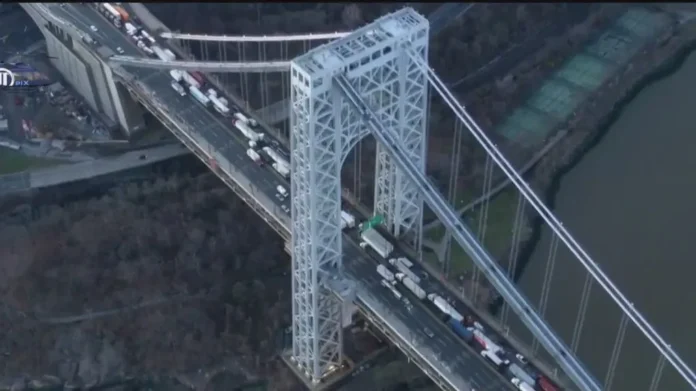

A major personal injury settlement involving one of the busiest transportation crossings in the United States is drawing renewed attention to infrastructure safety, roadway maintenance liability, and the enormous operational responsibilities attached to aging regional transportation systems after Brach Eichler Injury Lawyers secured a reported $10.5 million settlement tied to a serious roadway debris incident on the George Washington Bridge.
The case, resolved with the Port Authority of New York and New Jersey, centers on injuries allegedly caused by hazardous debris conditions on the heavily traveled interstate crossing linking northern New Jersey with Manhattan, a transportation artery carrying enormous strategic importance for regional commuting, freight movement, interstate commerce, tourism, and national logistics infrastructure.
While settlement agreements often conclude quietly, the scale and visibility of this case have intensified broader conversations surrounding roadway safety accountability and the immense challenges associated with maintaining critical transportation infrastructure operating under relentless daily stress.
The George Washington Bridge is not merely another roadway structure.
It stands among the most heavily trafficked bridges in the world, serving as one of the primary transportation gateways connecting New Jersey and New York City. Millions of passenger vehicles, commercial trucks, buses, emergency responders, and regional commuters rely on the bridge annually, making its operational integrity central not only to mobility but also to regional economic stability.
Any incident involving serious injuries on infrastructure of that scale immediately raises larger questions concerning inspection standards, maintenance procedures, hazard mitigation, emergency response coordination, and public-agency liability exposure.
Although detailed factual specifics surrounding the debris incident itself remain limited publicly, the settlement’s magnitude suggests the underlying injuries and legal claims were substantial enough to create significant litigation risk for the Port Authority.
Roadway debris cases occupy a uniquely complicated area within transportation and infrastructure law.
Unlike ordinary vehicle collisions involving individual drivers, infrastructure-related injury litigation frequently centers on questions involving notice, maintenance obligations, inspection procedures, engineering standards, operational oversight, hazard foreseeability, and governmental responsibility for public safety conditions.
In cases involving bridges, tunnels, highways, or large-scale transportation systems, attorneys often examine whether agencies responsible for infrastructure management knew — or reasonably should have known — about dangerous conditions before injuries occurred.
Those legal disputes can become extraordinarily technical.
Engineering reports, maintenance records, surveillance footage, inspection schedules, contractor responsibilities, operational protocols, and prior incident histories may all become central evidence in determining whether public entities exercised reasonable care under applicable legal standards.
The Port Authority, because of its unique interstate structure and operational scale, faces especially complex liability considerations.
Created as a bi-state agency overseeing major transportation infrastructure throughout the New York metropolitan area, the organization manages some of the most operationally demanding public assets in the country, including bridges, tunnels, airports, seaports, rail systems, bus terminals, and logistics infrastructure essential to the broader Northeast economy.
Maintaining those systems involves enormous engineering, financial, and operational challenges.
Much of the region’s transportation infrastructure was constructed decades ago under dramatically different traffic volumes and engineering assumptions. Today, those same structures face relentless wear tied to modern freight movement, population density, environmental stress, climate impacts, and sustained commuter demand far exceeding original design expectations.
The George Washington Bridge itself represents one of the clearest examples of that strain.
Opened in 1931, the bridge remains an engineering landmark but also functions under constant pressure from contemporary transportation realities. Tens of millions of vehicles cross annually, placing extraordinary demands on structural systems, roadway surfaces, maintenance schedules, inspection operations, and traffic management infrastructure.
As a result, infrastructure maintenance throughout the New York–New Jersey corridor has become not only a transportation issue but also a public safety issue carrying significant legal and political implications.
The settlement secured by Brach Eichler arrives during a period of increasing national concern surrounding infrastructure reliability overall.
Across the United States, aging bridges, highways, tunnels, transit systems, and public transportation assets continue requiring major modernization and maintenance investment. Federal infrastructure spending initiatives have accelerated in recent years precisely because many transportation systems nationwide face mounting operational and structural pressures after decades of deferred maintenance and underinvestment.
New Jersey sits directly at the center of those national infrastructure conversations.
The state operates within one of the most densely populated and heavily trafficked transportation networks in America. Interstate highways, commuter rail systems, freight corridors, ports, tunnels, bridges, airports, and public transit infrastructure throughout the region support not only local mobility but also national commerce and East Coast supply chains.
That interconnectedness means infrastructure failures or hazardous conditions can create consequences extending far beyond isolated incidents.
The legal significance of large infrastructure settlements also extends into broader public-agency risk management.
When major settlements occur involving public transportation infrastructure, agencies frequently reevaluate operational procedures, inspection practices, maintenance prioritization, contractor oversight, and hazard response systems in order to reduce future liability exposure.
Risk management has become increasingly important as transportation agencies confront rising litigation costs alongside escalating infrastructure maintenance demands.
For personal injury firms, infrastructure-related cases also represent one of the most technically demanding areas of civil litigation.
Unlike more straightforward accident claims, cases involving public infrastructure frequently require multidisciplinary legal strategies incorporating engineering analysis, governmental immunity law, transportation regulations, accident reconstruction, maintenance documentation, structural oversight review, and public-agency operational procedures.
Brach Eichler LLC has long maintained a prominent presence within New Jersey’s legal landscape, particularly across litigation and injury law sectors. High-profile infrastructure-related settlements further reinforce the growing importance of specialized litigation expertise involving transportation systems and public-agency liability.
The case also highlights how infrastructure litigation increasingly intersects with broader public discussions surrounding accountability.
Modern transportation systems operate under enormous public trust.
Drivers crossing bridges, entering tunnels, boarding trains, or using major highways generally assume those systems are being maintained safely and monitored consistently. When severe injuries allegedly result from roadway hazards or infrastructure conditions, public confidence can quickly become part of the broader conversation surrounding transportation governance itself.
That dynamic becomes even more sensitive when incidents occur on iconic infrastructure carrying symbolic importance beyond transportation alone.
The George Washington Bridge functions not only as a commuter corridor but also as a defining piece of the New York–New Jersey metropolitan identity. It represents engineering ambition, regional interconnectedness, economic movement, and daily life for millions of residents throughout the tri-state area.
Infrastructure failures or injury claims tied to such highly visible assets naturally attract greater public scrutiny.
The settlement also arrives amid accelerating infrastructure investment throughout the region overall.
Major projects including the Gateway Program, Portal North Bridge replacement, NJ Transit modernization initiatives, airport upgrades, tunnel rehabilitation efforts, and highway reconstruction programs all reflect growing recognition that maintaining Northeast transportation systems requires sustained long-term capital investment alongside rigorous operational oversight.
Yet even with major modernization efforts underway, maintaining aging infrastructure while simultaneously handling immense daily transportation demand remains extraordinarily difficult.
The tension between operational continuity and infrastructure maintenance defines much of modern transportation management throughout the Northeast Corridor. Agencies must keep systems functioning continuously while also repairing, upgrading, inspecting, and modernizing structures carrying nonstop traffic volumes.
That operational reality helps explain why infrastructure liability cases continue emerging nationwide despite significant maintenance investment efforts.
The broader implications of the George Washington Bridge settlement therefore extend beyond one lawsuit alone.
The case reinforces how infrastructure safety, transportation reliability, public accountability, engineering oversight, and legal liability have become increasingly interconnected within modern urban environments dependent on aging but essential transportation systems.
For New Jersey residents, the incident also serves as another reminder of just how deeply infrastructure shapes daily life throughout the region.
Every commute, freight delivery, emergency response route, transit connection, and interstate crossing depends on the safe and reliable functioning of transportation systems often operating under extraordinary pressure.
When those systems fail — even momentarily — the consequences can become life-altering.
And as New Jersey and the broader metropolitan region continue investing billions into transportation modernization, infrastructure accountability will likely remain one of the defining public policy and legal issues shaping the future of mobility throughout the Northeast corridor.



