


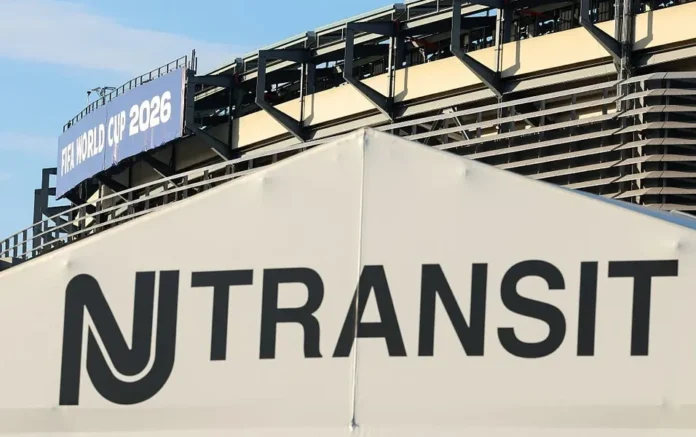

New Jersey is intensifying preparations for one of the largest international sporting events ever staged in the region as NJ Transit announced a major reduction in round-trip transportation pricing for the upcoming FIFA World Cup matches scheduled at the NY/NJ Stadium complex, lowering fares to $98 while simultaneously unveiling a broader operational strategy designed to handle the enormous transportation demands expected during the global tournament.
The move, announced under the direction of Mikie Sherrill, represents both a logistical and political balancing act as state leaders attempt to deliver efficient transportation infrastructure for hundreds of thousands of international visitors without shifting financial burdens onto New Jersey taxpayers or everyday NJ Transit commuters.
The revised $98 roundtrip fare — now reduced below the symbolic $100 threshold — applies to transportation for all eight FIFA World Cup matches being hosted in the region and will be available exclusively through NJ Transit’s newly redesigned mobile application.
State officials say the reduced fare was made possible through expanded advertising and corporate sponsorship revenue, allowing NJ Transit to offset transportation costs without relying on additional taxpayer subsidies or broader fare increases affecting regular riders throughout the statewide system.
The announcement reflects the extraordinary scale of operational planning now underway across New Jersey as the region prepares to host millions of visitors during what is expected to become one of the most heavily attended sporting spectacles in global history.
The FIFA World Cup represents far more than a sports tournament.
For New Jersey and the broader New York metropolitan region, the event functions as a massive international infrastructure stress test involving transportation systems, public safety operations, hospitality capacity, logistics coordination, crowd management, tourism infrastructure, emergency preparedness, and real-time mobility planning at unprecedented scale.
Transit infrastructure sits directly at the center of that challenge.
The NY/NJ Stadium complex — located in East Rutherford near the Meadowlands Sports Complex — was never originally designed to independently accommodate the sheer volume of simultaneous global tourism traffic associated with modern World Cup operations. As a result, NJ Transit’s rail network has become one of the most critical operational components determining whether the region can move hundreds of thousands of spectators efficiently while minimizing disruption to ordinary commuter activity.
Governor Sherrill framed the fare reduction within a broader policy philosophy emphasizing fiscal protection for New Jersey residents while still ensuring the state can successfully host a major international event.
Her remarks directly referenced ongoing frustrations surrounding FIFA’s refusal to absorb transportation costs despite the organization’s massive expected revenue generation from the tournament itself, estimated at approximately $13 billion globally.
That tension has become one of the more politically sensitive aspects of the region’s World Cup preparations.
Public officials throughout New Jersey have faced increasing pressure to demonstrate that hosting the tournament will generate long-term economic and international visibility benefits without forcing local taxpayers to subsidize private event infrastructure costs disproportionately.
By using private advertising partnerships to reduce ticket pricing, the administration appears intent on presenting the transportation strategy as financially responsible while also improving public accessibility for fans attending the matches.
The transportation operation itself will be extraordinarily complex.
NJ Transit expects hundreds of thousands of riders to utilize rail services connected to the eight World Cup matches being staged at the stadium. The agency’s transportation blueprint relies heavily on timed boarding systems, mobile-only ticketing, advance capacity management, controlled passenger flow, and highly coordinated rail transfers centered around Secaucus Junction and Penn Station New York.
Under the current plan, all World Cup transportation tickets must be purchased in advance through NJ Transit’s redesigned mobile application, which now serves as a central operational tool within the broader World Cup transit strategy.
The agency has confirmed that tickets will not be sold through traditional station ticket offices or vending machines, a decision likely intended to reduce congestion, streamline crowd management, and centralize rider coordination through digital systems capable of handling real-time capacity controls.
The mobile-first strategy reflects how dramatically large-scale event transportation planning has evolved in recent years.
Modern transit agencies increasingly rely on app-based ecosystems not only for ticket sales but also for crowd analytics, service updates, boarding coordination, passenger communication, GPS integration, emergency alerts, and operational flexibility during large-scale events.
For NJ Transit specifically, the World Cup will effectively function as a global demonstration of the agency’s broader modernization efforts, including its recently launched redesigned mobile platform and expanding digital infrastructure systems.
Officials say tickets will be capped at approximately 40,000 per matchday, reinforcing the highly controlled operational structure being implemented to avoid overcrowding and preserve system reliability during tournament operations.
Ticket holders will also be assigned designated boarding windows, with pre-boarding ticket checks occurring before passengers are allowed onto stadium-bound trains.
Fans traveling from New York City and all five boroughs will be required to use Penn Station New York as their departure point for direct rail travel into the stadium area on matchdays.
Meanwhile, New Jersey riders departing from regional rail stations will utilize timed mobile boarding systems and transfer through Secaucus Junction before connecting to stadium service.
That operational structure highlights the enormous importance of Secaucus Junction within New Jersey’s transportation ecosystem.
Long viewed as one of the state’s most strategically important transit hubs, Secaucus will now become a central gateway not only for regional commuters but also for international visitors traveling into the Meadowlands during the tournament.
The pressure on NJ Transit’s infrastructure during the event cannot be overstated.
The agency has spent years confronting criticism surrounding delays, aging equipment, overcrowding, communication failures, and operational reliability concerns. Hosting the World Cup therefore carries significant reputational implications for both NJ Transit and the broader state government.
A successful transportation operation could strengthen confidence in New Jersey’s transit modernization efforts and showcase the state’s ability to manage large-scale international infrastructure demands.
Operational failures, however, would likely generate immediate global visibility and criticism.
That reality helps explain the aggressive focus now being placed on digital coordination, rider communication, crowd flow management, and operational predictability throughout the planning process.
Priya Jain emphasized that protecting everyday NJ Transit commuters remains a major priority while still delivering safe and efficient transportation for World Cup attendees.
That balance remains politically essential.
Millions of New Jersey residents rely daily on NJ Transit for work commutes, school travel, business operations, and regional mobility. State officials appear acutely aware that ordinary commuters would likely react negatively if World Cup transportation planning disrupted already strained daily transit operations or created new financial burdens through broader systemwide fare pressure.
NJ Transit President and CEO Kris Kolluri also highlighted the role corporate sponsors played in helping offset transportation costs while framing those partnerships as both branding opportunities and broader community investments tied to the tournament.
The corporate sponsorship model itself reflects another growing trend in large-scale transportation and infrastructure financing.
Public agencies increasingly rely on advertising partnerships, naming rights agreements, sponsorship programs, and private-sector collaborations to supplement operational funding during major events or infrastructure initiatives. For NJ Transit, leveraging World Cup visibility to generate additional advertising revenue represents a strategic effort to monetize the global attention surrounding the tournament without further burdening taxpayers.
The transportation announcement also arrives during a larger period of modernization for NJ Transit overall.
The agency continues working through multiple long-term capital projects including the near-completed Portal North Bridge replacement, fleet modernization involving hundreds of new railcars and buses, expanded digital infrastructure initiatives, and broader customer experience upgrades involving safety, accessibility, station modernization, and real-time information systems.
The World Cup may ultimately become a defining operational moment for those broader modernization efforts.
Beyond transportation logistics, the tournament carries enormous economic implications for New Jersey.
Hotels, restaurants, retail centers, entertainment venues, transportation providers, tourism operators, hospitality groups, and local businesses throughout the region are expected to experience significant economic activity tied to the influx of global visitors. State officials continue promoting the event as a major international showcase capable of elevating New Jersey’s visibility on a worldwide stage.
The challenge, however, remains ensuring that economic opportunity does not come at the expense of public infrastructure stability or taxpayer exposure.
That tension is visible throughout nearly every aspect of the current transportation strategy.
By reducing ticket prices below $100 through private partnerships while centralizing operations around digital infrastructure and tightly managed capacity controls, the Sherrill administration appears determined to project both fiscal discipline and operational competence simultaneously.
The coming weeks will now test whether the state’s transit systems are truly prepared for the scale of what lies ahead.
Because when millions of international visitors arrive for the FIFA World Cup, NJ Transit will no longer function simply as a regional commuter agency.
For a brief moment, it will become one of the most visible transportation systems on Earth.