


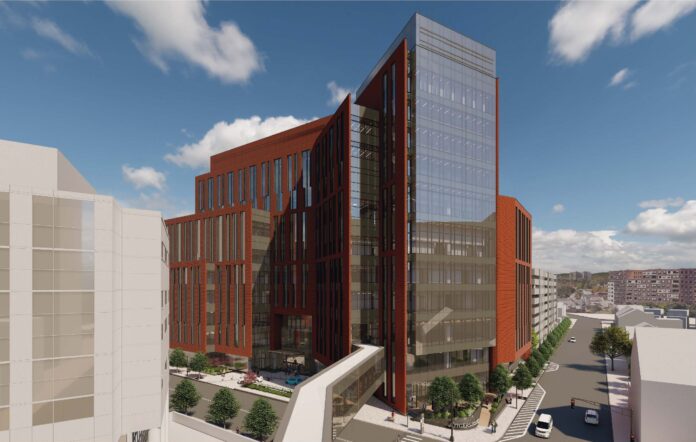

The skyline and civic infrastructure of New Brunswick continue evolving at a rapid pace as city officials have formally approved plans for a massive new $175 million Middlesex County administration complex that will transform a long-utilized surface parking site into a major government office hub at the center of one of New Jersey’s fastest-growing redevelopment corridors.
The project, approved by the New Brunswick Planning Board, will bring an eight-story, 218,000-square-foot office building to a site bordered by New Street and Redmond Street, further reinforcing the city’s emergence as one of the most aggressively developing urban centers in the state.
Developed by AST New Brunswick LLC, the new structure is expected to house hundreds of Middlesex County employees and serve as a significant new administrative anchor within downtown New Brunswick’s expanding institutional, commercial, and mixed-use landscape.
The approval marks another major milestone in the broader redevelopment transformation unfolding throughout Middlesex County as government agencies, private developers, healthcare institutions, educational organizations, and infrastructure planners continue reshaping the region around dense urban growth, transit-oriented investment, and expanded civic infrastructure.
At the center of the project is a dramatic physical reinvention of land that has spent years functioning primarily as surface parking after previous office and residential structures occupying the property were demolished.
That transition from low-density parking inventory to a major public-sector office complex reflects a much larger trend now redefining development strategy across New Jersey’s urban cores.
Cities increasingly view surface parking lots as underutilized assets capable of supporting significantly higher economic, institutional, residential, and operational value through vertical redevelopment. Particularly in transit-accessible downtown environments like New Brunswick, land scarcity and rising demand for dense mixed-use infrastructure are accelerating efforts to repurpose parking-heavy parcels into more active economic and civic uses.
The new Middlesex County Administration Building will stand as a highly visible example of that redevelopment philosophy.
According to approved site plans, the structure will feature a prominent “Middlesex County Administration” presence integrated directly into the building façade and surrounding streetscape, reinforcing the project’s role not only as an office development but also as a symbolic expansion of county government infrastructure within the urban center of New Brunswick.
The building’s first floor is expected to include public-facing county service space, while floors two through eight will house administrative offices tied to Middlesex County operations.
Although county officials have not yet disclosed detailed departmental occupancy plans, reports indicate that hundreds of employees are expected to relocate into the new facility once completed, potentially reshaping portions of county administrative operations and downtown workforce activity simultaneously.
The scale of the project itself is substantial.
With an at-grade footprint of approximately 27,000 square feet, the development will incorporate surface parking, landscaped areas, pedestrian sidewalks, and broader site improvements intended to integrate the project into the surrounding urban fabric. The project’s engineering and environmental planning were handled by Langan Engineering and Environmental Services Inc., while the concept plan for the redevelopment agreement was developed by Jarmel Kizel Architects and Engineers Inc..
The project’s approval under the New Redmond II Redevelopment Plan further highlights how aggressively New Brunswick continues leveraging redevelopment frameworks to guide long-term urban growth.
The redevelopment plan, adopted last year by the New Brunswick City Council, was specifically designed to stimulate new commercial opportunity, job creation, and broader economic development throughout the city.
Importantly, project engineers noted that the administration complex fully conforms to the redevelopment plan and does not require any zoning variances, a detail that significantly streamlined the approval process and suggests strong alignment between municipal planning priorities and the project’s design parameters.
That alignment reflects the increasingly coordinated nature of redevelopment strategy throughout New Brunswick.
For years, the city has operated as one of New Jersey’s most active urban redevelopment laboratories, balancing major institutional expansion with transit-oriented growth, residential density increases, healthcare infrastructure investment, educational development, hospitality growth, and commercial modernization.
The city’s transformation has been fueled in large part by the presence of powerful regional institutions including Rutgers University, the expanding healthcare corridor surrounding Robert Wood Johnson University Hospital, and a growing network of biotech, pharmaceutical, educational, and research-driven economic activity.
Now, Middlesex County itself appears increasingly committed to strengthening its physical footprint within the city center.
The administration complex represents more than simply another office building. It reflects the growing centralization of governmental infrastructure within New Brunswick’s evolving urban ecosystem.
That carries significant economic implications.
Large concentrations of government workers generate daily pedestrian activity, support surrounding retail and food-service businesses, increase daytime population density, strengthen transit utilization, and contribute to broader downtown economic stability. Public-sector office concentration often functions as an important stabilizing force within urban redevelopment zones because government occupancy tends to remain relatively durable even during broader commercial real estate volatility.
That stability may become increasingly valuable given the changing dynamics currently affecting office markets nationwide.
Many cities across the country continue struggling with elevated office vacancy rates tied to remote work trends, hybrid employment structures, and shifting workplace strategies following the pandemic era. Yet government, healthcare, educational, and institutional office uses have generally remained more resilient than purely private-sector speculative office development.
By anchoring the building around county administrative operations, the New Brunswick project may avoid some of the occupancy uncertainty affecting portions of the broader office sector nationally.
The location itself further strengthens the project’s strategic significance.
Situated within one of the most rapidly evolving portions of New Brunswick, the development will exist near major transportation infrastructure, expanding residential density, educational institutions, and growing commercial corridors. The city’s direct rail connectivity into New York City and broader Northeast Corridor transit access continue making downtown New Brunswick highly attractive for dense institutional and mixed-use investment.
Transit-oriented development remains one of the dominant forces shaping urban redevelopment across New Jersey.
Municipalities increasingly prioritize projects capable of concentrating employment, housing, services, and economic activity near existing transportation infrastructure in order to maximize land efficiency and reduce dependence on automobile-centered suburban sprawl patterns.
The Middlesex County administration project fits squarely within that broader planning philosophy.
At the same time, the project highlights the continuing role public-sector investment plays in sustaining New Jersey’s construction economy.
Major government-backed infrastructure and administrative projects continue generating substantial activity for architects, engineers, environmental consultants, construction firms, site planners, legal teams, and labor sectors throughout the region. In an environment where interest rates and financing pressures have complicated portions of private development activity, public and institutional projects increasingly provide important stability for segments of the construction industry.
The redevelopment also underscores how dramatically New Brunswick’s identity has changed over the past several decades.
Once known primarily as a post-industrial city struggling with economic transition, New Brunswick has increasingly repositioned itself as a major regional center for healthcare, education, government operations, biotechnology, research, housing, and mixed-use urban growth.
The city’s skyline, population density, institutional footprint, and development profile have all expanded significantly as investment continues flowing into both public and private redevelopment initiatives.
Projects like the new Middlesex County Administration Building reinforce that trajectory.
The decision to place a major county office hub directly within downtown New Brunswick reflects confidence not only in the city’s current economic strength but also in its long-term role as one of New Jersey’s most important urban centers moving forward.
The transformation of a former parking lot into a major civic office complex may appear, on the surface, like a straightforward redevelopment story.
But at a broader level, it reflects multiple forces simultaneously reshaping New Jersey’s urban future: institutional consolidation, transit-oriented planning, government infrastructure modernization, downtown revitalization, land-use intensification, and the continuing reinvention of older cities into highly integrated regional economic hubs.
As construction planning advances and redevelopment activity accelerates throughout Middlesex County, the new administration building stands poised to become another major piece of the rapidly changing New Brunswick landscape — a project that blends government expansion, urban redevelopment, economic strategy, and long-term civic investment into one of Central Jersey’s most ambitious ongoing transformation efforts.