


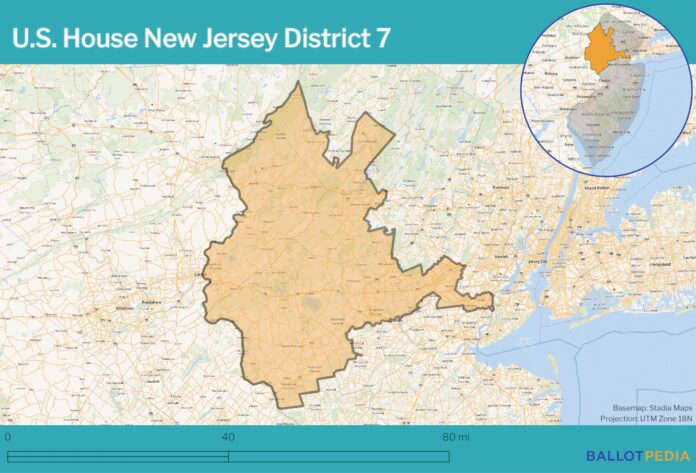

NEW JERSEY — The race to define the political future of New Jersey’s most competitive congressional district has entered a decisive phase, with a four-way Democratic primary set for June 2, 2026, now emerging as one of the most consequential contests in the state’s political landscape. At stake is not only the party nomination, but the strategic positioning for a high-stakes general election challenge against incumbent Tom Kean Jr., who is seeking a third term representing the 7th Congressional District—widely regarded as New Jersey’s premier swing district.
The significance of this race extends well beyond district lines. Control of competitive seats like NJ-07 is central to the broader battle for the House of Representatives, placing heightened attention on the Democratic primary as national organizations, advocacy groups, and political strategists increasingly view the outcome as a critical inflection point heading into the general election cycle. Within New Jersey, the district has become a focal point for voter engagement, fundraising activity, and policy messaging, reflecting the evolving dynamics of suburban and exurban electorates that continue to shape modern political outcomes.
The Democratic field, once expansive, has narrowed to four principal candidates, each bringing distinct professional backgrounds and policy priorities into a contest that remains fluid and highly competitive. Rebecca Bennett has emerged as a leading figure in the race, combining a background as a former U.S. Navy helicopter pilot and current Air National Guard officer with executive-level business experience. Her campaign has gained traction through strong fundraising performance and a growing network of endorsements, positioning her as a candidate capable of appealing to both traditional Democratic voters and independents critical to winning in a swing district.
Alongside Bennett, Michael Roth has built his campaign around fiscal policy and economic reform, drawing on his experience as a former interim leader within the Small Business Administration. His platform emphasizes tax restructuring and the modernization of federal benefit systems, aiming to connect with voters focused on economic stability and government efficiency. Tina Shah, a physician and former federal advisor, has centered her candidacy on healthcare affordability and systemic reform, an issue that continues to resonate strongly across the district’s diverse population. Meanwhile, Brian Varela, a small business owner and party caucus leader, has advanced a more progressive platform, highlighting economic equity, labor priorities, and grassroots-driven policy initiatives.
Despite Bennett’s early advantage in donor fundraising, the race remains notably competitive. Self-funding efforts and targeted campaign strategies from other candidates have contributed to what political observers continue to characterize as a “wide open” contest. This dynamic underscores a broader trend in modern primaries, where financial metrics alone no longer guarantee dominance, and where voter engagement, message clarity, and ground operations play an increasingly decisive role.
A key moment in the campaign timeline is set for May 12, when the candidates will meet for a 105-minute televised debate. This forum is expected to serve as a critical inflection point, offering voters a direct comparison of policy positions, leadership styles, and strategic vision. In a district where margins are often narrow, the ability to articulate a compelling and credible case in such settings can significantly influence undecided voters and shape late-stage momentum.
Overlaying the primary contest is a broader political context that continues to evolve. The absence of prior candidate Sue Altman from this race—now running in a different congressional district—has reshaped the competitive landscape, opening space for new leadership narratives to emerge. At the same time, incumbent Tom Kean Jr. faces increasing scrutiny over his recent visibility in Washington, an issue that Democratic campaigns are expected to leverage as they position themselves for the general election.
One of the most significant developments in the race has been the entry of VoteVets, which has announced a six-figure advertising investment in support of Bennett. The campaign, anchored by a $200,000 initial buy, represents a coordinated, multi-platform media effort designed to reach likely primary voters across cable television, streaming services, and digital channels. The strategy reflects a sophisticated understanding of modern media consumption, targeting audiences through a combination of traditional broadcast networks and digital ecosystems including ConnectedTV and social platforms.
The centerpiece of the campaign, an advertisement titled “Fighter’s Edge,” features testimony from a fellow Navy veteran who trained alongside Bennett. The messaging is calibrated to highlight leadership under pressure, decision-making in high-stakes environments, and a service-oriented approach to governance. These themes are not incidental; they align with broader voter sentiment research indicating that military experience and veteran advocacy continue to carry significant credibility across demographic groups, particularly among working-class voters and younger audiences whose political engagement has fluctuated in recent cycles.
VoteVets’ involvement also signals a broader nationalization of the race. With a track record of substantial electoral investment—including tens of millions of dollars in prior cycles—the organization’s decision to engage early in the NJ-07 primary reflects its assessment of the district’s strategic importance. Such investments are not solely about influencing primary outcomes; they are also about shaping narratives and building infrastructure that can carry forward into the general election.
The broader implications of this race are closely tied to the evolving identity of New Jersey’s suburban districts. Once considered reliably aligned with one party, these regions have become increasingly competitive, influenced by demographic shifts, economic pressures, and changing voter priorities. Issues such as cost of living, healthcare access, public safety, and economic opportunity are expected to dominate the discourse, requiring candidates to navigate a complex and often cross-cutting set of concerns.
Within the framework of Sunset Daily News New Jersey Politics, the NJ-07 primary represents a clear example of how local contests are increasingly interconnected with national dynamics. The candidates are not only articulating district-specific solutions but are also positioning themselves within broader debates that define the current political environment. This dual focus adds both complexity and significance to the race, elevating it beyond a typical primary contest.
As the June 2 primary approaches, the trajectory of the race will likely be shaped by a combination of factors: the effectiveness of campaign messaging, the impact of external investments, voter turnout patterns, and the outcomes of key public forums such as the upcoming debate. What remains consistent is the central role of the district itself—a competitive, closely watched battleground where small shifts can produce substantial political consequences.
The outcome of this primary will set the stage for one of New Jersey’s most closely contested general elections, determining which candidate will carry the Democratic banner into a race that could influence the balance of power in Congress. In that sense, the events unfolding now are not isolated—they are part of a broader narrative about representation, accountability, and the direction of governance at both the state and national levels.
For voters, stakeholders, and observers alike, New Jersey’s 7th Congressional District has become more than a geographic designation. It is a proving ground for political strategy, a reflection of changing electoral dynamics, and a central arena in the ongoing effort to define the future of American governance.



