


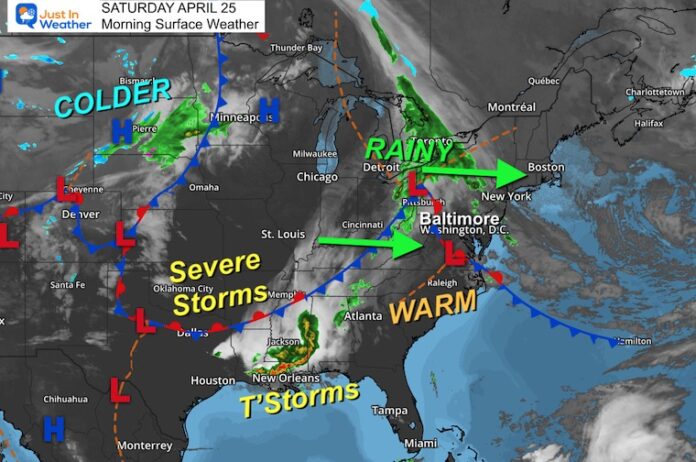

New Jersey is entering a defining stretch of spring weather that will challenge expectations for a rapid seasonal warm-up and instead reinforce a pattern more consistent with late March than late April. A developing split-flow configuration across the southeastern United States is placing the Garden State firmly within the northern stream, introducing a colder upper-level flow sourced from Canada and setting the stage for a multi-phase pattern that will influence conditions through at least the first third of May.
Hourly Forecast (Saturday, April 25)
| Hour | Sky Condition | Temperature | Chance of Rain |
|---|---|---|---|
| 11 AM – 3 PM | Cloudy | 52°F – 50°F | 10-15% |
| 4 PM – 7 PM | Light rain | 49°F – 45°F | 30-65% |
| 8 PM – 11 PM | Rain | 44°F – 43°F | 75-80% |
Weekend Highlights
- Rain Totals: Widespread rainfall of 1 to 1.5 inches is expected through tonight.
- Wind & “Feels Like”: Gusts of 20–25 mph will persist today, making temperatures in the high 40s/low 50s feel significantly colder.
- Improvement Sunday: Rain will taper off Sunday morning, leaving a cool and gloomy afternoon with highs in the mid-50s.
- Freeze Watch: Be aware that a freeze watch has been issued for most of the state starting Monday night as much colder air moves in.
7-Day Forecast (New Jersey)
| Day | Sky Condition | Temperature | Chance of Rain |
|---|---|---|---|
| Sat, Apr 25 | Rain | 52°F / 42°F | 78% |
| Sun, Apr 26 | Cloudy | 52°F / 40°F | 25% |
| Mon, Apr 27 | Sunny | 63°F / 42°F | 0% |
| Tue, Apr 28 | Cloudy | 65°F / 45°F | 10% |
| Wed, Apr 29 | Rain | 58°F / 47°F | 75% |
| Thu, Apr 30 | Partly sunny | 55°F / 42°F | 35% |
| Fri, May 1 | Partly sunny | 56°F / 39°F | 10% |
This is not a short-lived fluctuation. What is unfolding is a structural shift in the atmospheric setup, where neutral height anomalies over the region are being overridden by colder air aloft and a series of weak but persistent disturbances. The immediate result is a damp, unsettled weekend followed by a brief stabilization period, and then a return to below-average temperatures paired with above-average precipitation potential heading into early May. For a state that often oscillates quickly between seasons, this represents a more sustained and impactful regime.
The weekend forecast illustrates the mechanics of this pattern in real time. A weak upper-level disturbance is tracking slowly through the central Mid-Atlantic before drifting offshore, interacting with a steady influx of moisture and a cooler marine-influenced air mass. The result is not a high-intensity storm system but rather a prolonged period of low-grade precipitation—persistent drizzle, intermittent light rain, and occasional steadier bands that collectively produce meaningful rainfall totals without dramatic downpours. By the time this system exits, much of New Jersey is expected to approach or exceed one inch of total precipitation, with northern portions of the state likely reaching that threshold first due to slightly more favorable dynamics.
This type of rainfall profile carries implications beyond inconvenience. While it will disrupt outdoor plans and create extended periods of cloud cover and damp conditions, it also serves a functional role in replenishing soil moisture, supporting reservoir levels, and contributing to aquifer recharge. In a broader environmental context, this pattern aligns with a springtime trough-driven setup that prioritizes sustained precipitation over isolated heavy events—a distinction that matters for long-term water resource stability.
Friday sets the stage with a transitional atmosphere that underscores the regional contrasts typical of New Jersey’s geography. Inland areas push into the low 70s, while coastal communities remain suppressed in the 50s due to persistent northeast flow off the Atlantic. This gradient—often compressed into a span of just a few dozen miles—highlights the influence of maritime air and will become even more pronounced as the weekend system develops. Skies remain a mix of sun and clouds through the day, with overnight lows settling into the mid-to-upper 40s.
By Saturday, the pattern fully asserts itself. Temperatures flatten into the low 50s statewide, with limited diurnal variation as cloud cover thickens and precipitation begins. The onset is gradual—initially scattered drizzle and light rain—but conditions become more organized into the evening and overnight hours. Winds shift to an easterly component, increasing slightly along the coast where marine exposure enhances both moisture transport and wind speeds. Interior regions remain somewhat more sheltered but still experience a steady deterioration in conditions. Overnight lows drop into the low-to-mid 40s, with rainfall becoming more persistent heading into Sunday morning.
Sunday continues the theme of slow evolution rather than abrupt change. The first half of the day remains dominated by light rain, drizzle, and overcast skies, with temperatures hovering in the low-to-mid 50s. As the disturbance gradually exits and drier air begins to filter in, conditions improve from west to east during the afternoon. Rain tapers off, cloud cover begins to break, and there is potential for limited sunshine before sunset. Winds shift to a northerly or northeasterly direction, remaining modest but still more pronounced along coastal zones. Overnight temperatures dip into the upper 30s and lower 40s, marking one of the cooler nights of the period and reinforcing the broader trend toward a colder air mass.
The early part of next week offers a temporary reprieve. From Monday through midweek, high pressure builds modestly, allowing temperatures to recover into the 60s and bringing more stable, tranquil conditions. Nights remain cool, particularly in elevated inland areas where lows can fall into the mid-40s, while coastal regions hold closer to the low 50s. This window represents the most seasonable stretch in the near-term forecast, though even here, the atmosphere does not fully detach from its unsettled tendencies. There is potential for scattered spring showers, particularly around midweek, as residual energy moves through the broader pattern.
Beyond that, the larger-scale signal becomes increasingly clear. The atmosphere appears poised to reintroduce a trough-dominated regime beginning late next week and extending into approximately May 10. This phase is characterized by below-average temperatures—potentially limiting daytime highs to the 50s—and a continued emphasis on precipitation opportunities. While not every day will feature rainfall, the cumulative effect is expected to skew wetter than normal, with frequent disturbances maintaining an unsettled backdrop.
For residents and industries across New Jersey, this evolving pattern carries both operational and behavioral implications. Construction timelines, agricultural planning, outdoor event scheduling, and even energy demand forecasts will need to account for a cooler, wetter-than-average stretch that diverges from typical late-spring expectations. At the same time, the absence of extreme weather events within this pattern—no significant severe storm signals or rapid temperature swings—suggests a controlled, if persistent, influence rather than a volatile one.
This is a reminder that spring in the Mid-Atlantic is not defined solely by warming trends but by transition, variability, and atmospheric competition between lingering winter influences and emerging summer dynamics. In this case, the colder northern stream is maintaining the upper hand, shaping a period that prioritizes moisture, moderation, and gradual change over rapid seasonal acceleration.
For continued updates, evolving forecasts, and in-depth regional weather coverage, follow the latest reporting through Explore New Jersey Weather Report, where daily insights track the patterns shaping conditions across the state with precision and clarity.