


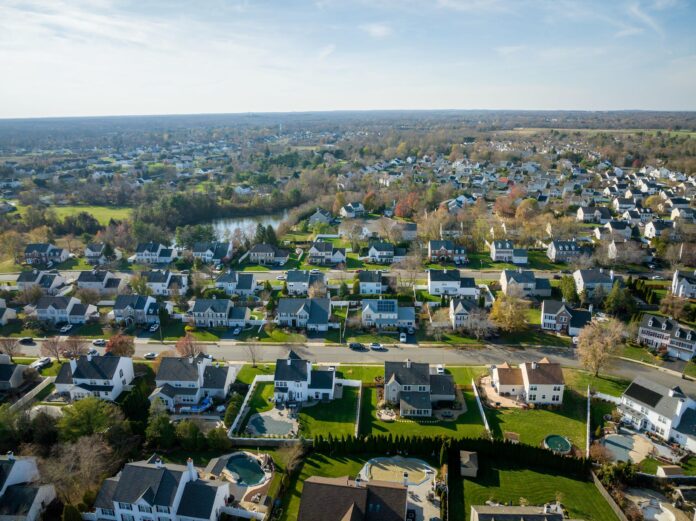

New Jersey’s housing market entered the year with a familiar imbalance—but the latest first-quarter data underscores that the story is no longer simply about rising prices. It is about a market recalibrating in real time, where constrained supply, cautious buyers, and persistent demand are reshaping transaction velocity without materially weakening home values. According to the latest figures released by New Jersey Realtors, median sales prices climbed across every major residential category in Q1, even as both pending and closed sales declined year-over-year.
This divergence—prices up, activity down—is now defining the state’s real estate environment. It reflects a market that remains fundamentally competitive but increasingly selective, where affordability pressures and macroeconomic uncertainty are slowing deal flow without triggering a broad-based price correction. For industry professionals, investors, and prospective buyers, the implications are significant: New Jersey is not cooling in the traditional sense—it is stabilizing at a higher baseline.
At the top level, the statewide median sales price reached $510,000 in the first quarter, marking a 2.2% increase compared to the same period last year. That figure alone reinforces the resilience of property values across the Garden State, particularly in high-demand suburban corridors and commuter-friendly regions. Yet beneath that headline number, transaction metrics tell a more nuanced story. Closed sales declined 6.1% to 15,106 units, while pending sales dropped even further, down 8.3% to 17,065. These are not marginal shifts; they represent a measurable slowdown in market throughput, driven in large part by affordability constraints and limited inventory turnover.
Inventory remains one of the most critical pressure points. New listings fell 5.1% year-over-year to 25,339, signaling that homeowners are still reluctant to enter the market, often due to the so-called “lock-in effect” tied to previously secured lower mortgage rates. This dynamic continues to restrict supply at a time when demand, while moderated, has not disappeared. In fact, total homes for sale did tick up slightly in March, rising 2.6% to 16,400, but that increase is not yet sufficient to materially rebalance the market.
The result is a slower-moving environment where properties are taking longer to transact. Days on market increased 9.1% to 48 days, indicating that buyers are proceeding with greater deliberation and negotiating more strategically. Even so, pricing power remains largely intact. Sellers are still achieving, on average, 100.3% of their list price, a figure that, while slightly down, continues to signal competitive conditions and limited discounting.
Breaking the data down by property type reveals additional layers of insight into how different segments are performing under these evolving conditions. Single-family homes—the backbone of New Jersey’s housing market—saw their median sales price rise 2.7% to $565,000. This segment continues to command strong demand, particularly among move-up buyers and families seeking space outside of dense urban centers. However, even here, transaction volume softened, with closed sales falling 4.8% to 10,163. The takeaway is clear: demand remains, but execution is more constrained.
The townhouse and condominium segment presents a slightly different profile. Median pricing held steady at $415,000, suggesting that this category may be reaching a short-term pricing ceiling. At the same time, closed sales dropped sharply by 11.2% to 3,483, indicating that this segment is particularly sensitive to interest rate fluctuations and affordability thresholds. For first-time buyers, who often rely on this category as an entry point into homeownership, higher borrowing costs are having a pronounced impact on purchasing decisions.
Adult communities—an increasingly important segment as demographic trends shift—posted a 1.4% increase in median sales price to $365,000. Closed sales declined modestly by 1.6% to 1,354, reflecting relative stability compared to other segments. This resilience may be attributed to the unique buyer profile in this category, where transactions are often driven by lifestyle transitions rather than purely financial considerations.
Taken together, these metrics illustrate a market that is not weakening, but rather recalibrating. The decline in sales activity is not being driven by a lack of interest, but by friction points within the transaction process—namely affordability constraints, limited inventory, and elevated borrowing costs. At the same time, the continued rise in median prices suggests that demand remains sufficiently strong to support current valuations.
From a strategic standpoint, this environment requires a more disciplined approach from all participants. Sellers must recognize that while pricing remains favorable, the days of immediate, above-ask bidding wars are less consistent and increasingly dependent on property condition, location, and pricing accuracy. Buyers, on the other hand, are gaining incremental leverage in terms of timing and negotiation, but must still contend with a competitive landscape where desirable properties do not linger indefinitely.
For developers and investors, the data reinforces the importance of aligning product offerings with evolving market realities. Entry-level housing remains undersupplied, while mid-range and move-up segments continue to show resilience. Meanwhile, the steady performance of adult communities highlights the growing influence of demographic-driven demand in shaping future development priorities.
More broadly, the first-quarter data positions New Jersey within a national narrative of constrained housing supply and elevated price floors. However, the state’s unique geographic advantages—proximity to major employment centers, diverse housing stock, and strong infrastructure—continue to underpin long-term demand. As a result, while transaction volume may fluctuate in response to economic conditions, the underlying value proposition of New Jersey real estate remains intact.
For ongoing coverage and deeper analysis of housing trends shaping the region, explore the latest updates in Sunset Daily News Real Estate, where market intelligence, local insights, and forward-looking perspectives continue to define the conversation around property in New Jersey.



