



New Jersey’s political climate is entering a sharper and more consequential phase, where rhetoric, governance, and the future of national leadership are converging in ways that demand careful scrutiny rather than reactionary interpretation. A recent flashpoint involving a vocal New Jersey critic calling for the “elimination” of former President Donald Trump has underscored just how overheated the discourse has become, raising serious questions about the boundaries of political expression, the normalization of extreme language, and the broader consequences for democratic stability.
This moment is not isolated. It is part of a wider pattern in which political rhetoric is accelerating faster than institutional guardrails, particularly as tensions grow around U.S. foreign policy decisions, executive authority, and the evolving balance of power between Congress and the presidency. The remarks in question emerged amid criticism of military actions involving Iran that were reportedly undertaken without formal congressional authorization, reigniting a long-standing constitutional debate over war powers. In New Jersey, where political engagement remains high and public awareness of national issues is deeply embedded in local discourse, these developments are resonating with unusual intensity.
The core issue is not simply what was said, but what it represents. When political language crosses into calls for harm—even rhetorically—it signals a breakdown in the norms that have traditionally separated fierce disagreement from dangerous escalation. New Jersey’s political environment, as reflected across ongoing coverage in Sunset Daily’s [Politics] section, has consistently emphasized accountability, institutional integrity, and the rule of law. Within that framework, rhetoric that suggests elimination rather than opposition stands in direct conflict with the foundational principles of democratic governance.
At the same time, the controversy is unfolding against the backdrop of a broader national recalibration. Congress appears increasingly sidelined in critical decision-making processes, particularly in matters of foreign policy and military engagement. This shift has not gone unnoticed by voters or political observers in New Jersey, where concerns about executive overreach are intersecting with a growing demand for legislative accountability. The tension between these branches of government is not new, but the current moment has amplified its urgency, especially as global conflicts and domestic political pressures intensify simultaneously.
2028 GOP Primary Frontrunners
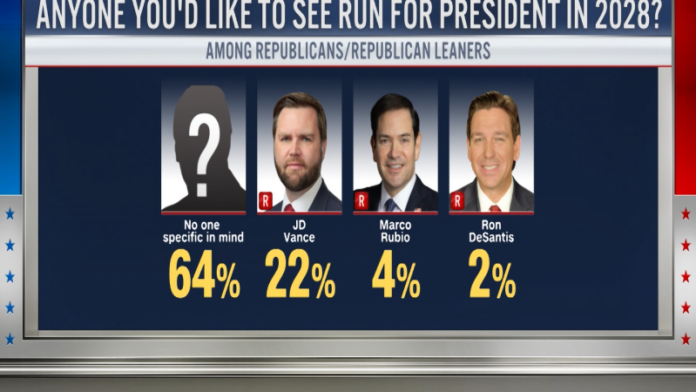
On the Republican side, JD Vance holds a dominant lead in most surveys, often besting his closest rivals by double digits.
- JD Vance (43% – 53%): As the sitting Vice President, Vance is considered the “logical successor” to the Trump movement. He recently won the 2026 CPAC straw poll with 53% of the vote.
- Marco Rubio (13% – 35%): The current Secretary of State has seen a significant surge in support, rising 12 percentage points in recent months.
- Donald Trump Jr. (13%): Continues to hold a steady base of support among the MAGA electorate.
- Other Contenders: Other names drawing early support include Ron DeSantis (6-9%), Robert F. Kennedy Jr. (4-7%), and Nikki Haley (3-7%).
2028 Democratic Primary Frontrunners
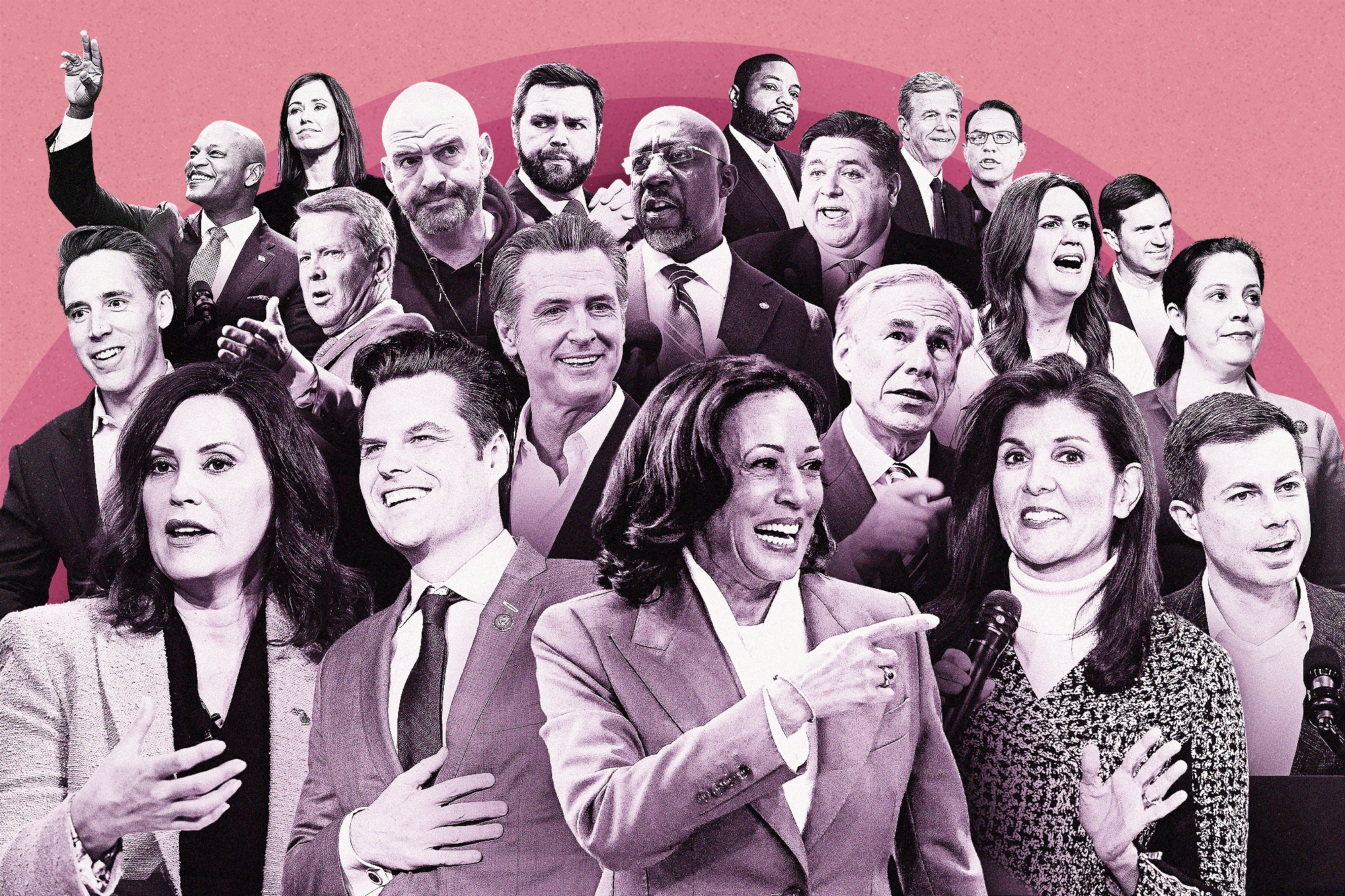
The Democratic field is more fragmented, with Kamala Harris and Gavin Newsom frequently trading the top spot.
- Kamala Harris (13% – 36%): While she maintains high name recognition, her lead has narrowed in some polls. She is reportedly thinking about a run but has not yet committed.
- Gavin Newsom (12% – 28%): The California Governor is often viewed as the most “electable” candidate by surveyed Democrats. Analysts at Morning Consult Pro noted his rise in support through late 2025.
- Pete Buttigieg (9% – 16%): The former Transportation Secretary led a February 2026 Emerson College poll, showing his strength with moderate voters.
- Alexandria Ocasio-Cortez (9% – 32%): She is the clear favorite among younger voters (ages 18–34), leading that demographic by a wide margin in the Spring 2026 Yale Youth Poll.
- Other Notables: A wide bench includes Josh Shapiro (7%), Mark Kelly (5%), and Gretchen Whitmer (2%).
Comprehensive Candidate List (Aggregated Polls)
| Candidate | Party | Key Polling Stats |
|---|---|---|
| JD Vance | GOP | 53% in latest CPAC straw poll |
| Marco Rubio | GOP | Second place with 35% in March 2026 |
| Kamala Harris | Dem | Leading contender at 36% in Morning Consult Pro |
| Gavin Newsom | Dem | Preferred by 28% of seniors |
| Alexandria Ocasio-Cortez | Dem | 32% support among voters under 35 |
| Pete Buttigieg | Dem | 16% in February 2026 Emerson poll |
Overlaying this environment is the emerging landscape of the 2028 presidential race, which is already taking shape despite the absence of formal declarations. Early polling data suggests that both major parties are coalescing around familiar figures, even as internal divisions remain unresolved. On the Republican side, Vice President JD Vance has established a commanding early position, widely viewed as the natural successor to the political movement that continues to define the party’s direction. His dominance in early surveys, including strong performances in key straw polls, reflects a consolidation of support that could shape the primary field well before campaigns officially begin.
However, that consolidation is not without competition. Secretary of State Marco Rubio has gained noticeable momentum, narrowing the gap in several recent polls and positioning himself as a viable alternative within the party’s evolving hierarchy. Donald Trump Jr. continues to maintain a consistent base of support, while other figures such as Ron DeSantis and Nikki Haley remain part of a broader, though less defined, field. The Republican primary landscape, while currently led by a clear frontrunner, retains enough fluidity to allow for shifts as political conditions evolve.
The Democratic field presents a different kind of complexity. Rather than coalescing around a single dominant figure, it reflects a fragmented but dynamic set of contenders, each representing distinct segments of the party’s coalition. Former Vice President Kamala Harris remains a central figure, benefiting from high name recognition and a strong base of support, but her position is not unchallenged. California Governor Gavin Newsom has steadily gained traction, often cited as a candidate with broad appeal and perceived electability. His rise in polling reflects a growing appetite within the party for leadership that can bridge ideological divides while maintaining a strong national profile.
At the same time, figures like Pete Buttigieg and Alexandria Ocasio-Cortez illustrate the diversity of the Democratic bench. Buttigieg’s appeal among moderate voters and his ability to perform strongly in targeted polling scenarios highlight his continued relevance, while Ocasio-Cortez’s dominance among younger voters underscores the generational shift shaping the party’s future. Additional names, including Josh Shapiro, Mark Kelly, and Gretchen Whitmer, contribute to a field that is both expansive and unsettled, with no single narrative yet defining its direction.
For New Jersey, these national dynamics are not abstract. The state’s political identity has long been influenced by its proximity to major media markets, its diverse electorate, and its role as both a policy innovator and a political battleground. The volatility observed in recent election cycles—where shifts toward one party are quickly followed by counter-movements—continues to define the state’s character. Voters are engaged, responsive, and increasingly skeptical of messaging that prioritizes spectacle over substance.
Economic factors remain central to this responsiveness. Issues such as inflation, housing affordability, and cost-of-living pressures are driving voter behavior across party lines, creating an environment where ideological alignment is often secondary to practical concerns. This dynamic complicates efforts by political actors to frame elections in purely ideological terms, as voters consistently demonstrate a willingness to shift based on performance and perceived impact rather than party loyalty alone.
The intersection of heightened rhetoric, evolving presidential dynamics, and structural economic concerns has created a uniquely charged atmosphere. In this environment, the role of political leadership becomes even more critical. Leaders are not only responsible for advancing policy but also for setting the tone of public discourse. When that tone escalates beyond the bounds of constructive engagement, it risks undermining the very institutions it seeks to influence.
New Jersey’s political community, including its voters, elected officials, and policy advocates, is now navigating this reality in real time. The state’s history of balancing strong opinions with pragmatic governance provides a foundation for managing these tensions, but the current moment tests that balance in new ways. The challenge is not merely to respond to individual controversies, but to maintain a broader commitment to the principles that sustain democratic systems: accountability, transparency, and respect for the rule of law.
As the 2028 presidential race begins to take shape and national debates continue to intensify, New Jersey remains a critical lens through which these developments can be understood. It is a state where national trends are both reflected and refracted, where local outcomes carry broader implications, and where the interplay between rhetoric and reality is constantly being negotiated.
What is clear is that the stakes are rising. The language used in political discourse, the decisions made in positions of power, and the choices voters make at the ballot box are all interconnected. In 2026, New Jersey stands at the intersection of these forces, offering a snapshot of a political system in transition—one that is being shaped not only by who leads, but by how that leadership is defined and communicated in an era of unprecedented intensity.



