


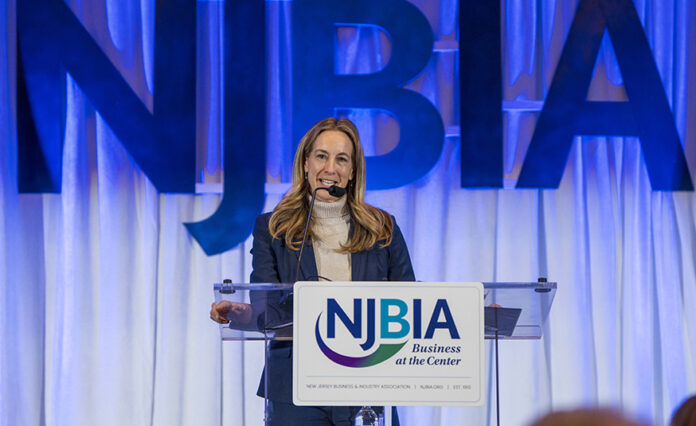

The Mikie Sherrill administration is intensifying its effort to reshape New Jersey’s economic positioning through an ambitious statewide business outreach initiative that is rapidly becoming one of the defining operational strategies of the governor’s first months in office.
At the center of the effort is a sweeping 21-county business listening tour designed to place state leadership in direct conversation with employers, industry leaders, regional business organizations, chambers of commerce, economic development advocates, and local stakeholders throughout New Jersey as the administration works to establish what it describes as a more responsive, collaborative, and growth-oriented relationship between government and the state’s private sector economy.
The initiative has drawn significant support from major business organizations including the New Jersey Chamber of Commerce, whose president and CEO Thomas A. Bracken publicly described the administration’s early outreach efforts as one of the most encouraging developments for New Jersey’s business climate in recent years.
The statewide tour represents far more than a symbolic political exercise.
It reflects a growing recognition within Trenton that New Jersey’s long-term economic competitiveness increasingly depends on whether state leadership can successfully rebuild trust, communication, and strategic alignment with the employers, entrepreneurs, manufacturers, logistics operators, technology firms, healthcare organizations, financial institutions, construction companies, and small businesses driving much of the state’s economic activity.
For decades, New Jersey has faced a complicated business identity.
The state possesses extraordinary structural advantages including geographic proximity to New York City and Philadelphia, one of the most educated workforces in the country, powerful transportation infrastructure, globally significant logistics corridors, world-class pharmaceutical and healthcare sectors, a massive consumer base, and dense concentrations of financial, technological, and professional expertise.
Yet despite those strengths, New Jersey has also spent years battling perceptions surrounding high taxation, regulatory complexity, affordability concerns, operational costs, energy pressures, infrastructure strain, and business migration risks.
The Sherrill administration appears increasingly focused on confronting those concerns directly rather than defensively.
By physically traveling across all 21 counties and meeting with employers inside their own regional economies, the administration is signaling that it views economic policy not as a purely statewide abstraction, but as a highly localized challenge requiring different conversations depending on geography, industry, workforce conditions, infrastructure realities, and regional growth opportunities.
That distinction matters significantly in a state as economically diverse as New Jersey.
The concerns facing logistics operators near Port Newark differ substantially from the priorities of pharmaceutical firms in Central Jersey, tourism businesses along the Shore, agricultural producers in South Jersey, technology startups in Hoboken and Jersey City, or manufacturers operating throughout Morris, Somerset, Bergen, and Monmouth counties.
A statewide business strategy increasingly requires micro-regional understanding.
The business outreach initiative appears designed specifically around that philosophy.
According to business leaders participating in the process, the administration has worked closely with local chambers of commerce, regional economic organizations, trade associations, and industry groups to identify meeting locations and structure discussions around localized business realities rather than generic statewide talking points.
The New Jersey Chamber of Commerce has reportedly played a significant coordination role in helping connect the governor’s office with business communities throughout the state.
For business advocates like Tom Bracken, the significance of the tour extends beyond the meetings themselves.
The outreach effort signals that economic growth, employer retention, investment attraction, and private-sector competitiveness are being elevated as central governing priorities early in the Sherrill administration rather than secondary policy discussions.
That positioning may prove politically and economically important as New Jersey navigates an increasingly competitive regional economy.
States across the Northeast continue aggressively competing for corporate investment, logistics expansion, data center development, advanced manufacturing growth, healthcare infrastructure, clean energy deployment, financial services operations, and technology-sector expansion. At the same time, remote work trends, migration shifts, AI-driven economic restructuring, and changing corporate location strategies continue reshaping traditional economic assumptions nationwide.
New Jersey’s ability to remain economically competitive increasingly depends on how effectively state government responds to those changing realities.
The administration’s business outreach strategy also reflects a broader national political trend in which governors increasingly position themselves not only as policymakers but also as active economic ambassadors responsible for directly cultivating relationships with industry leaders and regional employers.
Economic development today often functions as an ongoing relationship-management exercise rather than a purely transactional incentives-based model.
Business leaders increasingly want predictable communication, responsive government coordination, regulatory transparency, workforce development support, infrastructure reliability, and evidence that state leadership understands operational realities affecting employers daily.
The Sherrill administration appears intent on establishing that perception early.
The timing of the initiative is particularly significant given the broader economic uncertainty currently affecting many sectors nationwide.
Businesses continue navigating inflationary pressure, workforce shortages, interest rate volatility, AI disruption, cybersecurity concerns, supply chain restructuring, insurance cost increases, energy market fluctuations, transportation challenges, and shifting federal policy conditions. Simultaneously, employers are being forced to rethink long-term operational strategies involving automation, hybrid work, talent recruitment, digital infrastructure, and regional expansion planning.
For New Jersey specifically, those pressures intersect with longstanding structural challenges surrounding affordability and operational costs.
The administration’s statewide outreach campaign therefore functions partly as an intelligence-gathering exercise intended to better understand which barriers employers view as most urgent and where state government may need to prioritize reforms or targeted support strategies.
Importantly, the initiative also suggests that the administration recognizes economic growth as deeply interconnected with nearly every other major policy issue facing New Jersey.
Transportation infrastructure, housing affordability, public safety, workforce education, energy policy, healthcare systems, permitting processes, broadband access, taxation, environmental regulation, and regional planning all directly influence the state’s economic competitiveness.
Business leaders increasingly evaluate states not simply on tax incentives alone but on broader ecosystem stability and operational quality-of-life conditions affecting both employers and employees.
New Jersey’s strengths remain formidable.
The state continues serving as one of the nation’s most important logistics and distribution hubs due to the Port Newark-Elizabeth corridor, Newark Liberty International Airport, extensive rail infrastructure, and highway connectivity. Its pharmaceutical and biotech sectors remain among the strongest in the world. Financial services, healthcare, telecommunications, technology, higher education, and life sciences continue driving major portions of the regional economy.
But maintaining that competitive position requires constant adaptation.
The administration’s listening-tour approach suggests a recognition that economic growth strategies cannot remain static while national business conditions continue evolving rapidly.
The broader political implications are also substantial.
Governors increasingly rise or fall politically based on economic perception. Public confidence surrounding affordability, job creation, wage growth, infrastructure modernization, and business investment directly shapes voter attitudes regarding leadership competence and long-term state direction.
By placing economic engagement at the forefront early in the administration, Sherrill appears positioning business development as a defining component of her governing identity.
At the same time, the tour may help strengthen political relationships extending beyond traditional partisan structures.
Economic development conversations often create opportunities for collaboration between business groups, labor organizations, municipal governments, educational institutions, and regional planning entities even within politically divided environments. Building those relationships early may provide operational advantages later as the administration advances broader economic or infrastructure initiatives requiring cross-sector support.
The business outreach campaign is unfolding alongside a rapidly evolving New Jersey political environment overall.
Simultaneously, NJ Spotlight News and other political observers continue tracking important statewide developments including ongoing U.S. Senate primary positioning and shifting regional political alliances. Among the latest developments, Republican Senate candidate Bob Lebovics recently secured endorsement backing from the influential Lakewood Vaad, highlighting the continued importance of coalition-building and regional organizational support within New Jersey’s broader political ecosystem.
That political backdrop further reinforces why economic positioning remains so important.
As both parties compete to define New Jersey’s future direction, issues surrounding affordability, business competitiveness, infrastructure modernization, workforce opportunity, taxation, public safety, and economic growth increasingly dominate public discourse across suburban, urban, and regional communities statewide.
The Sherrill administration’s outreach strategy therefore represents more than a series of business meetings.
It reflects an attempt to redefine how state government interacts with New Jersey’s economic engine itself.
Whether the initiative ultimately produces measurable policy reforms, regulatory modernization, infrastructure acceleration, or broader economic gains remains to be seen. But the administration’s early emphasis on direct employer engagement signals an important shift in tone and operational philosophy — one centered on the idea that sustainable economic growth requires continuous dialogue between government leadership and the industries responsible for driving investment, innovation, hiring, and long-term regional stability.
In a state where economic complexity often mirrors the diversity of its geography and industries, that approach may ultimately prove essential.
Because New Jersey’s future competitiveness will likely depend not only on the policies written in Trenton, but on whether state leadership can successfully align itself with the evolving realities facing businesses operating across every corner of the Garden State.