


Hudson County’s development surge continues reshaping the architectural, residential, and commercial identity of Jersey City as two major construction-related projects now moving forward underscore the extraordinary pace of urban transformation unfolding throughout one of New Jersey’s fastest-changing regions.
From rapidly growing demand for specialized high-rise property maintenance services to the adaptive reuse of historic downtown structures tied to the city’s industrial and cultural legacy, the latest developments reveal how construction, redevelopment, and infrastructure investment are increasingly driving the next phase of Jersey City’s economic evolution.
This week, construction professional Krunal Kothari officially launched PatchMaster Jersey City & Hoboken, a new operator-led drywall repair and interior painting franchise designed specifically to meet the growing needs of Hudson County’s expanding network of high-rise residential buildings, multifamily communities, property management firms, and large-scale residential operators.
At the same time, major rehabilitation work is now visibly underway at 155 Morgan Street in Jersey City’s rapidly evolving Powerhouse Arts District, where a historic former firehouse once used as the headquarters for Queen Latifah’s Flavor Unit production company is being converted into a future restaurant, banquet hall, and event-driven hospitality space as part of the area’s continuing revitalization.
Taken together, the projects illustrate two interconnected realities currently defining Jersey City’s growth trajectory: the enormous operational demands created by high-density residential expansion and the increasingly aggressive redevelopment of historic urban structures into modern commercial and cultural destinations.
The launch of PatchMaster Jersey City & Hoboken arrives during a period of sustained construction and residential growth throughout Hudson County, where thousands of new residential units continue reshaping skylines across Jersey City, Hoboken, and surrounding communities.
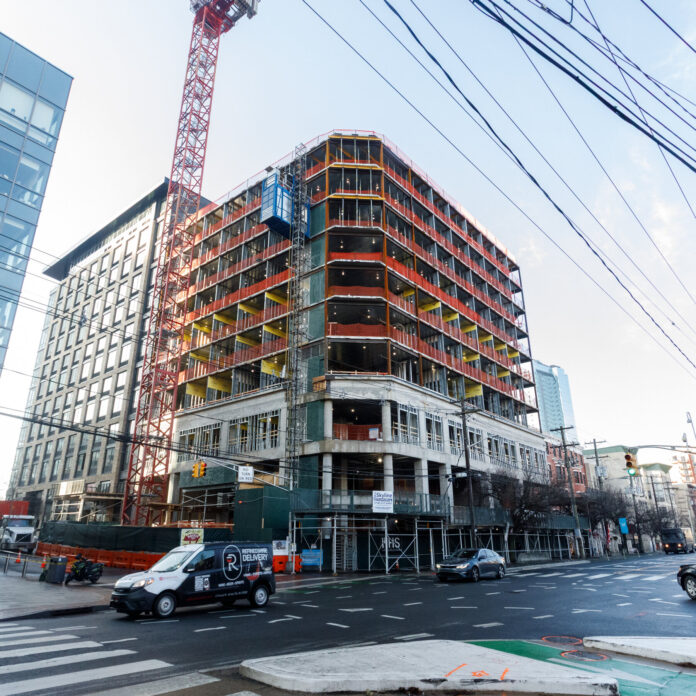
Over the last decade, Jersey City has emerged as one of the most active high-rise development markets in the Northeast, fueled by migration from New York City, expanding corporate presence, transit-oriented development, luxury residential construction, and continued investment in mixed-use urban neighborhoods. Entire sections of Downtown Jersey City, Journal Square, the waterfront corridor, and Hoboken have undergone dramatic physical transformation as towers continue rising across formerly industrial and underutilized properties.
That rapid vertical growth has created a parallel demand for highly specialized property maintenance and interior repair services tailored specifically to dense urban residential environments.
Unlike traditional suburban home repair operations, high-rise communities require service providers capable of operating efficiently within tightly managed residential buildings, condominium associations, luxury apartment towers, and large-scale multifamily portfolios where scheduling precision, rapid turnaround times, minimal disruption, and operational scalability are critical.
PatchMaster’s expansion into Jersey City and Hoboken appears designed directly around those emerging market demands.
The operator-led franchise model emphasizes drywall repair, patching, interior painting, and restoration work geared toward property managers, landlords, condominium operators, residential turnover cycles, and maintenance-intensive multifamily environments where unit preparation and repair timelines significantly impact operational revenue.
In fast-moving urban rental markets like Jersey City, even relatively small interior repair delays can affect occupancy turnover, leasing schedules, tenant retention, and building operations across entire portfolios.
The importance of maintenance infrastructure within rapidly expanding residential markets is often overlooked compared to headline-grabbing tower developments themselves. Yet as Jersey City’s residential inventory continues expanding dramatically, demand for scalable post-construction services, interior restoration, repair management, and ongoing building maintenance continues rising alongside it.
Kothari’s launch reflects a broader shift occurring throughout New Jersey’s urban construction economy where secondary service industries increasingly grow around large-scale residential expansion.
As high-rise development accelerates, entire ecosystems emerge involving specialized contractors, maintenance firms, painting services, drywall operations, infrastructure support providers, smart building technicians, restoration companies, and operational vendors supporting the long-term functionality of modern residential inventory.
Hudson County’s density makes that ecosystem especially important.
Buildings containing hundreds of residential units often require near-constant maintenance coordination involving move-ins, tenant turnovers, renovations, water damage repairs, drywall restoration, painting cycles, and ongoing cosmetic upkeep. Operators capable of responding efficiently inside highly populated urban buildings gain increasing value as residential competition intensifies.
At the same time, Jersey City’s broader development story continues extending beyond new towers alone.
The transformation currently underway at 155 Morgan Street represents another major example of how adaptive reuse and historic redevelopment are becoming central components of Downtown Jersey City’s evolving identity.
Construction crews have now officially begun rehabilitation work on the historic former firehouse property located in the heart of the rapidly changing Powerhouse Arts District. The building, originally constructed in the early 1900s, carries significant architectural and cultural history tied not only to Jersey City’s industrial era but also to its more recent creative and entertainment identity.
The property once served as offices for Queen Latifah’s Flavor Unit production company before remaining largely vacant in recent years.
Now, under ownership tied to Silverman — one of the most influential development groups involved in Jersey City’s downtown revitalization efforts — the structure is being repositioned for a possible future as a restaurant, banquet facility, and event-oriented hospitality venue capable of contributing to the district’s expanding cultural and entertainment ecosystem.
The project represents another major step in the continuing reinvention of the Powerhouse Arts District, which has rapidly evolved from a historically industrial section of Jersey City into one of the region’s most ambitious mixed-use redevelopment corridors blending residential growth, arts investment, entertainment infrastructure, hospitality concepts, adaptive reuse projects, and cultural destination planning.
The neighborhood’s transformation has accelerated dramatically in recent years as developers, investors, artists, hospitality operators, and municipal planners increasingly view the district as one of Jersey City’s most important long-term growth zones.
The rehabilitation work now visible at 155 Morgan Street highlights the increasingly preservation-oriented approach shaping portions of Downtown Jersey City redevelopment.
Rather than demolishing historic structures entirely, developers are increasingly incorporating adaptive reuse strategies that preserve architectural character while modernizing buildings for contemporary commercial and mixed-use functionality. Those efforts often carry enormous complexity due to structural deterioration, code modernization requirements, infrastructure replacement needs, and historical preservation considerations.
Permits filed for the Morgan Street project indicate substantial structural and infrastructure work is already underway.
Current construction includes reconstruction of a structurally compromised masonry wall, installation of new electrical systems, upgraded sewer infrastructure, and a modern fire sprinkler system — all common components of adaptive reuse projects involving century-old urban structures originally built under vastly different engineering and safety standards.
The project is also being developed initially as a “vanilla box” commercial shell under plans prepared by Weckenmann Architecture, suggesting that a final hospitality tenant may not yet be fully secured while core structural rehabilitation proceeds.
The strategic location of the property significantly increases its redevelopment importance.
Situated directly within one of Jersey City’s fastest-growing downtown corridors, the firehouse sits near numerous major residential developments and directly across from the future Jersey City Symphony theater currently under construction. That concentration of cultural, residential, and entertainment investment continues strengthening the district’s emergence as a major regional destination rather than simply another residential expansion zone.
The project also reflects a broader movement throughout Jersey City involving the repurposing of former civic and industrial properties into modern mixed-use assets.
Another former firehouse property located at 244 Bay Street — once home to the historic Jersey City Gong Club site — was recently approved for conversion into residential apartments with ground-floor retail space. Like 155 Morgan Street, the Bay Street structure dates back to the 19th century and represents another example of how Jersey City’s older architectural inventory is increasingly being reintegrated into the city’s next development era rather than erased entirely.
That balance between modernization and preservation has become one of the defining tensions shaping Jersey City’s evolution.
The city continues experiencing extraordinary residential growth, rising property values, infrastructure expansion, commercial investment, and urban densification. Yet simultaneously, increasing efforts are being made to preserve portions of the city’s industrial, civic, and cultural architectural legacy through strategic adaptive reuse projects capable of blending historic identity with modern economic functionality.
The launch of PatchMaster Jersey City & Hoboken and the rehabilitation of the Morgan Street firehouse may initially appear unrelated, but together they reveal the broader mechanics driving Jersey City’s transformation.
One project supports the operational realities of maintaining a rapidly expanding vertical residential city. The other reflects the cultural and architectural reinvention of older urban infrastructure into modern hospitality and entertainment destinations.
Both developments exist because Jersey City itself continues evolving at extraordinary speed.
As Hudson County pushes deeper into a new era defined by high-density living, mixed-use redevelopment, infrastructure modernization, cultural investment, and adaptive urban growth, projects like these increasingly represent the connective tissue holding together one of the most ambitious urban transformations currently unfolding anywhere in New Jersey.