


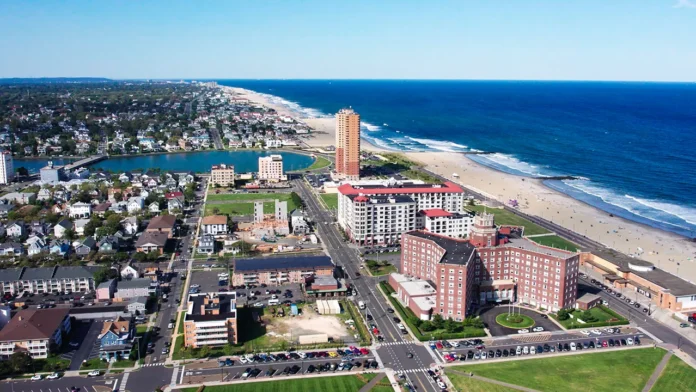

NEW JERSEY — The latest first-quarter housing data across New Jersey reveals a market that continues to push upward on price while simultaneously showing clear signs of transactional slowdown, a dual-track dynamic that is now defining the state’s real estate and development environment. At the same time, local planning decisions—such as the delayed vote on a major mixed-use project in Asbury Park—underscore how supply constraints, community expectations, and long-term economic strategy are converging into a more complex and deliberate phase of growth.
According to newly released data from New Jersey Realtors, median home prices increased across every major property category during the first quarter of 2026, reinforcing the structural imbalance between supply and demand that has characterized the market in recent years. The statewide median sales price reached $510,000, representing a 2.2% increase compared to the same period last year. This continued appreciation is not being driven by volume; in fact, the number of transactions is moving in the opposite direction.
Closed sales across the state declined 6.1% year-over-year, totaling just over 15,000 transactions, while pending sales fell even further, down 8.3%. These figures point to a market where buyer activity is being constrained—whether by affordability pressures, interest rate conditions, or limited inventory—despite sustained upward pressure on pricing. In practical terms, the result is a slower-moving market where competition remains intense for available properties, but fewer deals are ultimately closing.
Inventory conditions remain a central factor. New listings dropped 5.1% in the first quarter, continuing a trend that has restricted buyer choice and contributed to price stability. While the number of homes available for sale did see a modest increase in March, rising 2.6% to 16,400 units, the broader context remains one of tight supply. Homes are also taking longer to sell, with average days on market increasing by more than 9% to 48 days, signaling a subtle but important shift in market pacing.
Even with that adjustment, sellers are still commanding near-full value. Properties are closing at just above asking price on average, indicating that while buyer urgency may be moderating, pricing power has not meaningfully eroded. This balance—slower activity paired with sustained pricing—illustrates a market that is not weakening, but recalibrating.
A closer look at property types further clarifies the landscape. Single-family homes continue to anchor the market, with median prices rising 2.7% to $565,000, even as closed sales declined nearly 5%. Townhouse and condominium pricing held steady at $415,000, though this segment experienced a sharper drop in transaction volume, with sales down more than 11%. Adult community properties saw a 1.4% increase in median price to $365,000, with only a modest decline in closed sales. Collectively, these figures suggest that demand remains present across categories, but is being selectively constrained by financial and inventory considerations.
This evolving market backdrop is directly influencing how municipalities approach development, particularly in high-demand coastal areas where land availability, zoning flexibility, and community sentiment all intersect. Nowhere is that tension more visible than in Asbury Park, where a proposed mixed-use development has become a focal point for broader questions about growth, density, and neighborhood identity.
The Asbury Park Planning Board recently postponed a vote on a 67-unit mixed-use proposal at 320 Asbury Avenue, extending a review process that has already spanned multiple years. The project, backed by redevelopment entities including APW Redeveloper LLC and Asbury Partners, is designed to transform a 1.96-acre triangular parcel near Wesley Lake into a multi-building residential and commercial complex. The proposal includes a five-story apartment building with 50 units, a smaller three-story structure with additional residences and ground-floor retail space, and a townhouse component consisting of nine units with integrated garages.
From a development standpoint, the project reflects many of the priorities shaping modern urban planning: increased residential density, mixed-use integration, and proximity to transit and recreational assets. The site itself sits within one of the most strategically positioned corridors in Asbury Park, adjacent to established residential communities and within reach of the city’s beachfront, boardwalk, and historic landmarks. In purely economic terms, the development aligns with the realities of a market where demand for housing—particularly in desirable coastal locations—continues to exceed supply.
However, the planning process has highlighted the increasingly nuanced role that local boards and residents play in shaping outcomes. During recent hearings, board members and community participants raised concerns about architectural design, visual integration, and the project’s ability to serve as a transitional space between the city’s high-density waterfront and its surrounding residential neighborhoods. Questions around facade design, materials, and overall aesthetic compatibility became central to the discussion, reflecting a broader expectation that new developments must contribute to the character of the area, not simply maximize land use.
The developer’s team, including legal and architectural representatives, emphasized that the proposal has already undergone extensive revision, incorporating feedback gathered over several years of engagement with municipal stakeholders. Despite those efforts, the board ultimately requested further modifications before proceeding to a vote, pushing the decision to June 1. The delay underscores a larger reality: development in New Jersey’s most sought-after locations is no longer defined solely by zoning allowances, but by the ability to align with community expectations and long-term planning objectives.
This dynamic is particularly significant given the broader economic implications. As property values continue to rise, the pressure to increase housing supply intensifies. At the same time, residents and local officials are increasingly focused on preserving quality of life, managing infrastructure demands, and ensuring that growth is both sustainable and contextually appropriate. The result is a more deliberate development process, where projects are evaluated not only on feasibility, but on their contribution to the overall fabric of the community.
Within the framework of Sunset Daily News New Jersey Politics, these developments represent more than isolated market updates. They reflect the intersection of economic forces and policy decisions that are shaping the state’s future. Housing affordability, land use, and community planning are no longer separate conversations—they are interconnected elements of a broader governance challenge that requires coordination across local, regional, and state levels.
The trajectory of New Jersey’s housing market suggests that pricing pressures are unlikely to ease in the near term, particularly in high-demand areas. At the same time, the slowdown in transaction volume indicates that buyers are becoming more selective, and that market conditions are evolving in ways that demand careful navigation. For developers, this means adapting to a more complex approval landscape. For policymakers, it means balancing the need for growth with the expectations of constituents. For buyers and sellers, it means operating within a market that is simultaneously competitive and constrained.
As the second quarter unfolds, attention will remain fixed on both data and decisions—on whether inventory begins to expand, whether transaction activity stabilizes, and how projects like the Asbury Avenue development ultimately move forward. What is clear is that New Jersey is entering a phase where the fundamentals of real estate are being redefined not just by economics, but by the interplay of policy, planning, and community engagement.