


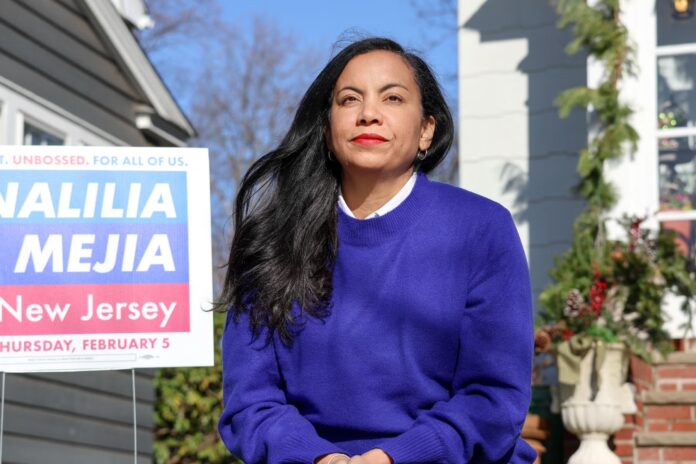

New Jersey politics has entered a sharper, more complex phase—one where electoral outcomes, economic pressure, and narrative-driven messaging are colliding in ways that resist easy classification. The April 16, 2026 special election victory of Analilia Mejia in New Jersey’s 11th Congressional District did not just deliver a decisive result at the ballot box; it ignited a broader conversation about the state’s direction at a moment when voters are clearly in motion, not settled. Mejia’s nearly 20-point margin, achieved despite aggressive ideological attacks, underscores a deeper reality: New Jersey is not drifting uniformly in any one direction. It is actively recalibrating.
Attempts to frame the outcome as evidence of a sweeping ideological shift miss the larger picture. Mejia’s win reflects a localized convergence of campaign execution, voter engagement, and issue alignment. It demonstrates that when candidates connect with constituents on tangible concerns—economic stability, cost of living, healthcare access, and institutional trust—they can outperform the noise surrounding national political labels. The result is not a signal of ideological takeover; it is a reminder that elections in New Jersey are still won on the ground, district by district, with voters making decisions based on immediacy rather than abstraction.
To understand the current moment, it is necessary to step back and examine the broader trajectory of the state over the past several election cycles. The data tells a story of movement, but not permanence. Since 2021, Republican voter registration has expanded at a faster rate than Democratic registration, narrowing a once wider advantage. That shift translated into a measurable rightward swing during the 2024 presidential election, where multiple counties changed hands and the overall margin tightened significantly. Economic concerns—particularly inflation and affordability—played a central role in that shift, pulling moderate and working-class voters toward messaging centered on cost control and fiscal restraint.
Yet the very next major statewide election told a different story. In 2025, New Jersey voters delivered a decisive outcome in the gubernatorial race, with Democrats regaining ground across every county. The margin was not incremental; it was emphatic. That rapid reversal illustrates the defining characteristic of New Jersey’s electorate in 2026: responsiveness. Voters are not locked into ideological camps. They are reacting—sometimes sharply—to conditions, candidates, and context.
Mejia’s victory fits squarely within this pattern. It signals that Democratic energy at the grassroots level remains strong, particularly in districts where organizing infrastructure and voter turnout are aligned. It also highlights the limits of broad-brush messaging that attempts to nationalize local races. Voters in the 11th District did not cast ballots based on labels; they responded to a campaign that spoke directly to their priorities and experiences.
At the same time, the broader political environment remains intensely competitive. New Jersey is no longer a state where outcomes can be assumed. The narrowing registration gap, the volatility of recent elections, and the heightened engagement on both sides of the aisle have created a landscape where every race matters and every message is contested. This is not a stable equilibrium; it is a dynamic system in constant adjustment.
Messaging itself has become a central battleground in this environment. Political communication is increasingly less about policy detail and more about framing—defining the terms through which voters interpret events. Candidates and parties are working to establish narratives that resonate quickly and stick, often compressing complex realities into simplified themes. The challenge for voters is to navigate that environment with clarity, distinguishing between rhetoric designed to provoke and information that reflects actual governance and policy outcomes.
The legislative reality in New Jersey provides an important counterbalance to the intensity of campaign narratives. Despite fluctuations at the electoral level, Democrats continue to hold a commanding position in the State Assembly, shaping the policy agenda and maintaining structural control over the legislative process. This continuity matters. It means that while elections may swing, the framework of governance remains anchored in established institutional dynamics. Coverage across Sunset Daily’s [Politics] section consistently reflects this interplay between volatility and stability, where the energy of campaigns meets the practical realities of governing.
Economic pressure remains the throughline connecting these political shifts. New Jersey residents are navigating rising costs in housing, healthcare, and everyday expenses, and those concerns are driving voter behavior more than ideological alignment alone. When economic anxiety increases, voters become more willing to shift, to test alternatives, and to hold incumbents accountable. That is what makes the state so fluid right now. It is not ideology that is dominant; it is urgency.
This environment creates both opportunity and risk for political actors. For Democrats, it reinforces the need to translate organizational strength into sustained voter connection, particularly in addressing affordability and economic security. For Republicans, it presents an opening to continue building on registration gains and to refine messaging that resonates beyond traditional bases. For both, it underscores the reality that New Jersey is no longer a predictable map—it is a contested arena where outcomes must be earned repeatedly.
What is emerging is a portrait of a state in active negotiation with itself. New Jersey is not moving in a straight line; it is oscillating, testing, and recalibrating in response to a rapidly changing set of conditions. Mejia’s victory is part of that process, not a conclusion to it. It reflects the strength of localized engagement and the continued relevance of issues that directly affect daily life, while also highlighting the broader volatility that defines the current political moment.
The deeper story is not about any single election or any single narrative. It is about a state where voters are engaged, where outcomes are competitive, and where the balance of power is continuously being tested. In that environment, clarity matters more than ever—clarity in messaging, clarity in policy, and clarity in understanding what is actually happening beneath the surface of headline-driven interpretations.
New Jersey is not being defined by a single ideological surge. It is being shaped, election by election, by a population that is actively responding to its circumstances. And in 2026, that responsiveness is the most important political force in the state.